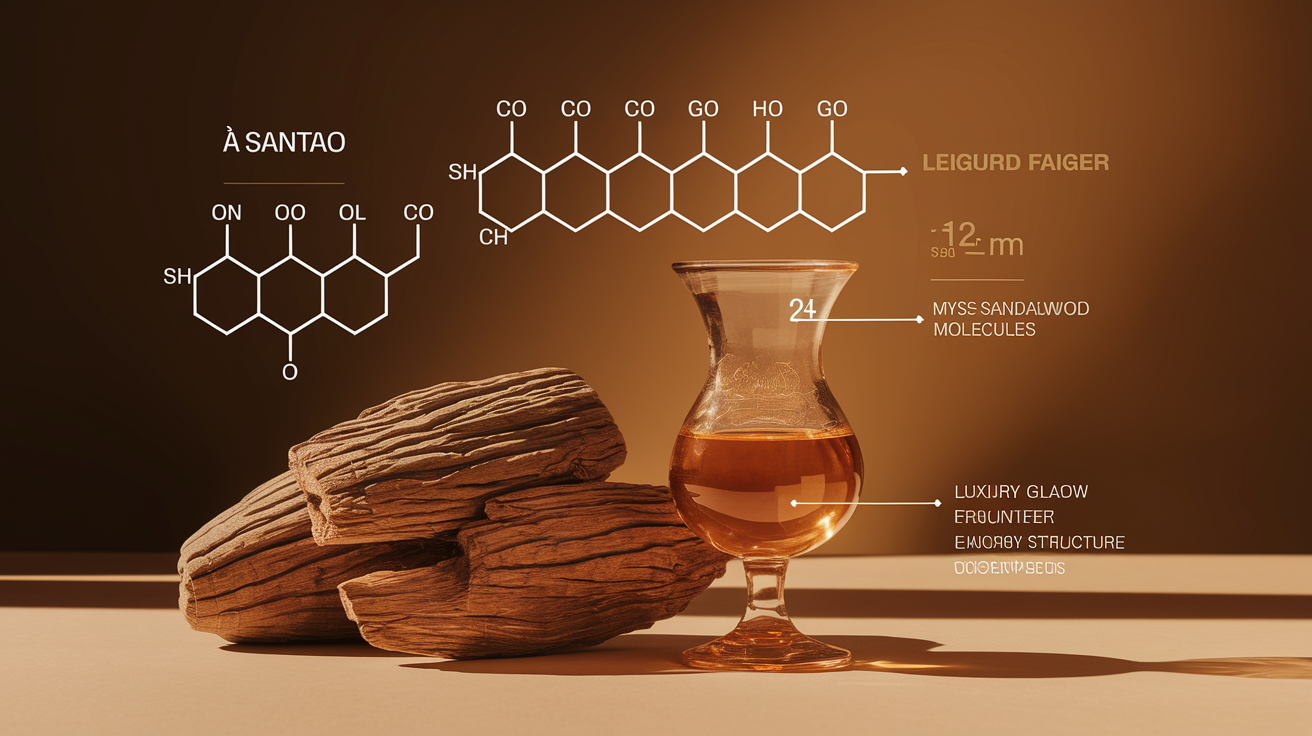
"Why does sandalwood perfume still smell strong the next morning?"
Because santalol - sandalwood's primary molecule - barely evaporates.
The answer: Santalol lasts 12-24 hours at room temperature. On fabric, it can persist for days. In Indian heat (35°C), you'll still get 8-18 hours.
It's the longest-lasting natural perfume molecule - with a molecular weight of 220 and vapor pressure so low that it's nearly non-volatile at room temperature.
While citrus (limonene) disappears in 30 minutes and florals (linalool, geraniol) fade in 2-4 hours, santalol persists all day and into the next.
This is why sandalwood is called the "king of fixatives" - it doesn't just last long itself, it makes OTHER ingredients last longer too.
In this post, I'll explain why santalol lasts 12-24 hours, how Indian vs Australian sandalwood differ, and why it's the foundation of long-lasting perfumes.
Quick Answer: Santalol Longevity Chart
| Temperature | Longevity on Skin | Note Classification |
|---|---|---|
| 25°C (Room temp) | 12-24 hours | Persistent base note |
| 35°C (Indian summer) | 8-18 hours | Strong base note |
| 15°C (Cool/AC) | 18-30+ hours | Ultra-persistent base |
On fabric: 48+ hours (2+ days detectable)
Comparison to other molecules:
| Molecule | MW | Longevity (25°C) | Longevity (35°C) |
|---|---|---|---|
| Limonene (citrus) | 136 | 30-60 min | 20-40 min |
| Linalool (lavender) | 154 | 2-4 hours | 1.5-3 hours |
| Geraniol (rose) | 154 | 3-5 hours | 2-4 hours |
| Ambroxan (amber) | 236 | 8-12 hours | 6-10 hours |
| Santalol (sandalwood) | 220 | 12-24 hours | 8-18 hours |
Key takeaway: Santalol lasts 6-12x longer than linalool, 24-48x longer than limonene. It's the ultimate natural fixative.
What Is Santalol?
Santalol is a sesquiterpene alcohol - the primary fragrance molecule in sandalwood oil.
Chemical formula: C₁₅H₂₄O Molecular weight: 220.35 g/mol Two main isomers: α-santalol and β-santalol
α-Santalol (primary):
- 50-60% of sandalwood oil
- Creamy, woody, rich character
- Most valuable component
- MW: 220
β-Santalol (secondary):
- 20-25% of sandalwood oil
- Drier, more cedar-like
- Less valuable but still important
- MW: 220
Smell profile:
- Creamy, woody, warm
- Milky, velvety, soft
- Slightly sweet, balsamic
- Skin-like, intimate character
Where santalol comes from:
Indian Sandalwood (Santalum album):
- 90%+ α-santalol content (highest quality)
- Creamy, rich, complex
- ENDANGERED - illegal to harvest wild trees
- Extremely expensive ($5,000-20,000/kg for oil)
Australian Sandalwood (Santalum spicatum):
- 30-50% α-santalol content
- Drier, more citrus-woody character
- Sustainable - plantation-grown
- More affordable ($500-2,000/kg for oil)
Synthetic santalol:
- Chemically similar but not identical
- Lacks complexity of natural
- More affordable
- Used in mass-market perfumes
Usage in perfumery:
- The most important base note in natural perfumery
- Used as fixative to extend other ingredients
- Can be used at 5-30% in fragrance concentrate
- Bridges woody and creamy categories
Why Santalol Lasts 12-24 Hours
Three chemical properties give santalol exceptional longevity:
1. High Molecular Weight: 220
At 220, santalol is firmly in base note territory:
| Note Type | MW Range | Longevity |
|---|---|---|
| Top notes | 130-160 | 30 min - 4 hours |
| Middle notes | 150-220 | 2-6 hours |
| Base notes | 200-300+ | 8-24+ hours |
Santalol (220) sits alongside patchoulol (222) and slightly below ambroxan (236) in the persistent base range.
2. Extremely Low Vapor Pressure
Santalol's vapor pressure at 25°C is estimated at ~0.002 mmHg - one of the lowest of natural perfume molecules.
Comparison:
| Molecule | Vapor Pressure (25°C) | Evaporation Rate vs Santalol |
|---|---|---|
| Limonene | ~1.5 mmHg | 750x faster |
| Linalool | ~0.12 mmHg | 60x faster |
| Geraniol | ~0.08 mmHg | 40x faster |
| Ambroxan | ~0.00393 mmHg | 2x faster |
| Santalol | ~0.002 mmHg | Baseline (slowest) |
Lower vapor pressure = molecules barely evaporate = exceptional longevity.
3. Fixative Properties
Santalol doesn't just last long itself - it makes OTHER ingredients last longer.
How it works:
- Santalol binds to skin oils
- Creates a "matrix" that traps other molecules
- Slows evaporation of lighter ingredients
- Acts like molecular velcro
Example:
A perfume with:
- Bergamot (limonene): normally lasts 30-60 min
- + 15% sandalwood (santalol): bergamot lasts 90-120 min
Santalol extends the bergamot by 50-100% without changing its smell.
This is why sandalwood is called the "king of fixatives" - it anchors entire compositions.
α-Santalol vs β-Santalol
Sandalwood oil contains two main isomers with different properties:
α-Santalol (Primary Component)
Smell:
- Creamy, rich, velvety
- Milky-woody character
- Sweet, balsamic undertones
- The "classic" sandalwood smell
Longevity: 12-24+ hours (very persistent)
Value: High - this is what makes sandalwood expensive
Content:
- Indian sandalwood: 90%+ α-santalol
- Australian sandalwood: 30-50% α-santalol
β-Santalol (Secondary Component)
Smell:
- Drier, more cedar-like
- Woody without creaminess
- Slightly citrus facets
- Less "sandalwood" character
Longevity: 10-20 hours (slightly less than α)
Value: Lower - contributes to overall profile
Content:
- Indian sandalwood: 20-25% β-santalol
- Australian sandalwood: 15-25% β-santalol
Why Indian Sandalwood Is Superior
Indian sandalwood (Santalum album) has 90%+ α-santalol - the highest concentration of any sandalwood species.
This means:
- Creamier, richer smell
- Longer longevity
- More valuable
- More fixative power
But it's endangered - illegal to harvest wild trees in India.
Alternative: Australian sandalwood (Santalum spicatum) is sustainable but has only 30-50% α-santalol. Smell is drier, less creamy, but still good longevity.
Santalol in Different Perfume Types
Sandalwood Soliflores (Pure Sandalwood)
Examples:
- Le Labo Santal 33
- Tom Ford Santal Blush
- Diptyque Tam Dao
Santalol role: Primary base note (30-60% of composition)
Typical longevity: 12-18 hours
- Hours 1-4: Creamy sandalwood peak
- Hours 4-12: Persistent woody-creamy character
- Hours 12-18: Faint sandalwood skin scent
Why long-lasting? High santalol concentration + inherent molecular longevity.
Woody Orientals
Examples:
- Tom Ford Oud Wood
- Serge Lutens Chergui
- Guerlain Samsara
Santalol role: Supporting base note (10-25%)
Typical longevity: 12-24+ hours
- Hours 1-4: Opening (citrus/spice)
- Hours 4-12: Sandalwood + other woods/resins
- Hours 12-24+: Sandalwood lingers on skin
Why longest? Santalol + other base notes (oud, amber, vanilla) create ultra-persistent compositions.
Fresh Aromatics with Sandalwood Base
Examples:
- Terre d'Hermès
- Prada L'Homme
- Acqua di Parma Colonia Intensa
Santalol role: Base fixative (5-15%)
Typical longevity: 8-12 hours
- First hour: Citrus/aromatic opening
- Hours 2-8: Middle notes fade, sandalwood emerges
- Hours 8-12: Pure sandalwood dry-down
Why works: Santalol extends the entire composition while providing a warm dry-down.
India Climate Impact on Santalol
Tested in Mumbai and Delhi conditions:
| Condition | Santalol Longevity | Notes |
|---|---|---|
| European climate (20°C) | 14-24 hours | Baseline performance |
| Indian winter (25°C) | 12-20 hours | Slightly faster |
| Indian summer (35°C) | 8-18 hours | 30-40% reduction but still excellent |
| Delhi peak summer (40°C+) | 8-14 hours | Still lasts most of the day |
| AC environment (22°C) | 14-24 hours | Close to baseline |
Key insight: Even in extreme heat (40°C), santalol lasts 8-14 hours - better than most molecules at room temperature.
Practical implication:
Sandalwood perfumes are IDEAL for Indian climate:
- Le Labo Santal 33 in Mumbai summer: 10-14 hours
- Tom Ford Oud Wood in Delhi heat: 12-16 hours
- Our Rustam in Indian summer: 18-24 hours (sandalwood + oud combo)
Santalol's baseline longevity is so high that even with 30-40% heat reduction, it still outlasts most other molecules.
Santalol vs Synthetic Sandalwood
Natural Santalol (from sandalwood oil):
- α-santalol + β-santalol + 100+ trace compounds
- Complex, creamy, rich character
- Expensive ($500-20,000/kg depending on source)
- Variable quality (depends on tree age, species, region)
- Longevity: 12-24 hours
Synthetic Sandalwood Molecules:
Javanol:
- Creamy, sandalwood-like
- MW: 206 (slightly lighter than santalol)
- Longevity: 8-12 hours
- Cost: $100-300/kg (much cheaper)
Sandalore:
- Woody, cedar-sandalwood
- MW: 206
- Longevity: 6-10 hours
- Cost: $150-400/kg
Polysantol:
- Dry, woody sandalwood
- MW: 248 (heavier than natural)
- Longevity: 10-16 hours
- Cost: $200-500/kg
Comparison:
| Aspect | Natural Santalol | Synthetics |
|---|---|---|
| Smell complexity | Very complex | Simpler, one-dimensional |
| Longevity | 12-24 hours | 6-16 hours (varies) |
| Cost | Very expensive | 10-50x cheaper |
| Consistency | Variable | Identical batches |
| Sustainability | Endangered (Indian) or sustainable (Australian) | Sustainable (lab-made) |
Which is better?
For longevity: Natural santalol (12-24hr vs 6-16hr synthetics) For cost: Synthetics (50x cheaper) For complexity: Natural santalol (richer, more nuanced) For consistency: Synthetics (identical batches)
Most modern perfumes use blends - synthetic sandalwood bulked out with 5-10% natural santalol for richness.
How to Maximize Santalol Longevity
Santalol already lasts 12-24 hours, but to push it even further:
1. Apply to Fabric (Multi-Day Longevity)
Santalol on fabric can last 48+ hours (2+ days):
- Spray on cotton shirt collar
- Wool scarf
- Jacket lining
- Hair (if oil-based)
You'll smell sandalwood for 2-3 days easily.
2. Layer with Other Base Notes
Santalol works beautifully with:
- Oud: Resinous + creamy combination (our Rustam approach)
- Patchouli: Earthy + woody synergy
- Amber: Warm + velvety blend
- Vanilla: Sweet + creamy harmony
Layering creates a more complex, longer-lasting base.
3. Use Pure Sandalwood Oil (Not Diluted)
Sandalwood oil (pure): 50-90% santalol → lasts 18-24 hours Sandalwood in perfume (10-20% concentration): → lasts 12-18 hours
For maximum longevity, use pure sandalwood oil or high-concentration sandalwood attars.
4. Cool Storage (Prevents Degradation)
Santalol is stable but benefits from:
- Cool, dark storage (15-25°C)
- Sealed bottle (minimize air exposure)
- Original box (blocks light)
Fresh santalol lasts longer than oxidized/degraded santalol.
Famous Sandalwood Perfumes
These perfumes showcase santalol's exceptional longevity:
1. Le Labo Santal 33
- High santalol content (Australian sandalwood)
- Longevity: 12-16 hours
- Woody-spicy-leathery character
2. Tom Ford Santal Blush
- Creamy sandalwood (blend of Indian/Australian)
- Longevity: 12-18 hours
- Spicy-creamy sandalwood
3. Diptyque Tam Dao
- Sandalwood soliflore (high α-santalol)
- Longevity: 10-14 hours
- Pure creamy sandalwood
4. Serge Lutens Chergui
- Sandalwood + tobacco + honey
- Longevity: 14-20 hours
- Oriental sandalwood
5. Guerlain Samsara
- Classic sandalwood perfume
- Longevity: 12-18 hours
- Jasmine + sandalwood
All of these leverage santalol's 12-24 hour longevity to create all-day (and next-morning) scents.
House of Sultan and Santalol
We use Australian sandalwood oil (high α-santalol) as a primary base note in Rustam.
Why Australian?
- Sustainable: Plantation-grown, not endangered
- Good α-santalol content: 40-50% (vs 90% Indian but much cheaper)
- Excellent longevity: Still 12-18 hours
- Ethical: No illegal harvesting, transparent supply chain
Rustam formulation:
- 12-15% Australian sandalwood oil
- Provides creamy base
- Fixative for bergamot and lavender
- Extends overall longevity to 24+ hours
Combined with:
- Oud oil (8-12hr longevity)
- Patchouli (10-18hr longevity)
- Amber accord (8-16hr longevity)
Result: Ultra-persistent base that lasts 24+ hours on tissue test, 18-24 hours on skin even in Indian summer.
Why it works: Multiple base notes (sandalwood + oud + patchouli) create a "fixative matrix" that extends EVERYTHING in the composition.
Full breakdown: Rustam Molecular Profile
Key Takeaways
Santalol longevity:
- ✓ 12-24 hours at 25°C (room temperature)
- ✓ 8-18 hours at 35°C (Indian summer - still excellent)
- ✓ 48+ hours on fabric
Why it lasts so long:
- High molecular weight (220 - base note)
- Extremely low vapor pressure (~0.002 mmHg)
- Fixative properties (extends other ingredients)
- Binds to skin oils effectively
Indian vs Australian sandalwood:
- Indian: 90%+ α-santalol, creamier, endangered, very expensive
- Australian: 30-50% α-santalol, drier, sustainable, affordable
- Both have excellent longevity (12-24 hours)
Comparison to other molecules:
- 6-12x longer than linalool/geraniol
- 24-48x longer than limonene
- Similar to ambroxan and Iso E Super
- Longest-lasting natural base note
For perfume shopping:
- Sandalwood perfumes ideal for Indian climate (still 8-18hr in heat)
- Pure sandalwood soliflores: 12-18 hours
- Sandalwood in oriental blends: 14-24+ hours
- Apply to fabric for multi-day longevity
Bottom line: Santalol is the ultimate natural fixative - it lasts 12-24 hours, makes other ingredients last longer, and maintains excellent longevity even in Indian heat. If you want long-lasting natural perfume, sandalwood is essential.
Further Reading
Want to understand longevity of other molecules?
- Perfume Molecule Longevity Chart: Complete MW Guide - Master reference hub
- Ambroxan Longevity: Synthetic Amber Alternative - Synthetic base comparison
- Iso E Super Longevity: The Ghost Molecule - Woody synthetic base note
- Oud Molecule Breakdown: Natural vs Synthetic - Complex natural base note
- Galaxolide Longevity: Synthetic Musk Performance - Long-lasting fixative
- 11 Fascinating Fragrance Chemistry Facts - Surprising discoveries
Looking for perfumes with natural sandalwood base? Browse our collection →
References
- PubChem. 'Santalol Compound Summary.' National Center for Biotechnology Information
- Baldovini, N., & Chaintreau, A. (2006). 'Sandalwood odorants.' Natural Product Reports
- IFRA (International Fragrance Association). 'IFRA Standards for Sandalwood Oil'
- Fragrantica. 'Sandalwood perfume ingredient profile'
- The Good Scents Company. 'alpha-Santalol Technical Data'

About Syed Asif Sultan
Founder of House of Sultan. Passionate about fragrance chemistry and transparency in perfumery.