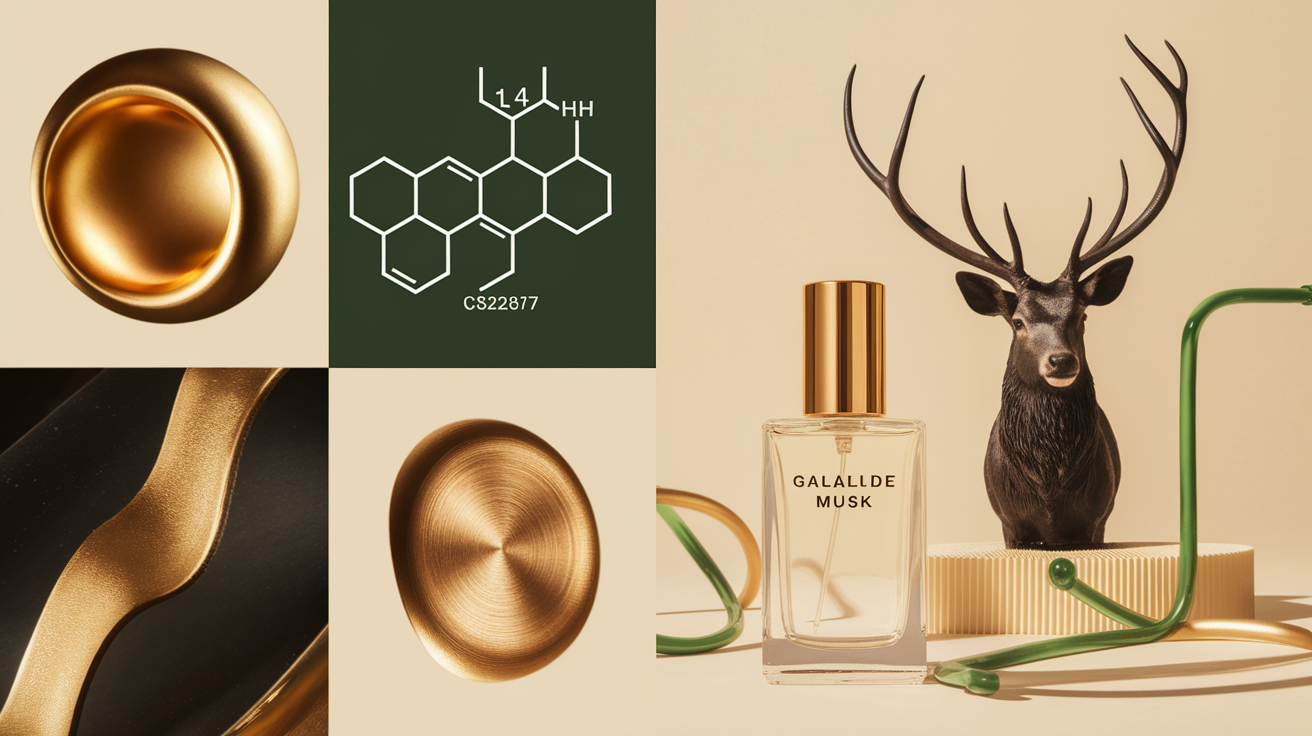
"Why does Galaxolide last 8-16+ hours while most perfume notes fade in 2-4?"
If you've ever worn a clean musk fragrance and noticed it still smells fresh the next morning, you're experiencing Galaxolide (HHCB) performance.
The short answer: Galaxolide lasts 8-16+ hours on skin (often 48+ hours on fabric) due to extremely low vapor pressure (0.0727 Pa), high molecular weight (258.4), and exceptional lipophilicity (log Kow 5.7-5.9). It binds to skin oils and evaporates extraordinarily slowly.
It's the most widely used synthetic musk in modern perfumery—replacing natural musk from endangered musk deer with an ethical, affordable, and higher-performing alternative.
Environmental Science & Technology research confirms Galaxolide's "extremely low vapor pressure indicates very limited volatilization potential"—explaining why it can last up to 400 hours on paper.
In this post, I'll explain the science behind 8-16+ hour longevity, why Galaxolide replaced natural musk (ethics + cost), how it compares to other synthetic musks, and what to know about safety and environmental impact.
Quick Answer: Galaxolide Longevity Chart
| Surface | Longevity | Note Classification |
|---|---|---|
| Skin (25°C) | 8-16+ hours | Deep base note / Fixative |
| Skin (35°C) | 8-14 hours | Minimal temperature sensitivity |
| Fabric | 48+ hours | Often several days |
| Paper/Blotter | Up to 400 hours | Extreme persistence |
Comparison to other musks:
| Musk Type | MW | Longevity (Skin) | Character | Cost |
|---|---|---|---|---|
| Galaxolide (polycyclic) | 258.4 | 8-16+ hours | Clean, sweet, floral, woody | Low |
| Tonalide (polycyclic) | ~258 | 8-16+ hours | Woody, earthy, warm | Low |
| Ethylene Brassylate (macrocyclic) | 270.4 | 8-14+ hours | Powdery, refined, less diffusive | Medium |
| Natural Musk (animal) | Variable | 12-24+ hours | Animalic, complex | Extremely high (banned) |
Key takeaway: Galaxolide combines exceptional longevity with clean odor profile, affordable cost, and ethical sourcing—making it the workhorse musk of modern perfumery.
What Is Galaxolide (HHCB)?
Galaxolide is a polycyclic synthetic musk with the chemical name 1,3,4,6,7,8-hexahydro-4,6,6,7,8,8-hexamethyl-cyclopenta[g]benzopyran (HHCB).
Chemical formula: C₁₈H₂₆O Molecular weight: 258.4 g/mol CAS Number: 1222-05-5 Trade name: Galaxolide (registered to IFF - International Flavors & Fragrances)
Structure: Polycyclic musk based on a substituted iso-chroman ring system. RIFM research identifies that "the geminal dimethyl groups at positions 6 and 8 on the cyclopentane ring confer high lipophilicity, low vapor pressure, and resistance to oxidative degradation."
This unique structure is why Galaxolide lasts so long—it's chemically engineered for persistence.
Odor profile:
Fragrantica describes it as a "'clean', sweet, floral, woody musk" with "a lightweight, pleasant, somewhat fruity fragrance." The Good Scents Company adds: "clean sweet musky floral woody."
Basenotes perfumer discussions note that Galaxolide is "floral, a bit watery, diffusive with somewhat berry-fruity undertone" and "will give a gloss or sheen to the fragrance."
Physical state: Highly viscous liquid at room temperature Boiling point: 330°C at 1.013 hPa
When developed: 1960s by IFF Usage today: Most widely used polycyclic musk in fine fragrance, laundry detergents, personal care products, and functional perfumery
The Science Behind 8-16+ Hour Longevity
Extremely Low Vapor Pressure
The primary reason Galaxolide lasts so long: vapor pressure of 0.0727 Pa at 25°C.
Environmental Science & Technology research (Lei et al., 2016) measured polycyclic musk vapor pressures: "Vapor pressure values for AHTN and HHCB are 0.0682 and 0.0727 Pa, respectively. These extremely low vapor pressures indicate very limited volatilization potential."
Comparison to other fragrance molecules:
| Molecule | Vapor Pressure (Pa at 25°C) | Relative Evaporation Rate |
|---|---|---|
| Limonene (citrus) | ~200 | 2,750x faster than Galaxolide |
| Linalool (lavender) | ~200-300 | 2,750-4,100x faster |
| Geraniol (rose) | ~0.08 | 1.1x faster |
| Galaxolide (musk) | 0.0727 | Baseline (slowest) |
Lower vapor pressure = slower evaporation = longer longevity. Galaxolide's vapor pressure is 100-1000x lower than typical middle notes, explaining why it outlasts florals and citrus by 4-8 hours.
High Molecular Weight (258.4 g/mol)
MW 258.4 puts Galaxolide firmly in base note territory:
- Top notes: MW 80-150 (citrus, aldehydes) - 1-2 hours
- Middle notes: MW 150-220 (florals like linalool 154) - 2-6 hours
- Base notes: MW 220-350+ (woods, musks, amber) - 8-24+ hours
Galaxolide at 258.4 is heavier than:
- Linalool (154) - 68% heavier
- Geraniol (154) - 68% heavier
- Limonene (136) - 90% heavier
Heavy molecules have lower volatility, resulting in sustained release over many hours.
Extreme Lipophilicity (Oil-Loving)
Galaxolide has a log Kow of 5.7-5.9 (extremely lipophilic/hydrophobic).
Archives of Environmental Contamination and Toxicology research (Rimkus & Wolf, 2002) found: "For HHCB the bioaccumulation factors on a lipid basis (BAFL) in tench were more than 20 times higher than in eel"—demonstrating Galaxolide's high affinity for fatty tissues and oils.
What this means for perfume:
- Binds to skin oils - instead of evaporating immediately, Galaxolide dissolves into sebum (skin's natural oils) and releases slowly over hours
- Adheres to fabric fibers - especially fabrics with oils or waxy coatings, explaining 48+ hour fabric longevity
- Hydrophobic - doesn't wash off easily with water, persisting through sweat
This lipophilicity is why industry sources report that "on skin and fabric the material can still be detected more than two days later."
Chemical Stability
Galaxolide is exceptionally resistant to degradation.
Environmental Science & Technology lake study (Buerge et al., 2003) found: "In Lake Zurich, during winter both compounds are eliminated primarily by outflowing water and atmospheric losses, while in summer, direct photolysis represents the predominant elimination process for AHTN but photochemical degradation is negligible for HHCB."
Translation: Sunlight breaks down Tonalide (AHTN) but barely affects Galaxolide. This stability means consistent performance throughout wear—no sudden "collapse" of the musk note.
Temperature Impact: Does Galaxolide Work in Indian Heat?
Short answer: Yes, exceptionally well.
| Temperature | Galaxolide Longevity | Notes |
|---|---|---|
| 15°C (Cool/AC) | 12-20+ hours | Extended longevity |
| 25°C (Room temp) | 8-16+ hours | Standard performance |
| 35°C (Indian summer) | 8-14 hours | Minimal reduction |
| 40°C (Delhi peak summer) | 7-12 hours | Still excellent base note |
Why minimal temperature sensitivity?
Temperature-dependent property research (Paasivirta et al., 1996) shows that while vapor pressure increases with temperature, Galaxolide's starting vapor pressure is so low (0.0727 Pa) that even doubling it (at higher temps) still results in very slow evaporation.
Comparison to other molecules in 35°C Indian summer:
| Molecule | 25°C Longevity | 35°C Longevity | % Reduction |
|---|---|---|---|
| Limonene | 30-60 min | 20-40 min | 50% reduction |
| Linalool | 2-4 hours | 1.5-3 hours | 37.5% reduction |
| Geraniol | 3-5 hours | 2-4 hours | 33% reduction |
| Galaxolide | 8-16+ hours | 8-14 hours | 12.5% reduction |
Galaxolide is one of the best-performing fragrance ingredients in hot climates—exactly why it's so popular in Middle Eastern and Indian perfumery.
Why Galaxolide Replaced Natural Musk
Ethical Concerns: CITES Endangered Species
Natural musk comes from the musk gland of male musk deer (genus Moschus). Extracting the gland requires killing the deer.
The scale of the problem: Producing 1 kg of musk pods required sacrificing ~30,000 animals.
Regulatory response: "The Convention on International Trade in Endangered Species of Wild Fauna and Flora (CITES) named musk deer an endangered species in the 1980s, restricting the trade of deer musk by its 170 signatory countries."
India, Mongolia, Korea, and Nepal implemented hunting bans. Wild musk deer populations were decimated by decades of overharvesting.
Result: Nearly all musk fragrance used today is synthetic.
Cost: 6,000-125,000x Cheaper
Natural musk: $500–$10,000 per gram
Synthetic musks (Galaxolide): $800 per kg ($0.80/gram)
Cost ratio: Synthetic is 6,000 to 125,000 times cheaper.
For comparison:
- Ambrette seed (plant-based musk alternative): $28,000 per kg
- Galaxolide: $800 per kg
This dramatic cost difference enabled the "clean musk" fragrance boom of the 1980s-2000s—affordable luxury for consumers, profitable margins for brands.
Performance: 3-5x Longer Than Natural Fixatives
Allan Chemical Corporation notes: "Synthetic musk in perfumery has extraordinary longevity, often persisting on the skin or clothing for several days. Synthetic fixatives typically outperform natural options in extending overall fragrance longevity by 3-5 times on average."
Additional advantages:
- Batch-to-batch consistency - natural musk varies wildly by animal, diet, season; synthetic is identical every time
- Cleaner odor profile - no fecal or animalic harshness
- Reliable supply chain - no seasonal/geographic limitations
- IFRA compliance - easier to meet safety standards with controlled synthesis
Galaxolide in Different Perfume Types
Perfumer & Flavorist industry analysis (Pajaujis Anonis, 2016) states: "Polycyclic musks like Galaxolide and Tonalide are widely used today and provide clean, powdery scents that perform well across various fragrance applications, making them a staple in contemporary perfumery."
Usage Levels by Fragrance Type
IFRA Amendment 51 standards report: "For IFRA 51, there is no restriction for category 4, with an average use of 5.9% in a perfume compound. Galaxolide has been measured in perfumes at concentrations up to 15 milligrams per gram (mg/g), equating to 1.5% (w/w)."
Basenotes perfumer community notes: "Galaxolide is usually used in a range of 5-20% of the formula" with "Galaxolide 50" (general purpose grade) "typically used at 10%."
Typical applications:
-
Clean/Laundry Musks: 10-20% (primary musk note)
- Examples: The Body Shop White Musk, clean cotton scents
- Galaxolide creates the signature "fresh laundry" character
-
Floral Bouquets: 5-10% (supporting fixative role)
- Extends longevity of linalool, geraniol, other florals
- Adds soft musky base without overpowering flowers
-
Woody Orientals: 5-15% (base note reinforcement)
- Blends with sandalwood, patchouli, amber
- Adds radiance and persistence
-
Men's Fougeres: 8-15% (combined with lavender, coumarin)
- Provides warm, powdery drydown
- Extends herbaceous top notes
-
Fresh/Aquatic: 5-10% (adds substance)
- Prevents "thin" character
- Anchors volatile marine/ozonic notes
Performance benefit: "Galaxolide will give a gloss or sheen to the fragrance" and "stays bright and fresh throughout" wear (Basenotes).
Comparison: Galaxolide vs Other Synthetic Musks
Galaxolide (HHCB) - The Workhorse Polycyclic Musk
- MW: 258.4 g/mol
- Odor: Clean, sweet, floral, woody, somewhat fruity
- Longevity: 8-16+ hours on skin, up to 400 hours on paper
- Diffusion: Moderate to high
- Cost: Economical (~$800/kg)
- Market position: Most widely used polycyclic musk globally
- Best for: Clean musks, laundry scents, general fixative duty
Tonalide (AHTN) - The Woody Polycyclic Alternative
- Odor: "Quite woody and earthy, musky, warm, radiant, and tenacious"
- Longevity: Similar to Galaxolide (8-16+ hours)
- Application: Excellent with coumarin in men's fougeres
- Usage: Second most common polycyclic musk
- Environmental concentration: ~10x lower than HHCB (indicates less widespread use)
Ethylene Brassylate (Musk T) - The Premium Macrocyclic
- MW: 270.4 g/mol (macrocyclic structure, not polycyclic)
- Longevity: 200+ hours on blotter (less than HHCB's 400, but more refined character)
- Odor: "Warmer and more powdery, less metallic" than Galaxolide
- Diffusion: Less diffusive, more delicate and refined
- Environmental: Lower bioaccumulation, higher biodegradability than polycyclic musks
- Cost: Higher than polycyclic musks (premium segment)
- Best for: Refined floral musks, premium niche perfumery
Muscone - The Natural Musk Replica
- Structure: 15-membered ring ketone (C₁₆H₃₀O)
- Odor: Closest synthetic approximation to natural deer musk
- Character: Soft, sweet, persistent (without animalic harshness of real animal musk)
- Cost: Highest among synthetics
- Usage: Premium/niche perfumery, where "natural musk" character is desired ethically
The verdict: Galaxolide dominates due to optimal balance of performance, cost, and clean odor profile. Macrocyclic musks offer refinement at higher cost; polycyclic musks offer economy and diffusion.
How to Maximize Galaxolide Longevity
Galaxolide already lasts 8-16+ hours, but you can extend it further:
1. Layer with Other Fixatives
Apply base notes first:
- Sandalwood oil (creamy + musky synergy)
- Patchouli (earthy depth)
- Amber/labdanum (resinous warmth)
- Vanilla (sweet fixative)
Then apply Galaxolide-rich fragrance on top. The combination creates a synergistic base lasting 12-24+ hours.
2. Apply to Cooler Skin Areas
- Inside elbows (cooler than wrists)
- Back of knees
- Lower back
- Behind ears (less sun exposure)
Cooler areas = slower evaporation = extended wear.
3. Use Oil-Based Formulations
Galaxolide's extreme lipophilicity (log Kow 5.7-5.9) means it performs even better in oil-based perfumes:
- Alcohol-based: 8-16 hours
- Oil-based (attars): 12-24+ hours
Oil binds Galaxolide molecules more tightly, slowing release.
4. Moisturize First
Apply unscented lotion before perfume. Hydrated skin holds fragrance better because:
- Creates oil-rich surface for lipophilic Galaxolide to bind
- Prevents absorption into dry skin layers
- Extends surface-level release
5. Apply to Fabric
Spray on:
- Scarves
- Shirt collars
- Jacket linings
- Hair (if alcohol-free formula)
Fabric longevity: often several days, sometimes a week with heavy application.
Safety Profile & Environmental Concerns
Regulatory Status
IFRA: Permitted with category-specific limits; no restriction for Category 4 EU: Deemed safe for cosmetics (2002 Scientific Committee opinion); no additional risk-reduction necessary (2008 assessment) U.S. EPA: Listed as high-priority TSCA substance due to aquatic toxicity concerns
Human Safety
At current cosmetic and fragrance usage levels, Galaxolide is generally recognized as safe.
Considerations:
- Potential endocrine effects (may alter estrogen activity; inhibit androgen/progesterone binding)
- In vitro studies show toxicity to brain and lung cells (at high concentrations)
- Animal studies: reduced sperm concentration/motility (high doses)
Context: Most safety data shows effects at concentrations far higher than typical human exposure from perfumes (1.5% in finished products). Regulatory bodies in EU and US have approved use at current levels.
Environmental Persistence & Bioaccumulation
This is where Galaxolide raises concerns.
U.S. EPA assessment (2014) found: "HHCB is moderately persistent in soil and sediment, has low mobility in soil, suboptimal removal in wastewater treatment plants (with removal primarily through sorption to sludge), and bioconcentration and bioaccumulation into aquatic organisms is low to moderate. HHCB is highly toxic to aquatic organisms under both acute and chronic exposure conditions."
What this means:
- Wastewater persistence: Galaxolide isn't fully broken down in sewage treatment—it sorbs to sludge or passes through to waterways
- Aquatic toxicity: High concentrations (987-2098 ng/L) found in sewage effluents; toxic to fish and aquatic invertebrates
- Bioaccumulation: Low to moderate in fish, with >20x species variation
- Photostability: Negligible photodegradation—persists in environment
Balanced perspective:
- For human users: Safe at current levels in perfumes and cosmetics
- For aquatic ecosystems: Environmental concern due to persistence and toxicity
- Industry response: Newer biodegradable musks (e.g., Habanolide) in development
- Consumer choice: Synthetic musks vs natural alternatives vs newer biodegradable options
Key Takeaways
Galaxolide longevity:
- ✓ 8-16+ hours on skin (25°C)
- ✓ 8-14 hours in Indian summer (35°C) - minimal temperature sensitivity
- ✓ 48+ hours on fabric (often several days)
- ✓ Up to 400 hours on paper
Why it lasts so long:
- Extremely low vapor pressure (0.0727 Pa at 25°C)
- High molecular weight (258.4 g/mol - base note territory)
- Extreme lipophilicity (log Kow 5.7-5.9 - binds to oils)
- Exceptional chemical stability (resistant to oxidation and photodegradation)
Why it replaced natural musk:
- Ethics: CITES endangered species protection (30,000 deer killed per kg of musk)
- Cost: 6,000-125,000x cheaper ($0.80/gram vs $500-10,000/gram)
- Performance: 3-5x longer than natural fixatives
- Consistency: Batch-to-batch reliability
Usage in perfumery:
- Most widely used polycyclic musk globally
- 5-20% in formulas (10% typical for general purpose)
- "Gives a gloss or sheen to the fragrance"
- Clean, sweet, floral, woody odor with fruity undertones
Safety & environment:
- Safe for humans at current usage levels (EU, US approved)
- Environmental concerns for aquatic ecosystems (persistence, toxicity)
- Biodegradable alternatives in development
Bottom line: Galaxolide is the workhorse synthetic musk of modern perfumery—delivering exceptional 8-16+ hour longevity, clean odor profile, ethical sourcing, and affordable cost. Its performance in hot climates makes it ideal for Indian formulations.
Further Reading
Want to understand longevity of other molecules?
- Perfume Molecule Longevity Chart: Complete MW Guide - Master reference hub
- Ambroxan Longevity: The Synthetic That Blooms in Heat - Similar synthetic base performance
- Iso E Super Longevity: The Ghost Molecule - Woody synthetic comparison
- Cashmeran Longevity: Velvety Woody Musk - Smooth musk alternative
- Santalol Longevity: Natural Sandalwood Base - Natural fixative comparison
- 11 Fascinating Fragrance Chemistry Facts - Surprising discoveries
Looking for perfumes formulated for Indian climate? Browse our collection →
References
- Lei, Y. D., Wania, F., & Mathers, D. (2016). 'Polycyclic Musks in the Air and Water of the Lower Great Lakes.' Environmental Science & Technology, 50(23)
- Rimkus, G. G., & Wolf, M. (2002). 'Synthetic Musks: Species-Dependent Bioaccumulation in Freshwater Fish and Mussels.' Archives of Environmental Contamination and Toxicology, 42, 437-446
- U.S. Environmental Protection Agency. (2014). 'HHCB (Galaxolide): Work Plan Chemical Risk Assessment.' EPA Document 746-R1-4001
- RIFM (Research Institute for Fragrance Materials). (2021). 'RIFM fragrance ingredient safety assessment, 1222-05-5'
- Buerge, I. J., Buser, H. R., Müller, M. D., & Poiger, T. (2003). 'Behavior of Polycyclic Musks HHCB and AHTN in Lakes.' Environmental Science & Technology, 37(24)
- IFRA (International Fragrance Association). 'IFRA Standard: Polycyclic Musks (Amendment 51)'
- Pajaujis Anonis, D. (2016). 'Natural and Synthetic Musks in Perfumery.' Perfumer & Flavorist
- Fragrantica. 'Galaxolide perfume ingredient profile'
- Basenotes Community Forum. 'Ethylene Brassylate vs Galaxolide discussions'
- Allan Chemical Corporation. 'How Synthetic Musks Shape Modern Perfumery'
- The Good Scents Company. 'Galaxolide technical database'
- PubChem. 'Compound Summary for CID 91497, Galaxolide'
- Environmental sources on CITES musk deer protection and cost comparisons

About Syed Asif Sultan
Founder of House of Sultan. Passionate about fragrance chemistry and transparency in perfumery.