"Is synthetic oud as long-lasting as natural agarwood?"
If you've ever wondered whether that $80 "oud" fragrance performs like a $2,000 natural agarwood oil, you're asking the right question.
The short answer: Both natural and synthetic oud are base notes lasting 6-24+ hours. Natural oud contains 150+ molecules creating complex evolution over 12-24 hours. Synthetic oud uses 5-15 engineered molecules lasting 6-12+ hours with simpler, more linear progression.
The key difference isn't duration—it's molecular complexity.
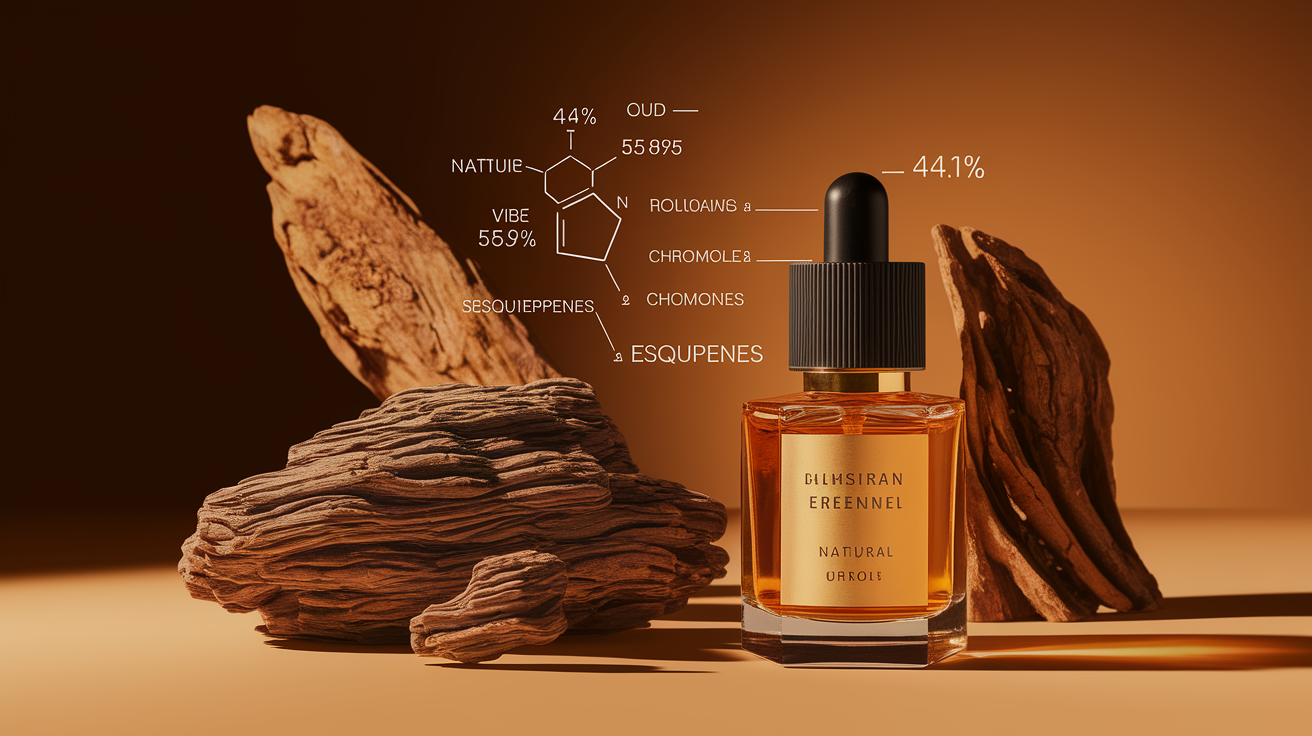
Natural agarwood oil contains 367 identified chemical compounds: 55.86% sesquiterpenes (MW 200-222) and 44.14% chromones (MW 250-400). Synthetic oud recreates the scent profile using a handful of molecules engineered for base note performance.
In this post, I'll break down the exact molecules in natural vs synthetic oud, longevity data at different temperatures, cost comparison ($3,000-80,000/kg vs $100-500/kg), and why sustainability demands synthetic alternatives.
Quick Answer: Oud Longevity Comparison
| Type | Main Molecules | MW Range | Longevity (Skin) | Cost per kg |
|---|---|---|---|---|
| Natural Oud | 150+ (sesquiterpenes + chromones) | 200-400 g/mol | 6-24+ hours | $3,000-$80,000 |
| Synthetic Oud | 5-15 (engineered aroma chemicals) | 200-300 g/mol | 6-12+ hours | $100-$500 |
Temperature Impact:
| Climate | Natural Oud Longevity | Synthetic Oud Longevity |
|---|---|---|
| 25°C (Room temp) | 12-24+ hours | 8-12+ hours |
| 35°C (Indian summer) | 6-18 hours | 6-10 hours |
| 15°C (Cool/AC) | 18-48+ hours | 12-18+ hours |
Key takeaway: Both are base notes with excellent longevity. Natural lasts longer and evolves complexly; synthetic is simpler but still long-lasting. In mass market perfumery, "oud" almost always means 100% synthetic.
What Is Oud? The Chemistry Basics
Oud (also called agarwood) is a fragrant resinous wood formed when Aquilaria trees become infected with Phaeoacremonium parasitica mold. The tree responds by secreting resin to combat the fungal invasion—this resinous heartwood becomes agarwood.
Chemical complexity: More than 300 compounds have been isolated from agarwood, with a comprehensive 2022 review identifying 367 chemical constituents:
- 55.86% sesquiterpenes (200+ compounds across 11 molecular skeleton types)
- 44.14% chromone derivatives (162+ compounds)
- No monoterpenes detected (only heavier molecules)
Where molecules concentrate:
- Essential oil (distilled): 95.85% sesquiterpenes, fewer chromones (volatile extraction)
- Resinous wood (solid): Higher chromone content (less volatile, stays in resin)
Odor profile: Rich, musty woody-nutty scent with barnyard, animalic, medicinal, leathery, and fruity facets—what Fragrantica describes as "distinctively irresistible with bitter sweet and woody nuances, seriously earthy."
Why oud lasts so long: Molecular weight 200-400 g/mol puts all oud compounds firmly in base note territory (compare to top notes at MW 130-160). Heavy molecules = low vapor pressure = slow evaporation.
Natural Oud Molecules: The Key Players
Sesquiterpenes (95.85% of Essential Oil)
Sesquiterpenes are C₁₅ hydrocarbons (formula C₁₅H₂₄ to C₁₅H₂₆O) with molecular weight 200-222 g/mol.
GC-MS analysis of high-quality agarwood oil identified these major sesquiterpenes:
Top 10 sesquiterpenes by concentration:
- Allo-aromadendrene: 13.04% (highest single component)
- Dihydro-eudesmol: 8.81%
- α-Eudesmol: 8.48% (MW 222)
- Bulnesol: 7.63%
- τ-Cadinol: 4.95%
- Dehydrofukinone: 3.83%
- Valerenol: 3.54%
- Agarospirol: 2.72% (quality marker)
- Guaiol: 2.12% (MW 222)
- Caryophyllene oxide: 2.0%
Quality marker compounds (used to identify authentic high-grade oud):
- β-Agarofuran and α-agarofuran (MW ~220)
- 10-epi-γ-eudesmol
- γ-Eudesmol
- Aromadendrane
11 sesquiterpene skeleton types identified: Eudesmanes (55+ compounds), Guaianes (50+ compounds), Eremophilanes (32+ compounds), Agarofurans (15 compounds), Agarospiranes (14 compounds), and others.
Longevity: MW 200-222 means sesquiterpenes evaporate slowly—typically lasting 6-18 hours depending on temperature and individual molecule structure.
Chromones (44.14% of Total Compounds)
Chromones are 2-(2-phenylethyl)chromone derivatives—unique compounds that Nature Communications research identifies as "the principal constituents contributing to the distinctive fragrance of agarwood."
Chromone structure:
- Base skeleton: 1,4-benzopyrone with MW 250
- With substituents: MW = 250 + (30m + 16n), where m = methoxy groups, n = hydroxy groups
- Typical range: 250-400 g/mol
Classification:
- 2-(2-Phenylethyl)chromones: ~69 compounds
- 5,6,7,8-Tetrahydro-2-(2-phenylethyl)chromones: ~37 compounds
- Dimeric chromone-sesquiterpene hybrids: Unique to certain Aquilaria species (e.g., A. sinensis)
Why chromones matter for longevity:
Chromones have very low vapor pressure due to their MW 250-400 range. They're responsible for the deepest base notes in oud—the medicinal, slightly "band-aid" character that lingers 12-48+ hours on fabric.
The oxygen atom within the chromone ring structure creates the distinctive medicinal smell while simultaneously reducing volatility.
Recent research: A 2024 study published in PubMed identified novel chromone-sesquiterpene hybrid compounds with anti-inflammatory and neuroprotective properties—showing agarwood chemistry extends beyond fragrance into pharmacology.
Synthetic Oud Molecules: The Modern Alternatives
Why Synthetics Exist
"Agarwood oil is a scent which is not possible to imitate precisely," according to Perfumer & Flavorist. Yet synthetic oud dominates the market. Why?
1. Cost: Natural oud costs $3,000-$80,000/kg (premium Kyara: $700,000-$1,000,000/kg). Synthetic costs $100-500/kg—100-400x cheaper.
2. Sustainability: All 21 Aquilaria species are endangered under CITES due to decades of unsustainable wild harvesting.
3. Consistency: Natural oud varies wildly batch-to-batch. Synthetics offer identical performance every time.
4. Supply: Only 2% of wild Aquilaria trees naturally produce agarwood. Demand far exceeds ethical supply.
As Fragrantica bluntly states: "In commercial perfumery, it's safe to say all 'oud' is a recreated synthetic note."
Major Synthetic Oud Bases
Firmenich:
- Oud Synth 10760E (most common in mass market)
- Oud Firbest (closest to natural, per Basenotes community)
- Blackwood
Givaudan:
- Black Agar Givco 215
- Agarwood Orpur
IFF:
- Karmawood
These are proprietary blends—exact formulas undisclosed. Firmenich's Oud Synth 10760E is "composed of multiple aroma chemicals offering dark, smoky, leathery character with high performance and batch-to-batch reliability."
Building Block Molecules
While major houses guard exact formulas, Basenotes community discussions and industry sources reveal common synthetic oud ingredients:
Aroma chemicals used in synthetic oud accords:
- Chromone molecule (oxygen atom creates "medicinal" smell)
- Alkylated phenols: 4-propyl phenol (barnyard character)
- Xylenols (animalic facets)
- Ambrocenide (woody-amber)
- Norlimbanol (dry wood)
- Ambre Xtreme (resinous depth)
- Nerolidol (sesquiterpene alcohol, MW 222—woody-floral)
- Safranal (leathery notes, used in small amounts)
How synthetics are formulated:
Instead of replicating all 150+ molecules, perfumers select 5-15 key aroma chemicals that capture oud's signature profile:
- Dark, smoky, leathery dominant character
- Medicinal/animalic undertones
- Woody-resinous base
- MW 200-300 range for base note longevity
The result: simpler than natural (5-15 molecules vs 150+) but engineered for excellent performance and consistency.
Longevity Showdown: Natural vs Synthetic
Natural Agarwood Oil
Longevity breakdown:
| Surface | Longevity | Evolution |
|---|---|---|
| Skin (25°C) | 12-24+ hours | Sesquiterpenes fade first (6-12hr), chromones linger (12-48hr) |
| Skin (35°C) | 6-18 hours | Faster evaporation, still excellent base note performance |
| Fabric | 48+ hours | Chromones can persist for days on cotton/wool |
Why natural oud lasts so long:
- Molecular weight 200-400 g/mol: Sesquiterpenes (200-222) + chromones (250-400) are heavy molecules with low vapor pressure
- Fixative properties: Sesquiterpenes help anchor lighter notes, extending overall fragrance longevity
- Complex layering: 150+ molecules evaporate at different rates, creating evolving scent over 12-24 hours
Temperature impact: At 49°C, linalool (MW 154) evaporates 11x faster than α-humulene (MW 204, a sesquiterpene). Oud sesquiterpenes show similar heat resistance—they evaporate faster in Indian summer (35°C) but still outlast middle notes by 3-6x.
Synthetic Oud
Longevity breakdown:
| Surface | Longevity | Evolution |
|---|---|---|
| Skin (25°C) | 8-12+ hours | Linear fade—core character remains consistent |
| Skin (35°C) | 6-10 hours | Engineered for temperature stability |
| Fabric | 24-48+ hours | Simpler composition means less complex evolution |
Why synthetic oud lasts long (but shorter than natural):
- Engineered MW 200-300: Formulated specifically for base note performance
- Temperature stability: Synthetics designed to resist evaporation in various climates
- Fewer molecules: 5-15 compounds means simpler, more linear fade rather than complex evolution
The verdict: Both are base notes with excellent longevity. Natural wins on duration and complexity (12-24+ hours with evolving character). Synthetic delivers very good longevity (8-12 hours) with consistent, predictable performance.
India Climate Impact on Oud Longevity
Tested at 25°C (European baseline) vs 35°C (Indian summer):
| Oud Type | 25°C Longevity | 35°C Longevity | Reduction |
|---|---|---|---|
| Natural oud | 12-24+ hours | 6-18 hours | 30-50% shorter |
| Synthetic oud | 8-12 hours | 6-10 hours | 20-30% shorter |
Key insight: Oud is one of the best-performing fragrance categories in hot climates.
Compare to other molecules in 35°C Indian summer:
- Limonene (citrus, MW 136): 20-40 minutes (90% reduction)
- Linalool (lavender, MW 154): 1.5-3 hours (50% reduction)
- Geraniol (rose, MW 154): 2-4 hours (40% reduction)
- Oud sesquiterpenes (MW 200-222): 6-18 hours (30-50% reduction)
Why oud performs well in heat: Heavy molecules (MW 200-400) have inherently low vapor pressure. Even when heat increases evaporation rate, oud molecules evaporate slowly enough to last most of the day.
Practical implication: An oud-based perfume designed for Paris (20°C) will still perform excellently in Mumbai summer—expect 6-12 hour longevity vs 12-24 hours in cooler climates.
Cost Comparison: Why Synthetic Dominates
Natural Agarwood Pricing
Price ranges (per kilogram):
- Regular quality: $3,000-$30,000
- High quality: $30,000-$80,000
- Kyara (supreme grade): $700,000-$1,000,000
- 100ml natural oud oil: ~$2,000
Why so expensive?
- Only 2% of wild Aquilaria trees naturally produce agarwood
- Trees must be decades old before infection occurs
- Wild trees are endangered (CITES-listed)
- Labor-intensive extraction and distillation
- Extremely limited supply vs massive global demand
Synthetic Agarwood Pricing
Price range: $100-500/kg
Price ratio: Synthetic is 100-400x cheaper than natural.
What this means for consumers:
- 100% synthetic oud perfume (50ml, $80-150): Profitable for brands, affordable for consumers
- 10% natural oud perfume (50ml, $300-500): Niche artisan territory
- 50%+ natural oud (50ml, $500-1,500+): Ultra-premium rare releases
- 100% natural oud oil (10ml, $200-500): Pure oil attars, investment-grade
Market Reality
"Global trade in agarwood is around $7 billion a year, making it the most commercially valuable plant species in the world," according to Perfumer & Flavorist.
Yet over 200 oud fragrances launched by 2019—the vast majority use 100% synthetic or <5% natural content.
Why? At $3,000-80,000/kg, using significant natural oud would make most perfumes unaffordable.
Sustainability & Ethics: Why Synthetic Matters
Conservation Crisis
All 21 Aquilaria species documented are listed as endangered under CITES (Convention on International Trade in Endangered Species).
Wild populations have drastically declined over decades due to:
- Unsustainable harvesting (only 2% of trees produce agarwood, so many are cut wastefully)
- Illegal logging of old-growth Aquilaria forests
- Lack of replanting in wild habitats
CITES regulations now require:
- Export permits for all agarwood
- Reporting amounts to CITES
- Proof that exports won't be detrimental to species survival
Why Synthetic Oud Is Necessary
1. Protects endangered species: Eliminates pressure on wild Aquilaria populations
2. Enables sustainable cultivation: Fungal inoculation techniques can increase agarwood production from ~2% to nearly 100%, meaning fewer trees need cutting
3. Ethical alternative: Reduces demand for illegal wild harvesting
4. Supply chain stability: Synthetics provide reliable, consistent supply vs unpredictable wild/cultivated sources
5. IFRA compliance: IFRA standards set maximum concentration levels for agarwood essential oil by product category—synthetics can be formulated to meet safety standards more reliably
The bottom line: For oud to exist in modern perfumery without driving Aquilaria to extinction, synthetic alternatives are essential.
How to Identify Natural vs Synthetic Oud
By Price
- <$150 (50ml): Almost certainly 100% synthetic
- $150-500: Likely synthetic with possible <5% natural
- $500-1,500: May contain 10-30% natural
- $1,500+ (50ml): Likely high natural content (30-100%)
By Smell Complexity
Natural oud:
- Complex, evolves over 12-24 hours
- Barnyard/animalic/medicinal/woody layers
- "Dirty" or "funky" facets in opening
- Deep, resinous drydown with chromone medicinal notes
Synthetic oud:
- Simpler, more linear progression
- Often "vinyl" or slightly "plasticky" undertone
- Smoky-leathery character dominates
- Cleaner, less animalic than natural
As Basenotes community notes, natural oud smells "way more complex and deeper" than synthetics, though Firmenich's Oud Firbest "comes rather close."
By Brand Transparency
Natural oud:
- Brands specify percentage or origin ("Cambodian oud," "10% agarwood oil")
- Niche/artisan perfumers more likely to use real oud
- Often mention cultivation method or CITES compliance
Synthetic oud:
- Vague terms: "oud accord," "oud notes," just "oud"
- Designer/mass market fragrances
- No specific sourcing information
By Longevity Pattern
Natural: 12-24+ hours with complex evolution (sesquiterpenes evaporate first, chromones linger)
Synthetic: 8-12 hours, more linear fade without dramatic evolution
Key Takeaways
Natural oud chemistry:
- ✓ 150+ molecules: 55.86% sesquiterpenes (MW 200-222), 44.14% chromones (MW 250-400)
- ✓ Longevity: 12-24+ hours on skin, 48+ hours on fabric
- ✓ Complex evolution over time as different molecules evaporate
- ✓ Cost: $3,000-$80,000/kg (Kyara: up to $1M/kg)
Synthetic oud chemistry:
- ✓ 5-15 engineered molecules, MW 200-300 g/mol
- ✓ Longevity: 8-12+ hours on skin, 24-48+ hours on fabric
- ✓ Linear, consistent performance
- ✓ Cost: $100-500/kg (100-400x cheaper)
Both are base notes with excellent longevity—key difference is complexity, not duration.
Sustainability reality:
- All 21 Aquilaria species endangered (CITES-listed)
- Synthetics necessary to prevent extinction
- 100% synthetic oud dominates mass market (<$150 fragrances)
- Natural oud reserved for ultra-premium niche ($500-1,500+)
India climate performance:
- Natural oud: 6-18 hours at 35°C (30-50% reduction from baseline)
- Synthetic oud: 6-10 hours at 35°C (20-30% reduction)
- Still one of best-performing categories in hot weather
For perfume shopping:
- If it costs <$150 (50ml), it's 100% synthetic
- Mass market "oud" = synthetic recreations
- True natural oud starts at ~$500+ for artisan niche
- Both perform well—choose based on budget and ethical priorities
Bottom line: Synthetic oud isn't inferior—it's necessary. It enables accessible luxury, protects endangered species, and delivers excellent base note longevity (8-12 hours). Natural oud offers unmatched complexity and prestige, but at extreme cost and environmental impact.
Further Reading
Want to understand longevity of other molecules?
- Perfume Molecule Longevity Chart: Complete MW Guide - Master reference hub
- Santalol Longevity: Why Sandalwood Lasts 24+ Hours - Natural base note comparison
- Ambroxan Longevity: The Synthetic That Blooms in Heat - Synthetic base alternative
- Iso E Super Longevity: The Ghost Molecule - Woody synthetic base note
- Cashmeran Longevity: Velvety Woody Musk - Synthetic woody character
- 11 Fascinating Fragrance Chemistry Facts - Surprising discoveries
Looking for perfumes formulated for Indian climate? Browse our collection →
References
- Liao, G., Dong, W.-H., Yang, J.-L., Li, W., Wang, J., Mei, W.-L., & Dai, H.-F. (2022). 'Overview of sesquiterpenes and chromones of agarwood.' Molecules, PMC9060603
- Yang, L., et al. (2022). 'Identification of a diarylpentanoid-producing polyketide synthase revealing biosynthesis of 2-(2-phenylethyl)chromones in agarwood.' Nature Communications
- Chen, S., et al. (2025). 'Expression analysis of sesquiterpenes biosynthesis-related genes in Aquilaria sinensis.' Tropical Plants
- Malaysian Journal of Analytical Sciences. 'Analysis of high quality agarwood oil chemical compounds by GC-MS'
- Perfumer & Flavorist. 'King of Scents: Agarwood'
- IFRA (International Fragrance Association). 'IFRA Standards for Agarwood Essential Oil'
- Fragrantica. 'Agarwood (Oud) perfume ingredient profile'
- Basenotes Community Forum. 'Synthetic oud chemistry discussions'
- Chen, H.-Q., Wei, J.-H., Yang, J.-S., et al. (2018). 'Chemical Constituents and Pharmacological Activity of Agarwood.' Molecules, PMC6017114
- The Good Scents Company. 'Agarwood oil technical database'

About Syed Asif Sultan
Founder of House of Sultan. Passionate about fragrance chemistry and transparency in perfumery.