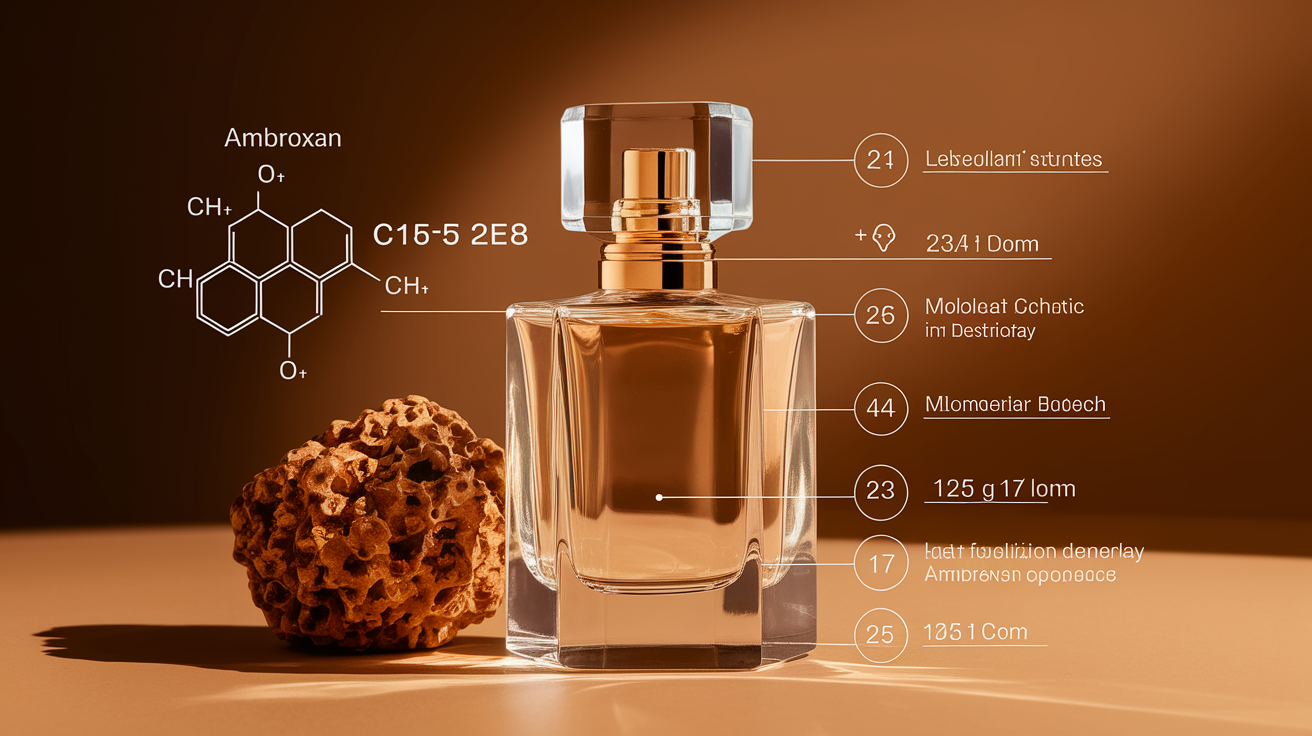
"Why does Dior Sauvage last 8-12 hours when most perfumes fade in 4-6?"
The answer is one molecule: Ambroxan.
It's not magic. It's chemistry.
Ambroxan has a molecular weight of 236 and a vapor pressure so low (<0.00393 mmHg) that it barely evaporates at room temperature. While citrus molecules (limonene) disappear in 30 minutes and florals (linalool) fade in 2-4 hours, ambroxan persists for 8-12 hours on skin.
And here's the interesting part: it actually performs BETTER in heat. While most perfume molecules evaporate faster when warm, ambroxan "blooms" and projects more strongly when body temperature rises.
This is why Dior Sauvage is even more powerful in Mumbai summer than in Paris winter.
In this post, I'll explain exactly what ambroxan is, why it lasts so long, how it compares to natural ambergris, and why it's become the backbone of modern perfumery.
Quick Answer: Ambroxan Longevity Chart
| Temperature | Longevity on Skin | Note Classification |
|---|---|---|
| 25°C (Room temp) | 8-12 hours | Persistent base note |
| 35°C (Indian summer) | 6-10 hours | Still excellent (heat bloom effect) |
| 15°C (Cool/AC) | 10-16 hours | Extended base note |
On inert surfaces (fabric, smelling strip): 1+ month
Comparison to other molecules:
| Molecule | MW | Longevity (25°C) | Longevity (35°C) |
|---|---|---|---|
| Limonene (citrus) | 136 | 30-60 min | 20-40 min |
| Linalool (lavender) | 154 | 2-4 hours | 1.5-3 hours |
| Geraniol (rose) | 154 | 3-5 hours | 2-4 hours |
| Ambroxan (amber) | 236 | 8-12 hours | 6-10 hours |
| Santalol (sandalwood) | 220 | 12-24 hours | 8-18 hours |
Key takeaway: Ambroxan lasts 4-6x longer than linalool, 16-24x longer than limonene. It's in the same longevity league as sandalwood.
What Is Ambroxan?
Ambroxan is a synthetic fragrance molecule that mimics the smell of natural ambergris (whale secretion), but without the whales.
Full chemical name: (3aR,5aS,9aS,9bR)-3a,6,6,9a-Tetramethyldodecahydronaphtho[2,1-b]furan
Molecular weight: 236.4 g/mol
CAS Number: 6790-58-5
Chemical formula: C₁₆H₂₈O
Structure: Polycyclic ether with four fused rings
Smell profile:
- Dry, mineral, woody-amber
- Warm, musky, slightly marine/salty
- Smooth, radiant, "skin-like"
- Clean, effervescent, abstract
The Perfume Society describes it as: "A synthetic fragrance molecule that has become the backbone of modern perfumery, capturing the warm, musky, slightly salty radiance of natural ambergris, but without whales, rarity, or inconsistency."
Odor threshold: 0.3 ppb (parts per billion) - extremely potent
This means you can detect ambroxan at incredibly low concentrations. Most perfumes use only 0.1-1% ambroxan, yet it dominates the composition.
Discovery:
- Invented in the 1950s
- Originally dosed at 10% in classic "Fixateur" bases
- Now central to modern woody-amber perfumes
Commercial names:
- Ambroxan (KAO)
- Ambrofix (Givaudan)
- Ambrox Super (dsm-firmenich)
- Orcanox (Mane)
- Ambermor, Cetalor (IFF)
- Ambroxide (Symrise)
Different manufacturers, same molecule (with minor purity variations).
Why Ambroxan Lasts 8-12 Hours
Three chemical properties give ambroxan exceptional longevity:
1. High Molecular Weight: 236
At 236, ambroxan is firmly in base note territory:
| Note Type | MW Range | Example Molecules | Longevity |
|---|---|---|---|
| Fast top notes | 130-140 | Limonene (136) | 30-60 min |
| Middle notes | 150-220 | Linalool (154), Geraniol (154) | 2-6 hours |
| Base notes | 200-300+ | Ambroxan (236), Santalol (220) | 8-24+ hours |
Higher molecular weight = slower evaporation = longer longevity.
2. Extremely Low Vapor Pressure: <0.00393 mmHg
Technical data shows ambroxan vapor pressure at 25°C is <0.00393 mmHg.
Comparison:
| Molecule | Vapor Pressure (25°C) | Relative Evaporation Rate |
|---|---|---|
| Limonene | ~1.5 mmHg | 380x faster than ambroxan |
| Linalool | ~0.12 mmHg | 30x faster than ambroxan |
| Ambroxan | <0.00393 mmHg | Baseline (slowest) |
Lower vapor pressure = molecules stay in liquid phase longer = much slower evaporation.
Ambroxan's vapor pressure is so low that it's nearly non-volatile at room temperature.
3. Heat-Activated Diffusion (Unique Property)
Here's where ambroxan gets interesting.
Most molecules evaporate FASTER when hot (simple thermodynamics).
Ambroxan behaves differently: it "blooms" and diffuses more strongly when body temperature rises.
What this means:
- Exercise: Ambroxan projects more as you heat up
- Warm weather: Stronger diffusion in summer heat
- Body heat: Activates radiance without faster evaporation
This is why Dior Sauvage is famously powerful in warm weather. It's not evaporating faster - it's diffusing more actively while still maintaining longevity.
Chemical explanation:
Increased temperature raises molecular kinetic energy → more diffusion into air → stronger projection.
But vapor pressure remains low → minimal evaporation → longevity maintained.
Result: More smell, same duration. Perfect for hot climates.
Ambroxan vs Natural Ambergris
Ambroxan is synthetic. Natural ambergris comes from sperm whales.
Let's compare:
What Is Natural Ambergris?
Ambergris is a waxy substance produced in the digestive system of sperm whales. When expelled and aged in seawater for years, it develops a complex, prized fragrance.
Chemical composition:
- 12-45% ambrein (the key fragrance compound)
- Cholesterol derivatives
- Triterpene alcohols
- Various oxidation products
Smell:
- Marine, salty, animalic
- Earthy, musky, slightly fecal (when fresh)
- Sweet, tobacco-like, woody (when aged)
- More complex and aquatic than synthetic ambroxan
Cost: $40,000+ per kilogram
Availability: Extremely rare, inconsistent quality, ethically problematic
Synthetic Ambroxan
Research shows that synthetic ambroxan production "traditionally...is produced from the diterpene sclareol through four steps: extraction of (−)-sclareol from the plant Salvia sclarea [clary sage], oxidation of the (−)-sclareol side chain to yield (+)-sclareolide, reduction of (+)-sclareolide to (−)-ambradiol, and finally cyclodehydration of (−)-ambradiol."
Modern methods include:
- One-pot synthesis (2016): 20% yield from sclareol
- Catalytic asymmetric synthesis (2024): breakthrough using homofarnesol
- Chemo-enzymatic biosynthesis (2026): sustainable route using Saccharomyces cerevisiae
Smell:
- Cleaner, more radiant than natural
- Less animalic, more mineral-woody
- More consistent batch-to-batch
- Slightly less complex but more versatile
Cost: $350-590 per kilogram
Purity: 98.7% (synthetic) vs 12-45% (natural)
Why Synthetic Ambroxan Won
| Factor | Natural Ambergris | Synthetic Ambroxan | Winner |
|---|---|---|---|
| Cost | $40,000/kg | $350-590/kg | Synthetic (100x cheaper) |
| Purity | 12-45% | 98.7% | Synthetic |
| Consistency | Highly variable | Identical batches | Synthetic |
| Ethics | Whale byproduct | Plant-derived | Synthetic |
| Availability | Extremely rare | Abundant (30+ tons/year) | Synthetic |
| Sustainability | Depends on whales | Renewable (clary sage) | Synthetic |
| Complexity | More complex | Cleaner, more focused | Depends on use case |
Bottom line: Synthetic ambroxan is cheaper, cleaner, more ethical, and more consistent. That's why modern perfumery uses it almost exclusively.
Annual production exceeds 30 tons - far more than natural ambergris could ever supply.
The "Olfactory Amplifier" Effect
Ambroxan doesn't just last long. It makes OTHER ingredients smell better.
How It Works
Ambroxan acts as an olfactory amplifier - it enhances the clarity, radiance, and projection of surrounding notes without dominating the composition.
Properties:
- Increases overall sillage (scent trail)
- Sharpens perception of other notes
- Adds "radiance" and "glow"
- Creates smooth, seamless blending
Why perfumers love it:
You can use 0.1-1% ambroxan and it:
- Doesn't smell like pure ambroxan
- Makes bergamot smell brighter
- Makes florals more luminous
- Makes woods more expansive
It's like adding reverb to music - it doesn't change the notes, but makes everything sound bigger and more present.
Famous example: Dior Sauvage
Dior Sauvage uses heavy ambroxan (likely 10-15% of fragrance concentrate). This:
- Amplifies the bergamot opening
- Enhances the pepper spiciness
- Creates massive projection
- Extends longevity to 8-12 hours
Without ambroxan, it would be a 3-4 hour fresh aromatic. With ambroxan, it's an all-day powerhouse.
Escentric Molecules Molecule 02
Perfumer Geza Schoen created this as 100% pure ambroxan to demonstrate its olfactory amplifier properties.
The concept: Wear pure ambroxan. It interacts with your skin chemistry and ambient molecules to create a unique "aura" for each person.
Some people smell strong woody-amber. Others barely detect it. Same molecule, different perception.
This leads to...
The Genetic Sensitivity Problem
Here's something weird: ~20% of people can't smell ambroxan very well.
Research identified OR7A17 as the odorant receptor tuned to ambroxide (ambroxan).
Genetic variation in this receptor means:
- 80% of people: Normal to high sensitivity
- ~20% of people: Low sensitivity (genetic variant)
Studies confirm: "Approximately 20% of the population exhibits a low sensitivity to ambroxan, a synthetic compound belonging to the tetranorlabdane oxide class."
What this means:
If you spray Dior Sauvage and think "this smells weak" or "I don't get the hype," you might have the genetic variant.
Meanwhile, your friend smells it from across the room.
Same perfume, radically different perception.
Implications for perfumery:
- Blind-buying ambroxan-heavy perfumes is risky
- Always test on skin first
- If you can't smell Molecule 02, you likely have low ambroxan sensitivity
- Explains wildly divergent reviews for the same perfume
This genetic variation is unique to ambroxan. Most perfume molecules don't have this issue.
Ambroxan in Famous Perfumes
Ambroxan is everywhere in modern perfumery. Here are the most famous examples:
1. Dior Sauvage (2015)
Ambroxan role: Primary base note (estimated 10-15% of concentrate)
Composition:
- Top: Bergamot (citrus opening)
- Heart: Pepper, lavender
- Base: Heavy ambroxan + vanilla
Why it works:
- Ambroxan amplifies bergamot brightness
- Creates massive projection (legendary sillage)
- 8-12 hour longevity
- Blooms in heat (perfect for all climates)
Result: Best-selling men's fragrance globally for 5+ years
2. Bleu de Chanel (2010)
Ambroxan role: Supporting base note (balanced with sandalwood, cedar)
Composition:
- Top: Citrus (lemon, mint, pink pepper)
- Heart: Ginger, nutmeg, jasmine
- Base: Ambroxan, sandalwood, cedar, incense
Why it works:
- Ambroxan provides radiance without dominating
- Works with natural woods to extend longevity
- More subtle than Sauvage, still powerful
3. Baccarat Rouge 540 (Maison Francis Kurkdjian, 2015)
Ambroxan role: Structural pillar for radiance and projection
Composition:
- Top: Saffron, jasmine
- Heart: Amberwood, cedar
- Base: Ambroxan, fir resin
Why it works:
- Ambroxan creates the legendary "aura" effect
- Extreme projection (clouds of scent)
- Longevity 10-12+ hours
- Smells different on everyone (genetic variation)
4. Escentric Molecules Molecule 02 (2008)
Ambroxan role: 100% pure ambroxan (no other ingredients)
Concept:
- Demonstrate ambroxan as olfactory amplifier
- Interacts with skin chemistry uniquely
- Some smell strong woody-amber, others barely detect it
Result: Cult following among fragrance enthusiasts
Other notable perfumes:
- Blanche (Byredo): Clean musky-woody with ambroxan
- Santal 33 (Le Labo): Sandalwood + ambroxan radiance
- Not a Perfume (Juliette Has a Gun): Pure ambroxan (like Molecule 02)
- Ombre Nomade (Louis Vuitton): Oud + ambroxan modern twist
Ambroxan has become so ubiquitous that it's hard to find a modern woody/aromatic perfume WITHOUT it.
India Climate Performance: Ambroxan Actually Excels
Most perfume molecules perform worse in Indian heat. Ambroxan is the opposite.
Why Ambroxan Loves Heat
Normal molecules:
- Heat → faster evaporation → shorter longevity
- Result: Citrus (30min) becomes (20min) in 35°C
Ambroxan:
- Heat → increased diffusion + maintained longevity
- Result: Same 8-12hr duration, but MORE projection
Fragrantica notes: "Ambroxan is highly reactive to heat and literally 'blooms' and diffuses more strongly when body temperature rises (e.g., during exercise or in warm weather)."
Real-World Performance in India
| Condition | Ambroxan Longevity | Projection |
|---|---|---|
| European climate (20°C) | 10-14 hours | Moderate |
| Indian winter (25°C) | 8-12 hours | Good |
| Indian summer (35°C) | 6-10 hours | Very strong (heat bloom) |
| Delhi peak summer (40°C+) | 6-8 hours | Extremely strong |
| AC environment (22°C) | 10-14 hours | Moderate |
Key insight: You get 6-10 hours PLUS stronger projection in Indian heat. That's a win-win.
Practical implication:
Dior Sauvage performs BETTER in Mumbai summer than in Paris winter:
- Slightly shorter duration (8hr vs 10hr)
- But MUCH stronger projection
- More noticeable scent trail
- Heat activates the radiance effect
This is why ambroxan-heavy perfumes are actually ideal for hot climates - they use the heat to their advantage.
How to Maximize Ambroxan Longevity
Ambroxan already lasts 8-12 hours. But if you want to push it further:
1. Apply to Pulse Points (Heat Activation)
Ambroxan blooms with heat, so apply where body temperature is highest:
- Wrists
- Neck
- Chest (under clothes)
- Inside elbows
More heat = more diffusion = stronger presence.
2. Layer with Complementary Base Notes
Ambroxan works beautifully with:
- Sandalwood: Creamy + radiant combination
- Vetiver: Earthy + clean contrast
- Cedarwood: Woody + mineral synergy
- Vanilla: Sweet + musky warmth
Layering extends the overall composition beyond just ambroxan.
3. Use in Warm Weather
Paradoxically, ambroxan performs BEST in heat:
- Summer days → maximum bloom effect
- Exercise/gym → activates diffusion
- Warm climates → ideal environment
Don't save ambroxan perfumes for winter. Use them in summer when they shine.
4. Proper Storage
Ambroxan is stable, but like all molecules, benefits from:
- Cool, dark storage (15-25°C)
- Keep bottle sealed (minimize air exposure)
- Original box (blocks light)
IFRA standards note ambroxan stability range is 5-40°C, so it's quite robust.
Note on concentration: Maximum solubility is 13.5%. If perfume has >13.5% ambroxan, it may crystallize during storage. This is rare in commercial perfumes.
Safety and IFRA Standards
Ambroxan is one of the safest synthetic fragrance molecules.
IFRA Standards
IFRA (International Fragrance Association) Certificate of Conformity for ambroxan (49th Amendment):
- No specific restrictions under IFRA 51st Amendment
- Category 4 (perfumes): Average use 0.1%, no upper limit
- Allowed for use in all fragrance categories
Translation: Ambroxan is safe for use at any concentration (within solubility limits of ~13.5%).
Safety Profile
Toxicity: Low Sensitization: No evidence of skin sensitization Phototoxicity: None Environmental: Biodegradable
Purity: 98.7% in commercial batches (extremely pure compared to natural alternatives)
Population tolerance:
- 80% have normal-to-high sensitivity (safe, pleasant)
- 20% have low sensitivity (genetic, not a safety issue)
Ambroxan has been used in perfumery for 70+ years with an excellent safety record.
House of Sultan and Ambroxan
We use natural base notes (sandalwood, oud, patchouli) instead of synthetic ambroxan in our formulations.
Why?
Differentiation: Ambroxan is ubiquitous in modern perfumery. We wanted to offer something different - natural, traditional, grounded in heritage.
Natural complexity: Sandalwood (santalol) has more complexity than ambroxan's clean radiance. We prefer the creamy, woody depth of natural materials.
Climate optimization: Indian sandalwood + oud perform excellently in our climate without needing synthetic amplifiers.
Transparency: Our customers value knowing exactly what's in their perfumes. Natural ingredients are more transparent than proprietary synthetic blends.
Rustam Formulation
Base notes:
- Sandalwood oil (santalol MW 220): 12-24hr longevity
- Oud oil (complex sesquiterpenes): 8-12hr longevity
- Patchouli (patchoulol MW 222): 10-18hr longevity
- Amber accord: 8-16hr longevity
No synthetic ambroxan, yet Rustam achieves 24+ hour longevity on tissue test.
How?
Natural base notes + climate-specific formulation + 8-week maceration = exceptional longevity without synthetics.
Full breakdown: Rustam Molecular Profile
Key Takeaways
Ambroxan longevity:
- ✓ 8-12 hours at 25°C (room temperature)
- ✓ 6-10 hours at 35°C (Indian summer) + stronger projection
- ✓ 1+ month on fabric/smelling strip
Why it lasts so long:
- High molecular weight (236 - base note territory)
- Extremely low vapor pressure (<0.00393 mmHg)
- Heat-activated diffusion (blooms in warmth)
- Fixative properties (extends other ingredients too)
Ambroxan vs natural ambergris:
- 100x cheaper ($590/kg vs $40,000/kg)
- Higher purity (98.7% vs 12-45%)
- More ethical (no whales)
- More consistent (identical batches)
- Cleaner smell (less animalic, more radiant)
Unique properties:
- "Olfactory amplifier" effect (enhances other notes)
- Genetic variation (20% have low sensitivity)
- Heat blooming (performs BETTER in warm climates)
Famous perfumes:
- Dior Sauvage (heavy ambroxan base)
- Bleu de Chanel (balanced with woods)
- Baccarat Rouge 540 (radiance pillar)
- Escentric Molecules Molecule 02 (100% pure)
For perfume shopping:
- Ambroxan-heavy perfumes are ideal for Indian climate
- Test on skin first (genetic sensitivity varies)
- Expect 8-12hr longevity (6-10hr in heat)
- Works best with heat (not despite it)
Bottom line: Ambroxan revolutionized modern perfumery by providing ambergris-like radiance with exceptional longevity at 1/100th the cost. It's the secret behind most blockbuster fragrances of the last 15 years.
Further Reading
Want to understand longevity of other molecules?
- Perfume Molecule Longevity Chart: Complete MW Guide - Master reference hub
- Iso E Super Longevity: The Ghost Molecule - Similar woody synthetic base
- Galaxolide Longevity: Synthetic Musk Performance - Long-lasting musk fixative
- Cashmeran Longevity: Velvety Woody Musk - Smooth base note character
- Santalol Longevity: Natural Sandalwood Base - Natural alternative comparison
- 11 Fascinating Fragrance Chemistry Facts - Surprising discoveries
Looking for perfumes with natural base notes instead of synthetics? Browse our collection →
References
- Yang, F., Tian, X., et al. (2016). 'One-pot synthesis of (−)-Ambrox.' Scientific Reports, 6, 32650
- Nature (2024). 'The catalytic asymmetric polyene cyclization of homofarnesol to ambrox.' Nature, 632, 1072–1079
- Green Chemistry (2026). 'A bio-inspired environmentally friendly and cost-effective chemo-enzymatic synthesis of (−)-ambrox from trans-nerolidol'
- Journal of Agricultural and Food Chemistry (2023). 'From Ambergris to (−)-Ambrox: Chemistry Meets Biocatalysis for Sustainable (−)-Ambrox Production'
- Chem & Bio Engineering (2023). 'Efforts toward Ambergris Biosynthesis.' ACS Publications
- PMC (2025). 'An odorant receptor for a key odor constituent of ambergris.' PubMed Central
- Frontiers in Psychology (2013). 'Brain responses to odor mixtures with sub-threshold components'
- International Fragrance Association (IFRA). 'Certificate of Conformity with IFRA Standards - Ambroxan (49th Amendment)'
- The Perfume Society. 'Ambroxan - Ingredient Post'
- The Good Scents Company. 'Ambroxan (CAS 6790-58-5) - Technical Data Sheet'
- Fragrantica. 'Ambroxan perfume ingredient'
- Fragrantica (2023). 'Ambergris, Ambrox and Ambroxan of the Year - Raw Materials'

About Syed Asif Sultan
Founder of House of Sultan. Passionate about fragrance chemistry and transparency in perfumery.