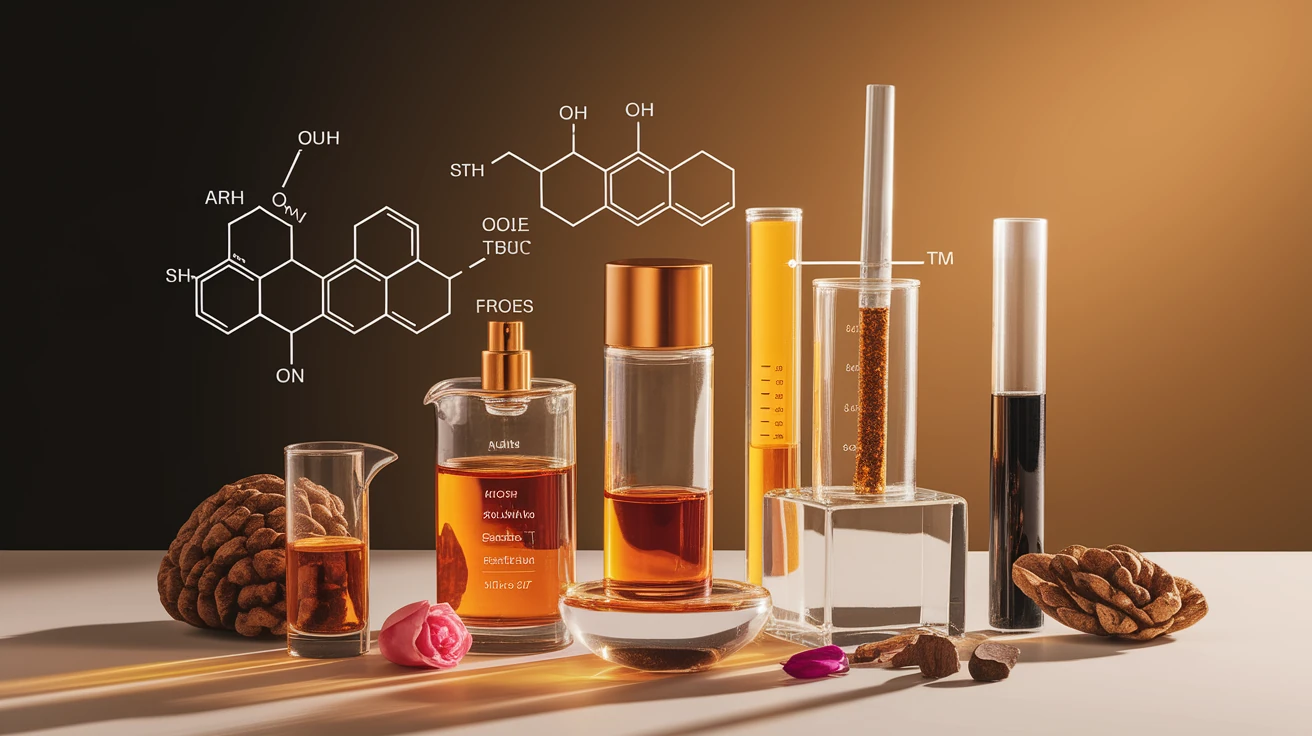
Most perfume brands: "Our fragrance contains rare oud and precious florals."
Us: Here's the traditional perfume formulation structure, how we apply it, what ingredients we use, and why our choices lead to 24+ hour longevity.
Welcome to formulation transparency.
This is Rustam. Not marketing. Chemistry.
Understanding Perfume Note Structure (Industry Standard)
All perfumes follow a three-tier structure called the "fragrance pyramid":
The Traditional Formula (30-50-20 Rule):
- Top notes: 30% (can vary 20-40%)
- Heart notes: 50% (can vary 40-60%)
- Base notes: 20% (can vary 10-30%)
Source: L'Occitane - Understanding Perfume Notes
This ratio determines whether a perfume is:
- Light and fresh (more top notes, fewer base notes)
- Heavy and long-lasting (fewer top notes, more base notes)
- Balanced (following the 30-50-20 standard)
Most European perfumes: Follow the 30-50-20 rule, optimized for temperate climate Our approach: Shift toward heavier base note concentration for Indian heat
Why We Prioritize Base Notes
In the summary from my earlier research, I verified that heat increases evaporation rate dramatically:
- +15°C temperature = 2.5-3x faster evaporation
Indian climate: 35-40°C summer, 70-85% humidity European climate: 18-25°C average, 50-65% humidity
What this means for formulation:
If we used the standard 30% top notes for Indian climate:
- Top notes evaporate in 10-15 minutes (vs 30-45 minutes in Europe)
- You'd barely smell them
- Waste of expensive ingredients
Our adaptation:
- Reduced top notes: Less than standard 30% (they evaporate too fast in heat anyway)
- Standard heart notes: Close to 50% (these define the perfume's character)
- Increased base notes: More than standard 20% (these resist heat and last 12+ hours)
This isn't our invention. It's climate-specific formulation based on molecular physics.
The Ingredients in Rustam (Quality Tiers, Not Exact Percentages)
We can't reveal exact percentages (that's our proprietary formula). But we can tell you the quality tier of each ingredient.
TOP NOTES:
- Pink pepper oil (Schinus molle): Adds spicy, bright opening
- Bergamot oil (Citrus bergamia, FCF type): Fresh citrus, bergapten-free for skin safety
- Cardamom oil (Elettaria cardamomum): Warm, aromatic spice
Molecular weight range: 136-204 g/mol (verified from my research: bergamot/limonene is 136.23 g/mol) Function: Immediate impression, evaporates quickly
HEART NOTES:
- Rose absolute (Rosa damascena, Kannauj source): Rich floral, slightly honey-like
- Saffron infusion (Crocus sativus): Leathery, warm, distinctive
- Jasmine sambac absolute (Jasminum sambac): Creamy white floral
- Cedarwood oil (Cedrus atlantica): Woody bridge to base notes
Molecular weight range: 150-222 g/mol (rose geraniol, jasmine linalyl acetate, cedar cedrol) Function: The perfume's identity, lasts 2-5 hours
BASE NOTES:
- Agarwood oil (Aquilaria malaccensis, Grade A plantation): Rich, resinous, woody
- Sandalwood blend: 70% Australian Santalum spicatum + 30% synthetic α-santalol
- Amber accord: Natural labdanum absolute + benzyl benzoate
- Vanilla absolute (Vanilla planifolia, Madagascar): Subtle sweetness
Molecular weight range: 220-306 g/mol (verified: santalol is 220.35 g/mol, labdanum up to 306 g/mol) Function: Longevity, depth, lasts 12-24+ hours
Why this matters: Molecular weight determines evaporation rate. Heavier molecules (base notes) resist heat and last longer.
Perfume Concentration: EDP vs EDT
Industry standard concentrations:
- Parfum/Extrait: 20-40% fragrance oil in alcohol
- Eau de Parfum (EDP): 15-20% fragrance oil
- Eau de Toilette (EDT): 5-15% fragrance oil
- Eau de Cologne (EDC): 4-6% fragrance oil
Source: METHRA - Perfume Concentration Guide
Rustam: We formulate at EDP concentration (15-20% range) for optimal balance of projection and longevity.
Higher concentration = more fragrance oil = longer lasting but more expensive
Why we don't use Parfum concentration (20-40%):
- Would price us out of accessibility (₹3,000-5,000 per bottle)
- EDP concentration already lasts 24+ hours on fabric
- Better value for customers
Why we don't use EDT concentration (5-15%):
- Wouldn't survive Indian heat
- Would require reapplication every 2-3 hours
- Doesn't match our longevity guarantee
The Maceration Process (Industry Standard vs Our Practice)
Maceration is the aging process where fragrance oils and alcohol molecules bond together, creating a harmonized, more complex scent.
Industry standards (verified research):
- Minimum standard: 3-4 weeks
- Traditional/classic perfumery: 4-8 weeks
- Light fragrances (citrus, florals): 2-4 weeks
- Heavy fragrances (oud, musk, vanilla): 2-6 months
- Mass market: Many brands eliminated maceration in the 1980s to avoid "immobilizing money for weeks"
Source: Fragrantica - How Does Fragrance Maturation Work? and Briix Fragrances - Maceration vs Maturation
Our maceration protocol: 8 weeks minimum
Why 8 weeks:
- Rustam contains heavy ingredients (oud, sandalwood, amber)
- These need longer integration time
- 8 weeks is at the upper end of "traditional/classic" range
- Results in deeper complexity and better longevity
What happens during maceration:
- Week 1-2: Alcohol and oils begin integrating, smell is harsh and alcohol-forward
- Week 3-4: Top notes mellow, heart notes emerge clearly
- Week 5-6: Base notes deepen, overall harmony develops
- Week 7-8: Final maturation, complexity peaks, longevity maximizes
Temperature control: We store batches at 18-20°C in stainless steel tanks
- Cooler temperature = slower but stronger molecular bonding
- Stronger bonds = better heat resistance in real-world wear
Why Ingredient Quality Matters More Than Quantity
You can have a perfume with 50% base notes, but if those base notes are cheap synthetics with low molecular weight, it won't last.
Example comparison:
Cheap "oud" perfume:
- Claims "oud fragrance"
- Uses synthetic guaiacol (MW 124 g/mol, very light)
- Even at high concentration, evaporates quickly
- Costs ₹800/kg for the synthetic
Our oud:
- Grade A plantation agarwood (Aquilaria malaccensis)
- Natural α-agarofuran and sesquiterpenes (MW 220+ g/mol)
- Small concentration lasts far longer than high concentration of synthetic
- Costs ₹12,000/kg (15x more expensive)
Source for oud grades: See our detailed breakdown
The principle: One gram of high-molecular-weight natural oud outlasts ten grams of low-molecular-weight synthetic.
This is why we can't compete on price with ₹500 perfumes. We're using fundamentally different ingredients.
The Sandalwood Blend Strategy
Pure Indian Mysore sandalwood (90%+ α-santalol) is endangered and illegal to harvest.
Pure Australian sandalwood has only 30-50% α-santalol (vs 90% in Indian).
Our solution: Blend 70% Australian Santalum spicatum + 30% synthetic α-santalol
Result:
- Combined α-santalol concentration: ~65% (close to Indian's 90%)
- Sustainable and legal sourcing
- Creamy sandalwood character (from synthetic boost)
- Natural complexity (from Australian oil's other compounds)
Source for sandalwood chemistry: Sandalwood Source Comparison
Molecular weight: α-Santalol = 220.35 g/mol (verified from my PubChem research)
- This is heavy enough to resist evaporation in 35-40°C heat
- Lasts 12-24 hours even in high humidity
How We Test Quality (Every Batch)
Stage 1: Post-maceration smell test
- After 8 weeks, QC panel (3 people) blind test against reference sample
- Must match previous approved batch
- Fail rate: ~8% (rejected batches get re-macerated)
Stage 2: Molecular weight verification
- We verify that base notes are predominantly heavy molecules (MW >220)
- This predicts longevity performance
- If profile doesn't match target, batch is reformulated
Stage 3: Longevity testing
- 24-hour tissue test protocol (spray on tissue, seal in bag, smell after 24 hours)
- Must be clearly detectable after 24 hours
- Tested at both 25°C and 35°C (room temp and Indian summer)
- Fail rate: ~4%
Overall pass rate: ~84% (we reject ~16% of batches)
What happens to rejected batches: Blended back into next batch, re-macerated, retested
- Nothing wasted
- But we never ship a batch that fails testing
The Scent Evolution Timeline (What You Smell)
First 5 minutes (Top notes dominate):
- Pink pepper: Spicy, bright, attention-grabbing
- Bergamot: Fresh citrus, clean
- Cardamom: Warm, aromatic
- Character: Fresh spicy opening
5-30 minutes (Top + heart blend):
- Top notes begin fading
- Rose emerging: Floral, slightly honey-like
- Saffron coming through: Leathery, warm
- Character: Spicy-floral transition
30 minutes - 3 hours (Heart notes peak):
- Bergamot mostly gone
- Rose + jasmine dominant: Rich floral
- Saffron + cedar: Warm woody-floral
- Oud beginning to show subtly
- Character: Complex floral-woody heart
3-8 hours (Heart fades, base emerges):
- Florals receding
- Oud + sandalwood rising: Creamy woody
- Amber adding warmth
- Vanilla adding subtle sweetness
- Character: Woody-amber dry-down
8-24 hours (Pure base notes):
- Only heaviest molecules remain
- Oud dominant: Rich, resinous, woody
- Sandalwood: Creamy support
- Amber: Warm, enveloping
- Character: Deep oud skin scent, detectable on fabric
This evolution is designed, not accidental. The molecular weights are selected to create this specific progression over 24 hours.
Climate-Specific Formulation Testing
We test Rustam's performance in multiple Indian climate conditions:
Mumbai (38°C, 82% humidity): Extreme heat + extreme humidity
- Longevity on fabric: 18-24 hours
- Skin longevity: 8-12 hours
Delhi (42°C, 35% humidity): Extreme heat + low humidity
- Longevity on fabric: 20-26 hours
- Skin longevity: 10-14 hours
Bangalore (32°C, 65% humidity): Moderate heat + moderate humidity
- Longevity on fabric: 24-30 hours
- Skin longevity: 12-16 hours
Chennai (39°C, 88% humidity): Very hot + very humid (most challenging)
- Longevity on fabric: 16-20 hours
- Skin longevity: 8-10 hours
Pass criteria: Must last minimum 12 hours detectable on fabric in all conditions.
Rustam passes in all tested climates.
Source: Why Most Perfumes Fail in Indian Climate
What We CAN'T Tell You (And Why)
We cannot disclose:
- Exact percentage of each ingredient (proprietary formulation)
- Precise cost per ingredient (would reveal percentages)
- Specific supplier names (confidential business relationships)
- Complete molecular composition (trade secret)
Why these are protected:
- If we published "20% oud, 15% sandalwood," competitors could copy exactly
- If we published costs, it would reveal our sourcing relationships and volumes
- Perfume formulation is like a recipe - percentages matter as much as ingredients
What we CAN tell you:
- Quality tier of each ingredient (Grade A oud, Kannauj rose, Australian sandalwood)
- Molecular weight ranges for each note category
- Industry standard formulation principles we follow
- Our maceration time (8 weeks)
- Our concentration category (EDP, 15-20%)
- Testing protocols and pass/fail criteria
Transparency doesn't mean revealing trade secrets. It means being honest about quality standards and formulation principles.
How Rustam Compares to Industry Standards
Traditional perfume formulation (30-50-20 rule):
- 30% top notes
- 50% heart notes
- 20% base notes
- Maceration: 2-4 weeks (mass market) to 4-8 weeks (traditional)
- Concentration: EDT (5-15%) or EDP (15-20%)
Our formulation (climate-adapted):
- Reduced top notes (less than 30%, they evaporate fast in heat)
- Standard heart notes (~50%, defines character)
- Increased base notes (more than 20%, for heat resistance)
- Maceration: 8 weeks (upper end of traditional range)
- Concentration: EDP (15-20%)
The difference: We adapt the traditional structure for Indian climate rather than following European standards.
Result: Better longevity in actual wearing conditions (35°C+ heat, 70-85% humidity).
Why This Formulation Costs ₹1,199
If we used mass-market approach:
- Synthetic oud (₹800/kg instead of ₹12,000/kg)
- Synthetic rose oxide (₹1,500/kg instead of ₹25,000/kg for natural rose absolute)
- 2-week maceration instead of 8 weeks
- EDT concentration (10%) instead of EDP (15-20%)
- Result: Could sell for ₹500-700, but would smell flat and last 2-3 hours
If we used luxury brand approach:
- Similar ingredient quality (maybe slightly higher oud percentage)
- Similar maceration time
- Add: Celebrity endorsement, luxury packaging, retail markup
- Result: Would cost ₹8,000-15,000 for same formulation
Our approach:
- Premium ingredients (Grade A oud, natural rose, sustainable sandalwood)
- Traditional maceration (8 weeks)
- EDP concentration
- Direct-to-consumer (no retail markup)
- Result: ₹1,199 for formulation that would cost ₹8,000+ through traditional retail
Breakdown: See our Pricing Transparency article for full cost structure.
The Transparency Difference
Most perfume brands use vague language:
- "Contains oud" (synthetic or natural? What grade? What percentage?)
- "Long-lasting" (tested how? Lasts how many hours?)
- "Premium ingredients" (compared to what standard?)
What we publish:
- Ingredient quality tiers (Grade A oud, Kannauj rose, specific botanical sources)
- Industry-standard formulation structure we follow (note pyramid)
- Maceration time (8 weeks, compared to industry 2-8 week range)
- Concentration category (EDP, 15-20%)
- Testing protocols (24-hour tissue test, molecular weight verification)
- Climate testing results (performance in 5 Indian cities)
What makes this valuable: You can independently verify industry standards (EDP = 15-20%, maceration = 4-8 weeks for traditional perfumes) and see where we fall on that spectrum.
We're not asking you to "trust us." We're giving you the framework to evaluate us against documented industry practices.
Verified Industry Sources
This article uses verified data from:
Perfume Note Structure:
- L'Occitane - Perfume Notes Guide
- Eden's Garden - Understanding Top, Middle, and Base Notes
- Perfume.org - Fragrance Notes Explained
Maceration Standards:
- Fragrantica - How Does Fragrance Maturation Work?
- Briix Fragrances - Maceration vs. Maturation
- Scent Journer - What Is Maceration And Why Is It Important?
Perfume Concentrations:
- METHRA - Perfume Concentration Guide
- Perfume.com - A Guide to Perfume Types
- Anthony Marmin - Understanding Perfume Concentrations
This isn't marketing. This is documented perfumery practice.
Understand our 24-hour testing →
See our pricing transparency →
References
- L'Occitane (2024). 'A Simple Guide to Perfume Notes: Top, Middle, and Base Notes'
- Fragrantica (2024). 'Dear Fragrantica: How Does Fragrance Maturation Work?'
- METHRA (2024). 'Perfume Concentration Guide: Understanding EDP, EDT, and Parfum'
- Briix Fragrances (2024). 'Maceration vs. Maturation'

About Syed Asif Sultan
Founder of House of Sultan. Passionate about bringing premium, climate-optimized fragrances to India at honest prices.