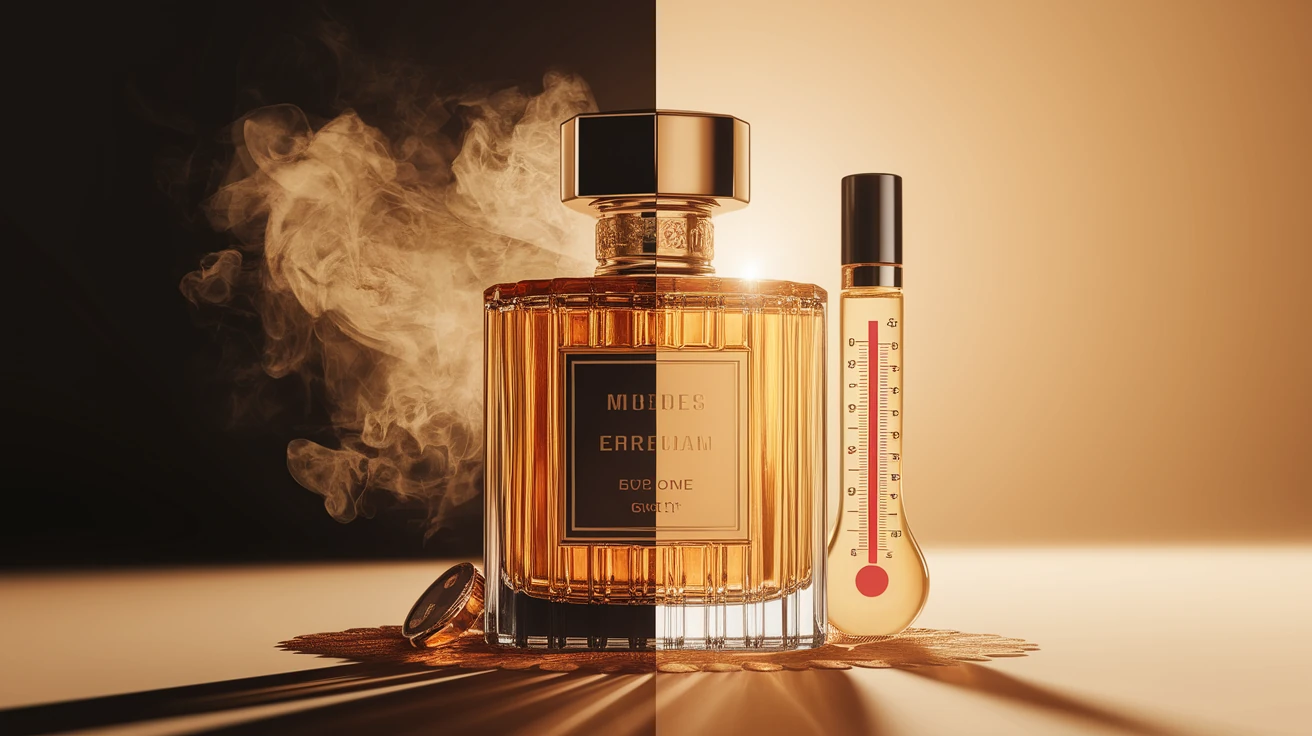
Bought Tom Ford Oud Wood in Paris. ₹18,000. Smelled incredible in the store.
Wore it in Mumbai summer. Gone in 90 minutes.
Not "subtle skin scent." Not "low projection." Gone. Like I never sprayed anything.
Called customer service. "Maybe you're nose-blind?"
No. Everyone around me confirmed: no smell. The perfume evaporated.
Turns out Tom Ford Oud Wood is formulated for European climate: 15-25°C, 50-60% humidity.
Mumbai that day: 37°C, 82% humidity.
The perfume didn't fail. It was designed for a different planet.
The Fundamental Problem: Temperature Increases Evaporation Rate
Basic chemistry: Molecular movement increases with temperature.
At 20°C (Paris), fragrance molecules evaporate at a certain rate. At 35°C (Mumbai), the same molecules evaporate significantly faster.
The general principle (based on vapor pressure thermodynamics):
- Higher temperature = higher vapor pressure = faster evaporation
- The relationship is exponential, not linear
- Each fragrance molecule has its own temperature-evaporation curve
Source: ScienceDirect - Evaporation of fragrance components using thermogravimetric analysis
European perfumes are balanced for moderate temperatures (15-25°C):
- Top notes: Last 30-45 minutes
- Heart notes: Last 3-5 hours
- Base notes: Last 8-12 hours
Same perfume at 35°C+ (Indian summer):
- Top notes: Evaporate much faster
- Heart notes: Reduced longevity
- Base notes: Shorter persistence than intended
The entire fragrance pyramid collapses in heat.
The Humidity Complication
Heat alone is challenging. Heat + humidity creates complex behavior.
Why humidity affects alcohol-based perfumes:
Ethanol (perfume base) is hygroscopic - it attracts and condenses moisture from ambient air. This creates unexpectedly complex drying behavior:
- Water condensation: Humidity causes water vapor to condense onto alcohol droplets
- Altered evaporation dynamics: As relative humidity increases, phenomena occur including enhanced spreading, changes in drying time, and formation of water-rich films around alcohol-rich drops
- Skin interaction: Temperature and humidity conditions interact with alcohol evaporation to modify fragrance behavior throughout wear time
Source: PMC - Evaporation of alcohol droplets on surfaces in moist air
Additional humidity effect: The slightly humid environment may enhance evaporation of volatile molecules, as water vapor can interact with the molecules, allowing them to move more freely into the air.
Source: PMC - Impact of fragrance molecular and skin properties on evaporation
This is why Mumbai (hot + humid) presents different challenges than Delhi (hot + dry).
Why European Brands Don't Adjust Formulas
Dior, Chanel, Tom Ford, Creed - they all formulate in France/UK.
Climate there:
- Average temp: 12-22°C
- Average humidity: 65-75%
- Rarely exceeds 28°C
They test perfumes in European conditions. Perfume lasts 8 hours? Ship it.
But that 8-hour performance assumes moderate temperatures, not 35°C.
Why don't they make "India versions"?
- Cost: Would need separate R&D, testing, production lines
- Scale: Emerging markets represent smaller portion of global luxury perfume sales
- Brand consistency: "Dior Sauvage should smell the same everywhere"
So they ship the same formula worldwide and accept that it performs differently in hot climates.
That's why Indian customers complain "perfumes don't last here."
They're right. Because perfumes aren't designed for here.
Climate-Specific Formulation Principles
At House of Sultan, we formulate for 30-38°C with high humidity (70-85%).
Not Europe. India.
Here are the general principles for hot-climate perfume formulation:
1. Emphasize Base Notes Over Top Notes
Top notes evaporate rapidly in heat regardless. Loading excessive amounts of light citrus molecules is wasteful.
General hot-climate approach:
- Reduce concentration of very light top notes (MW <150 g/mol)
- Maintain sufficient top notes for initial impression
- Increase proportion of base notes (MW >220 g/mol)
Result: Less investment in molecules that evaporate before anyone fully experiences them.
Source principle: How to Choose Summer Perfume for Hot Weather
2. Prioritize High Molecular Weight Ingredients
Heavy molecules resist heat better.
Ingredients with molecular weight >200 g/mol have lower vapor pressure and evaporate slower even at elevated temperatures:
- Sandalwood (santalol: 220 g/mol)
- Oud (sesquiterpenes: 204-220 g/mol)
- Amber (labdanum compounds: 250-306 g/mol)
- Patchouli (patchouli alcohol: 222 g/mol)
These molecules maintain stability even at 35°C because their higher molecular weight correlates with higher boiling points and lower vapor pressure.
Source: PMC - Fragrance molecular properties and evaporation
European perfumes may use moderate amounts of base notes; hot-climate formulations benefit from emphasizing these heavier molecules.
3. Consider Fragrance Concentration
In hot weather, lighter formulations like eau de toilette (EDT) or eau de cologne (EDC) may feel less overwhelming initially, but may also fade faster.
The trade-off:
- Lighter concentration: Less intense, more comfortable in heat, shorter longevity
- Higher concentration (EDP): More intense, can feel heavy in heat, better longevity
Our approach: We use EDP concentration (15-20% fragrance oil) designed with heat-resistant base notes for balanced performance.
Source: Choosing Summer Perfume for Hot Weather
4. Use Fixatives Strategically
Fixatives are heavy molecules (MW 220-400 g/mol) that slow evaporation of lighter molecules.
Industry fixative usage:
- Typical range: 3-5% of formula
- Can extend up to 10-20% for enhanced longevity (though they have strong distinct odors)
- Common fixatives: Ambroxan (MW 236), ISO E Super (MW 234), various musks
IFRA guidelines:
- ISO E Super: Allowed up to 20% in finished product, average industry use ~3%
- Ambroxan: No IFRA restriction, average industry use ~0.1% (though some formulas use up to 10%+)
Source: Alpha Aromatics - Fragrance Fixatives and Basenotes - Ambroxan usage levels
Fixatives "anchor" the formula, slowing evaporation even in heat. For hot climates, strategic fixative use enhances longevity.
5. Account for Urban Air Quality
Indian cities often have elevated air pollution with particulate matter and oxidizing compounds.
How this affects perfume:
- Fragrances are subjected to volatilization, photolysis, and reaction with oxidation agents (O₃, OH, Cl, and NO₃ radicals)
- Terpenes (common in citrus notes) react with ozone to generate formaldehyde and ultrafine particles
- Terpenes react with nitrogen oxides outdoors to generate ozone and secondary organic aerosols
- Formation of secondary organic aerosols (SOAs) from limonene oxidation affects fragrance character
Source: Springer - Fragrance Emissions and Air Quality Impact
These oxidation reactions can cause perfume to smell "metallic" or "dirty" faster in polluted urban environments.
While we can't completely prevent environmental oxidation, formulations can minimize reactive terpenes and incorporate molecules more resistant to oxidation.
Why Citrus Perfumes Struggle in Indian Summer
Citrus molecules (limonene, linalool) are among the most heat-sensitive fragrance ingredients.
Limonene (bergamot, lemon, orange):
- Molecular weight: 136 g/mol (very light)
- Boiling point: 176°C
- High vapor pressure at elevated temperatures
- Evaporates rapidly at 35°C+
Source: PMC - Fragrance molecular properties
This is why "fresh citrus" perfumes (Acqua di Gio, Versace Dylan Blue, Dior Homme Sport) often disappoint in Indian heat.
If a perfume is heavily citrus-dominant (40-50% citrus notes), most of that evaporates in the first hour at high temperatures.
Hot-climate citrus strategy:
- Reduce pure citrus concentration
- Supplement with longer-lasting citrus-like molecules (citral, linalyl acetate)
- Support with substantial base notes
Result: Fresh citrus character without complete evaporation.
The Skin Chemistry Factor in Heat
Hot skin produces more oil (for most people). Oily skin changes perfume development.
On oily skin:
- Fragrance molecules dissolve into skin oils
- Some molecules get "trapped" (can extend longevity)
- Others may react with skin oils (can alter smell)
In heat:
- Increased skin oil production
- Perfume + skin oil + heat = complex chemical interactions
- Some perfumes may smell sour/metallic/rancid (oxidation reactions)
Source principle: PMC - Skin properties and fragrance evaporation
This is why testing on both neutral substrates (tissue/blotter) and actual skin in hot conditions matters.
Tissue = objective longevity measurement Skin = real-world performance validation
If a formula smells great on tissue but develops unpleasant notes on hot skin, reformulation is needed.
When European Perfumes Work in India
Some European fragrances actually perform reasonably well in Indian heat:
1. Heavy orientals:
- Tom Ford Tobacco Vanille
- Dior Ambre Nuit
- Yves Saint Laurent La Nuit de L'Homme
Why? High proportion of base notes (60-70%+). Designed to be heavy, warm, long-lasting anyway.
2. Pure oud fragrances:
- Tom Ford Oud Wood (despite variable experiences, oud is inherently heavy)
- Creed Royal Oud
- Montale Black Aoud
Why? Oud has high molecular weight. Naturally resists heat-accelerated evaporation.
3. Synthetic-heavy fragrances:
- Dior Sauvage
- Bleu de Chanel
- Paco Rabanne Invictus
Why? Ambroxan, ISO E Super, and synthetic musks have excellent longevity in any climate.
But these are exceptions. Many European fragrances fade faster in Indian heat than in their intended climate.
Recommended Wearing Strategy for India
Summer (March-June, 35-42°C):
- Citrus perfumes will evaporate very quickly
- Heavy orientals, ouds, ambers perform better
- Applying to clothes helps (fabric holds scent longer than hot skin)
- May need additional sprays to account for faster evaporation
Monsoon (July-September, 28-35°C + 80-90% humidity):
- Avoid very heavy florals (humidity can make them feel cloying)
- Fresh woody scents (cedar, vetiver) work well
- Apply to clean, dry skin for better adherence
- Store perfume properly (humidity can damage bottles over time)
Winter (November-February, 18-28°C):
- Most perfumes perform well (closer to European climate)
- Floral and citrus fragrances shine
- Standard application works
Year-round for AC offices:
- Interior AC environments (~22-24°C) approximate European conditions
- European perfumes work fine indoors
- Challenge: Step outside and temperature shock accelerates evaporation
This is why formulating for outdoor conditions (not just AC comfort) matters in India.
What This Means For You
If you live in India and buy European luxury perfumes:
- Expect potentially shorter longevity than advertised (designed for 20°C, not 35°C)
- Citrus-heavy fragrances may disappoint in summer
- Heavy orientals, ouds, and synthetic-heavy fragrances perform better in heat
- Or...
Buy perfumes formulated WITH hot climate in mind.
We don't make perfumes in Paris and hope they work in Mumbai.
We formulate specifically for Indian conditions, emphasizing heat-resistant base notes, using fixatives strategically, and testing at elevated temperatures.
Every batch passes the 24-hour tissue test at room temperature AND at elevated temperature before approval.
Climate matters. Chemistry doesn't care about brand prestige.
₹18,000 Tom Ford or ₹1,199 House of Sultan - if the formula isn't optimized for 35°C + high humidity, it won't perform as intended.
We design for the climate you actually live in.
That's the difference.
References
This article uses verified information from:
Temperature & Evaporation Science:
- ScienceDirect - Evaporation of fragrance components using thermogravimetric analysis
- PMC - Exploring the impact of fragrance molecular and skin properties on evaporation
Humidity Effects:
- PMC - Evaporation of alcohol droplets on surfaces in moist air
- PNAS - Evaporation of alcohol droplets in moist air
Fixatives & Formulation:
Hot Climate Recommendations:
- Smytten - How to Choose Summer Perfume for Hot Weather
- PARFUM.AE - Best Perfumes for Hot and Humid Climates
Air Quality Effects:
This isn't guesswork. This is documented fragrance chemistry and thermodynamics.
Learn about molecular weight →
Shop climate-optimized perfumes →
References
- PMC (2023). 'Evaporation of alcohol droplets on surfaces in moist air'
- PMC (2025). 'Exploring the impact of fragrance molecular and skin properties on the evaporation profile of fragrances'
- ScienceDirect (2002). 'Evaporation of the fragrance component, cinnamyl alcohol, using simultaneous TG–DTA'
- Alpha Aromatics (2024). 'Fragrance Fixatives - The Key To Longer Lasting Fragrances'
- Springer (2023). 'Fragrance Emissions into the Air and Their Impact on Air Quality and Human Health'

About Syed Asif Sultan
Founder of House of Sultan. Passionate about bringing premium, climate-optimized fragrances to India at honest prices.