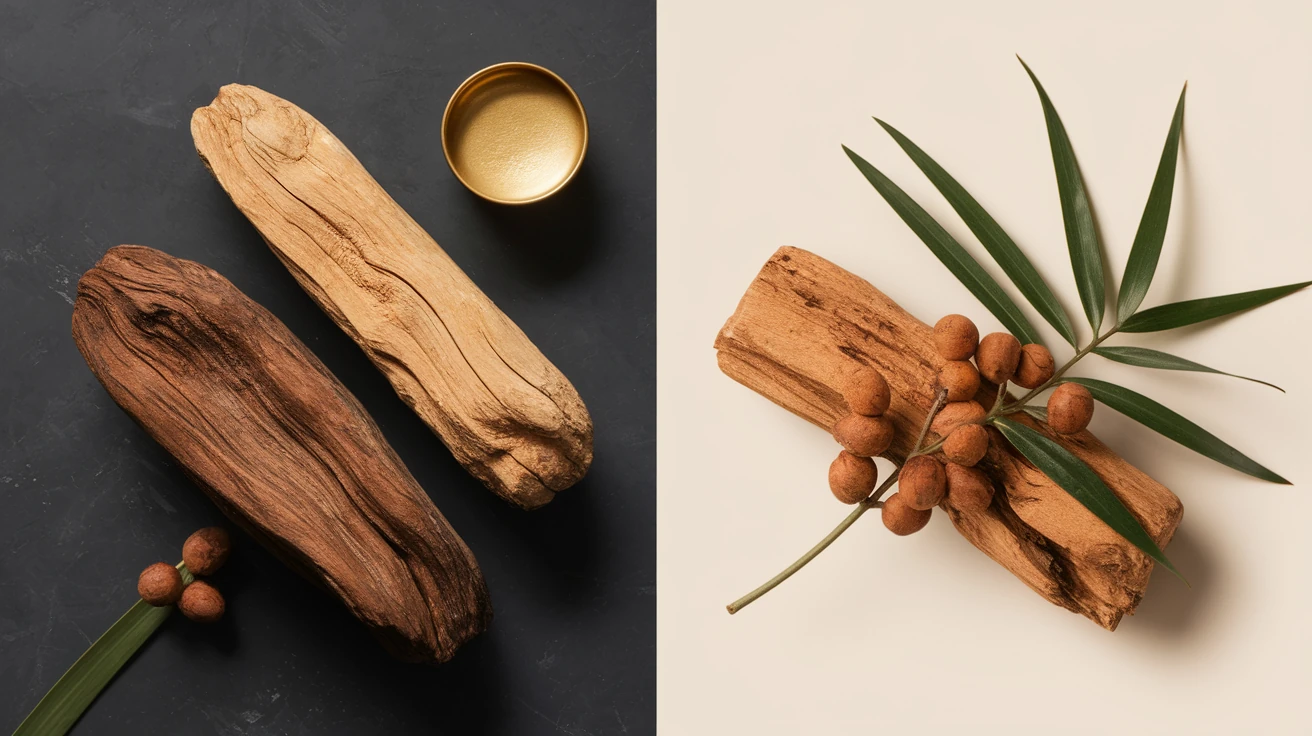
Customer: "I want REAL sandalwood perfume. None of that Australian substitute."
Me: "Genuine Indian Mysore sandalwood?"
Customer: "Yes! Only the best."
Me: "That's heavily restricted. Most sources are either illegal, old limited stock, or actually Australian labeled as Indian."
Customer: "...What?"
Indian Mysore sandalwood (Santalum album) is endangered and heavily regulated. Here's what actually matters: sustainability, legality, and performance.
The Sandalwood Species Breakdown
"Sandalwood" isn't one tree. Multiple species exist, each with different characteristics and legal status.
Santalum album (Indian/Mysore sandalwood):
- Origin: South India (Karnataka, Tamil Nadu)
- Status: Vulnerable (conservation restrictions)
- Legal status: Harvesting heavily regulated by Indian government
- Smell: Creamy, rich, slightly sweet, woody
- Key molecule: α-Santalol (high concentration in quality oil)
- Problem: Limited legal supply, high price, sustainability concerns
Santalum spicatum (Australian sandalwood):
- Origin: Western Australia
- Status: Cultivated in plantations, sustainable supply
- Legal status: Fully legal with proper plantation certification
- Smell: Drier, more citrus-woody notes, less creamy than Indian
- Key molecule: α-Santalol (lower concentration than Indian)
- Benefit: Sustainable, legal, consistent supply
Santalum austrocaledonicum (Pacific/New Caledonian sandalwood):
- Origin: New Caledonia, Vanuatu, South Pacific islands
- Status: Varies by region, some areas overharvested
- Smell: Similar to Australian, varies by origin
- Note: Less common in mainstream perfumery
Amyris balsamifera (West Indian "sandalwood"):
- Origin: Caribbean, South America
- NOT TRUE SANDALWOOD (entirely different botanical family)
- Smell: Woody, but completely different chemistry from real sandalwood
- Contains different molecules (β-Eudesmol instead of α-Santalol)
- Warning: Often fraudulently sold as "sandalwood oil"
Sources: Braun et al. (2005) - Chemistry and analysis of sandalwood oils and Howes et al. (2004) - Life of Santalum album
The Molecular Difference: α-Santalol
The signature sandalwood smell comes primarily from α-santalol (molecular weight: 220.35 g/mol).
Chemical reality:
- α-Santalol creates the characteristic creamy-woody sandalwood scent
- Higher α-santalol concentration = more "classic" sandalwood character
- Lower α-santalol concentration = lighter, different woody character
Indian Santalum album oil: High α-santalol concentration (can exceed 50% in quality oil)
- Result: Very rich, creamy, "classic" sandalwood smell
Australian Santalum spicatum oil: Lower α-santalol concentration (typically 20-30%)
- Also contains other sesquiterpenes (farnesol, bergamotol, etc.)
- Result: Woody with citrus/floral undertones, less creamy
Synthetic α-santalol: Can be produced at very high purity (95-99%)
- Result: Creamy-woody but lacks natural complexity
Source: Jones et al. (2011) - Sandalwood Fragrance Biosynthesis
The difference is noticeable: Indian sandalwood's high α-santalol gives intense creaminess. Australian's lower α-santalol (plus other compounds) creates different character.
Why Indian Sandalwood Became Restricted
Historical context:
- 1920s-1980s: Indian sandalwood heavily harvested for perfumes, incense, religious use
- Mysore region (Karnataka) was world's primary source
- Trees take 15-30 years to reach maturity with valuable heartwood
- Harvested faster than natural regeneration rates
1990s-2000s: Population crisis
- Wild sandalwood populations significantly declined
- Indian government declared species under protection
- Harvesting restricted to government-controlled operations
- Export heavily regulated
Current situation:
- Most "Indian sandalwood oil" in market is either:
- From controlled government auctions (limited supply)
- Old stock (finite, not replenishable)
- Fraudulently labeled (actually Australian or other species)
- Illegal poaching still occurs (sandalwood smuggling continues)
Reality: Genuine, legally-sourced Indian Mysore sandalwood is extremely limited in commercial availability.
Our position: We prioritize sustainable, legally-sourced alternatives over restricted/problematic materials.
Australian Sandalwood: The Sustainable Solution
Western Australia has developed extensive sandalwood plantations.
How sustainable plantation sandalwood works:
- Plant Santalum spicatum (native Australian species)
- Proper plantation management (10-15 years to harvest)
- Sustainable harvesting (quotas, replanting, forest management)
- Steam distillation for oil extraction
- Legal certification (proper documentation, no endangered species issues)
Aroma profile (compared to Indian):
- Creaminess: Less than Indian (lower α-santalol)
- Woody depth: Good, but different character
- Additional notes: More citrus/floral complexity
- Overall: Different, not "worse" - depends on perfume context
Why this matters: Australian sandalwood is legally sustainable, but smells different from Indian. Perfumers must adjust formulations accordingly.
Source: Braun et al. (2005) - Chemistry and analysis of sandalwood oils
Blending Strategy: Natural + Synthetic
Pure Australian sandalwood: Sustainable but lower α-santalol concentration Pure synthetic α-santalol: High purity but lacks natural complexity
Common industry approach: Blend Australian sandalwood with synthetic α-santalol
Why this works:
- Australian oil provides natural complexity (multiple sesquiterpenes)
- Synthetic α-santalol boosts creamy character
- Result: Sustainable sourcing + good sandalwood character
- Cost: More affordable than pure Indian (if available)
This isn't "cheating": It's practical formulation using legal, sustainable materials to achieve desired aroma profile.
Our approach: We use Australian Santalum spicatum oil blended with synthetic α-santalol to create sandalwood character while maintaining sustainability and legality.
How to Identify Fake "Sandalwood"
Amyris (West Indian "sandalwood") fraud:
- Problem: Amyris balsamifera is NOT sandalwood (different botanical family)
- Chemical difference: Contains β-Eudesmol, NOT α-Santalol
- Smell: Woody, but distinctly different from true sandalwood
- Cost: Much cheaper than real sandalwood (~₹1,500-3,000/kg)
- Usage: Often sold as "sandalwood" to unsuspecting buyers
How to tell:
- Price: If "sandalwood oil" is very cheap, it's likely Amyris or synthetic
- Smell: True sandalwood (any species) has characteristic creamy-woody scent
- Labeling: Check botanical name - should be Santalum species, not Amyris
- Transparency: Reputable suppliers specify exact species (album vs spicatum)
We don't use Amyris: We use genuine Santalum spicatum (Australian sandalwood), clearly labeled.
The Synthetic α-Santalol Option
Modern chemistry can synthesize α-santalol (MW 220.35 g/mol) identical to natural.
Synthetic α-santalol characteristics:
- Chemically identical to natural α-santalol
- Very high purity (95-99% vs varying percentages in natural oils)
- Produced from sustainable precursors
- Significantly less expensive than natural sandalwood oil
Smell characteristics:
- Matches the creamy-woody sandalwood note
- Lacks the minor compounds that add complexity in natural oils
- Result: "Correct" but somewhat one-dimensional
Why blend rather than use pure synthetic: Natural sandalwood oils contain dozens of minor compounds that add depth. Combining natural Australian (for complexity) with synthetic α-santalol (for creaminess) achieves better overall character than either alone.
Why Transparency Matters
Most perfume brands don't specify sandalwood source:
- Label just says "sandalwood" (which species?)
- Don't disclose natural vs synthetic ratio
- May use Amyris and call it "sandalwood"
What we disclose:
- We use Australian Santalum spicatum (not restricted Indian)
- Blended with synthetic α-santalol (for enhanced character)
- No Amyris (not true sandalwood)
- Sustainably sourced, properly certified
Why this matters: You deserve to know what you're actually getting, not vague "sandalwood" claims.
Indian Sandalwood Plantation Attempts
India has attempted to revive Mysore sandalwood through government plantations.
Challenges:
- Slow growth: 15-30 years to harvest-ready trees
- Hemiparasitic nature: Sandalwood is semi-parasitic, needs host plants
- Theft: High value leads to illegal harvesting from plantations
- Limited yield: Only heartwood contains valuable santalol
Current state:
- Small amounts of plantation Indian sandalwood exist
- Supply insufficient for global demand
- Price remains very high
- Availability inconsistent
Future outlook: May take decades before plantation Indian sandalwood becomes widely commercially available at accessible prices.
Until then: Sustainable alternatives (Australian plantation, Australian + synthetic blends) are the practical solution.
What This Means For You
Indian Mysore sandalwood is the historical "gold standard," but:
- Supply: Extremely limited legally
- Price: Prohibitively expensive
- Sustainability: Problematic if not properly sourced
- Availability: Mostly restricted
Practical options:
- Pay premium prices for limited legal Indian sandalwood (if available)
- Accept Australian sandalwood's different character (sustainable)
- Use blends (Australian + synthetic α-santalol)
Our choice: #3 - Sustainable Australian sandalwood enhanced with synthetic α-santalol for balanced character and performance.
Why:
- Fully sustainable ✓
- Fully legal ✓
- Good sandalwood character ✓
- Accessible pricing ✓
- Transparent sourcing ✓
Chemistry and sustainability can coexist. Australian + synthetic blend delivers sandalwood character without endangering forests or breaking regulations.
How to Evaluate Sandalwood Claims
Questions to ask perfume brands:
- "Which sandalwood species do you use?"
- "Is it Indian album, Australian spicatum, or other?"
- "Do you blend natural and synthetic?"
- "Can you verify sustainable/legal sourcing?"
Red flags:
- Won't specify species
- Claims "Indian sandalwood" at low price
- Vague about sourcing
- Can't provide documentation
Green flags:
- Clearly states species (Santalum album or spicatum)
- Transparent about natural/synthetic blends
- Can document sustainable sourcing
- Realistic pricing
We answer all these questions: Australian Santalum spicatum + synthetic α-santalol, sustainably sourced, fully documented.
References
This article uses verified information from:
Sandalwood Chemistry:
- Jones, C.G., et al. (2011). 'Sandalwood Fragrance Biosynthesis Involves Sesquiterpene Synthase' - The Plant Cell
- Braun, N.A., et al. (2005). 'Chemistry and analysis of sandalwood oils' - Flavour and Fragrance Journal
Sustainability & Conservation:
This isn't marketing spin. This is documented botany, chemistry, and conservation science.
Understand our formulation approach →
See our sourcing transparency →
Shop sustainably-sourced perfumes →
References
- Jones, C.G., et al. (2011). 'Sandalwood Fragrance Biosynthesis Involves Sesquiterpene Synthase.' The Plant Cell, 23(12), 4472-4486.
- Braun, N.A., et al. (2005). 'Chemistry and analysis of sandalwood oils.' Flavour and Fragrance Journal, 20(1), 3-12.
- Howes, M.J.R., et al. (2004). 'An account of the life of Santalum album (East Indian sandalwood).' Journal of Ethnopharmacology, 93(2-3), 231-236.

About Syed Asif Sultan
Founder of House of Sultan. Passionate about bringing premium, climate-optimized fragrances to India at honest prices.