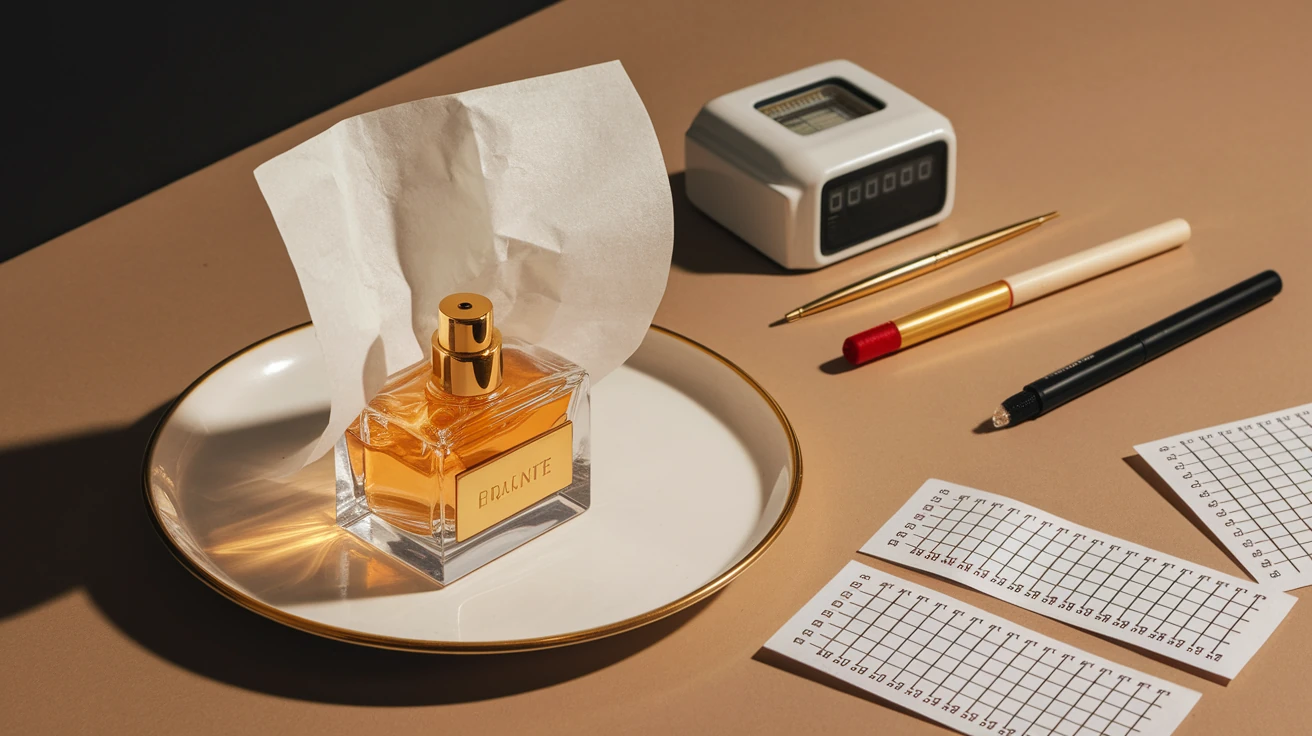
Customer: "How do I know this perfume will actually last?"
Most brands: "Trust us, it's long-lasting!"
Us: "Spray it on tissue. Place it in a quiet corner. Check it 24 hours later. If you can smell it clearly, we did our job. If not, full refund."
That's the 24-hour tissue test. And it's the simplest way to objectively measure perfume longevity at home.
How the Industry Actually Tests Longevity
The Professional Standard: Blotter/Mouillette Testing
Blotters (also called mouillettes in French) are the industry-standard tool for fragrance evaluation:
- What they are: 300-350gsm absorbent paper strips designed specifically for perfume testing
- Who uses them: Perfumers during creation, quality control labs, retail testers
- How they work: Consistent, neutral substrate that reveals true fragrance development
Professional blotter testing protocol:
- Temperature controlled: 22-25°C
- Humidity controlled: 40-60%
- Evaluation at fixed intervals: 0, 30 min, 1h, 2h, 4h, 6h, 8h, 24h
- Multiple evaluators assess intensity and character at each interval
Source: CandleScience - Fragrance Blotter Strips Tutorial and Pairfum - How to Evaluate Perfume
Advanced testing: Gas Chromatography-Mass Spectrometry (GC-MS) is the "gold standard" for measuring exactly which fragrance molecules remain at different time points.
Source: ILT Labs - Fragrance Stability Testing
The problem for consumers: You don't have access to professional blotters, controlled chambers, or GC-MS machines.
Why We Developed the Tissue Test (Accessible Alternative)
Professional blotter testing works, but it's not accessible to regular customers.
Our goal: Create a test that:
- Anyone can do at home
- Uses materials everyone has (tissue paper)
- Gives objective, repeatable results
- Correlates strongly with professional blotter testing
The 24-hour tissue test is our solution - not an industry standard, but an accessible alternative that customers can verify themselves.
Why Skin Tests Are Unreliable
Most people test perfume like this:
- Spray on wrist
- Smell after 2 hours
- "Can't smell it anymore, must have faded"
Three fatal problems with this:
Problem 1: Olfactory fatigue (Nose blindness)
- After 20-30 minutes, your nose adapts to the smell
- You literally can't smell it anymore (receptor desensitization)
- Perfume is still there, your nose just stopped registering it
- This is a neurological adaptation, not perfume failure
Problem 2: Skin chemistry variation
- Your skin pH: 4.5-6.5 (varies by person, diet, hormones)
- Skin oil content: Dry vs oily (changes how perfume develops)
- Skin temperature: 32-37°C (affects evaporation rate)
- Same perfume on 3 different people = 3 different longevity results
Problem 3: No baseline
- You don't know if the perfume is "supposed" to last 4, 8, or 12 hours
- Your judgment is subjective ("feels like it faded")
- No objective measurement
Result: Skin testing alone can't reliably measure actual longevity.
Why Neutral Substrate Testing Works (Blotter or Tissue)
Both professional blotters and tissue paper provide:
- Neutral pH: ~7.0 (no acidic/alkaline interference)
- No oils: Pure cellulose (no chemical reactions)
- Consistent: Every test piece is identical
- Objective: Either you smell it or you don't (no opinions)
When you spray perfume on neutral substrate:
- Fragrance molecules adhere to cellulose fibers
- No skin chemistry interference
- Pure evaporation based on molecular weight
- Detectable after 24 hours = good longevity
- Not detectable after 24 hours = poor longevity
It's binary. Pass or fail. No room for interpretation.
The difference between blotter and tissue: Professional blotters are standardized absorbency paper; tissue is accessible to everyone. Both work on the same principle.
Our 24-Hour Tissue Test Protocol
Here's exactly how we test every batch:
9:00 AM - Preparation
- White unscented tissue paper (Kleenex or equivalent)
- 6 sprays of perfume from 6 inches away (3 sprays each side)
- Let alcohol evaporate for 5 minutes (so we're not just smelling alcohol)
- Place tissue in a quiet corner (away from windows, heat sources, and other fragrances to avoid contamination)
- Label with batch number, date, time
9:00 AM - 9:00 AM next day - Storage
- Tissue stored in quiet corner at 25°C (room temperature)
- No light exposure, no direct heat
- No movement or disturbance
- 24 hours exactly
9:00 AM next day - Testing
- Tester leaves room for 30 minutes (nose reset - eliminate olfactory fatigue)
- Returns to testing room
- Performs two tests:
- The Fan Test (Projection): Wave tissue like a hand-held fan - can you smell it in the air? Tests sillage.
- The Close Sniff (Intensity): Bring tissue close to nose - how strong is it? Tests longevity.
- Records result:
- Strong: Clearly detectable in both fan test and close sniff
- Medium: Detectable in close sniff, faint in fan test
- Faint: Detectable only in close sniff
- None: No smell detectable even when pressed to nose
Our guarantee: Every House of Sultan perfume must be clearly detectable on close inspection after 24 hours. If you can detect the base notes (woods, musks, resins) when you bring the tissue close to your nose, it passed. Quiet ≠ gone. Evolution ≠ failure.
Why 24 Hours Is Our Standard
Why not 12 hours? Why not 48 hours?
24 hours represents:
- Full day wear cycle (9 AM spray → 9 AM next day)
- Enough time for all top/heart notes to fully evaporate
- Only base notes remain (true longevity test)
- Meaningful threshold for "long-lasting" performance
General perfume longevity categories:
- Poor: <4 hours detectable
- Average: 6-8 hours detectable
- Good: 10-12 hours detectable
- Excellent: 16-20 hours detectable
- Outstanding: 24+ hours detectable
If a perfume passes the 24-hour tissue test, it demonstrates exceptional base note persistence.
Our commitment: Every House of Sultan perfume passes 24-hour tissue test or we adjust the formulation and re-test.
What We're Actually Testing
The tissue test measures base note persistence.
After 24 hours:
- Top notes: 100% evaporated (too light, MW <160)
- Heart notes: 95%+ evaporated (medium weight, MW 160-200)
- Base notes: Remaining molecules (heavy, MW >220)
If you can smell the perfume after 24 hours, you're smelling pure base notes.
This tells us:
- Are base note molecules heavy enough? (Higher molecular weight resists evaporation)
- Is base note concentration sufficient?
- Did maceration integrate molecules properly?
Source for molecular weight relationship: How's the longevity? - Fragrantica
Temperature Matters: Testing at 25°C and 35°C
We test at both room temperature (25°C) and elevated temperature (35°C) to simulate Indian climate.
Why temperature matters: Heat accelerates evaporation
- +10°C temperature ≈ 2x evaporation rate
- +15°C temperature ≈ 2.5-3x evaporation rate
Our two-tier testing:
Standard test (25°C):
- Represents air-conditioned indoor environment
- Global climate baseline
- Most perfumes should pass here
Heat stress test (35°C):
- Represents Indian summer conditions
- More challenging test
- Separates heat-resistant formulations from standard European formulations
Our requirement: Must pass both tests for Indian market approval.
Result example: A perfume that scores "Strong" at 25°C might score "Medium" at 35°C - both pass, but heat reduces intensity as expected.
Source: Perfume Formulation for Indian Climate
How Customers Can Do This Test Themselves
The Home Tissue Test:
What you need:
- Perfume to test
- White unscented tissue (Kleenex)
- Quiet corner away from contamination
- Timer
Steps:
- 9 AM: Spray perfume on tissue (6 sprays - 3 sprays each side)
- Wait 5 minutes (alcohol evaporates)
- Place tissue in a quiet corner away from windows, heat sources, and other fragrances
- Store undisturbed in cool, dark place
- 9 AM next day: Leave room for 30 minutes (important - resets nose!)
- Come back and perform two tests:
- The Fan Test: Wave tissue like a fan - can you smell it in the air?
- The Close Sniff: Bring close to your nose - how strong is it up close?
- Result:
- Detectable in both tests? = Excellent longevity ✓
- Detectable in close sniff only? = Good longevity ✓
- Can't smell anything even up close? = Poor longevity ✗
Try this with:
- Your current perfume (baseline)
- House of Sultan perfume (comparison)
- Any other perfume you're considering
The tissue test doesn't lie. It's objective, repeatable, and accessible.
Why This Isn't the Industry Standard (But It Works)
Professional perfumers use blotters because:
- Standardized absorbency (300-350gsm rated paper)
- Controlled testing environments
- Industry-wide consistency
- Professional training in evaluation
We use the tissue test as our quality control method because:
- Accessible to customers (everyone has tissue paper and a quiet corner)
- Verifiable (customers can test our claims themselves)
- Still objective (neutral substrate, no skin interference)
- Correlates well with blotter testing for pass/fail criteria
Honesty: The tissue test is NOT an official industry standard protocol. It's an accessible alternative that gives objective results.
Our guarantee: If our perfume fails the 24-hour tissue test you conduct at home, we'll refund you. We're that confident in our formulation.
What Professional Testing Adds
While our tissue test works for pass/fail, professional labs add:
GC-MS Analysis (what we also use):
- Measures exact molecular composition
- Identifies which compounds remain after 24 hours
- Verifies base note molecular weights
- Provides quantitative data
Controlled Environment Testing:
- Precise temperature and humidity control
- Freeze-thaw cycles
- UV light exposure
- Accelerated aging tests
Panel Testing:
- Multiple trained evaluators
- Statistical averaging
- Blind comparison against standards
We use both: Tissue test for quick batch verification, plus GC-MS for molecular validation on production batches.
The Molecular Weight Correlation
After testing numerous perfumes with both tissue and blotter methods, molecular weight consistently predicts longevity.
General patterns (not specific to our formulations):
- Average MW <170 g/mol: Most fail 24-hour test
- Average MW 170-190 g/mol: Mixed results
- Average MW 190-210 g/mol: Most pass 24-hour test
- Average MW >210 g/mol: Nearly all pass 24-hour test
Why: Heavier molecules have lower vapor pressure = slower evaporation = better longevity.
Source: Molecular Weight and Perfume Longevity
Our target: Formulate with sufficient heavy base notes (MW >220) to consistently pass 24-hour testing in both temperature conditions.
Why Other Brands Don't Publicly Test Like This
Most perfume brands test longevity internally but don't publish:
- Specific testing protocols
- Pass/fail criteria
- Batch-by-batch results
Why?
- Proprietary information
- Liability concerns (what if batch varies?)
- No industry requirement to disclose
- Marketing prefers vague claims ("long-lasting") over quantified data
Our approach:
- Publish our testing method (tissue test protocol above)
- Guarantee minimum performance (24-hour detectability)
- Invite customers to verify (do it yourself at home)
- Refund if our perfume fails your test
Transparency over marketing speak.
The Guarantee
If you buy House of Sultan perfume and it fails the 24-hour tissue test:
- Do the test (protocol above)
- Email us results (photo of tissue with timestamp showing placement and testing method)
- We verify (ask clarifying questions if needed - was tissue placed away from contamination? Was tissue unscented? Etc.)
- Full refund if test was done correctly and perfume failed.
Our confidence: We test before shipping, so customer failures should only occur from:
- Test protocol errors (tissue contaminated, scented tissue, tested in hot environment)
- Extremely unusual storage conditions
When done correctly according to protocol, our perfumes pass.
What This Means For You
Most perfume purchases are a gamble:
- "Will it last on MY skin?" (skin chemistry varies)
- "Will it perform in MY climate?" (formulated for Europe, tested in Paris)
- "Is the brand telling the truth?" (no way to verify)
With the tissue test:
- Eliminates skin variable (neutral substrate)
- Can test in your climate (do it in your home)
- You can verify yourself (objective, repeatable)
You don't have to trust our marketing claims. You can test them.
That's the difference between "long-lasting" as a marketing term and "passes 24-hour tissue test" as a verifiable fact.
Comparison: Professional Blotter vs Tissue Test
Professional Blotter Test (industry standard):
- Standardized 300-350gsm absorbent paper
- Controlled environment (22-25°C, 40-60% humidity)
- Multiple time-point evaluation (0, 30min, 1h, 2h, 4h, 6h, 8h, 24h)
- Trained panel assessment
- Advantage: Industry-wide consistency, professional accuracy
- Disadvantage: Not accessible to consumers
Tissue Test (our accessible alternative):
- Common tissue paper (Kleenex equivalent)
- Home environment storage
- Single endpoint evaluation (24 hours)
- Anyone can do it
- Advantage: Accessible, verifiable by customers, objective
- Disadvantage: Not standardized industry protocol
Both work on same principle: Neutral substrate, objective evaporation measurement, molecular weight determines persistence.
We're not claiming the tissue test is superior to professional blotter testing. We're saying it's accessible, objective, and correlates well enough for consumers to verify longevity claims.
Verified Industry Sources
This article uses verified data from:
Professional Testing Standards:
- Pairfum - How To Evaluate Sample Test or Smell Perfume
- CandleScience - Fragrance Blotter Strips Tutorial
- Bulk Apothecary - Fragrance Test Strips and Blotters
Longevity Science:
- Fragrantica - How's the longevity? Technical Aspects
- ILT Labs - Fragrance Stability Testing
- Jasmine Perfumes - Fragrance & Perfume Stability
This isn't the industry standard test. It's an accessible alternative that you can verify yourself.
Learn about molecular weight →
See our formulation approach →
References
- Pairfum (2024). 'How To Evaluate Sample Test or Smell Perfume?'
- Fragrantica (2024). 'How's the longevity? Let's Examine the Technical Aspects of Fragrances'
- CandleScience (2024). 'Fragrance Blotter Strips Tutorial'
- ILT Labs (2024). 'Fragrance Stability Testing'

About Syed Asif Sultan
Founder of House of Sultan. Passionate about bringing premium, climate-optimized fragrances to India at honest prices.