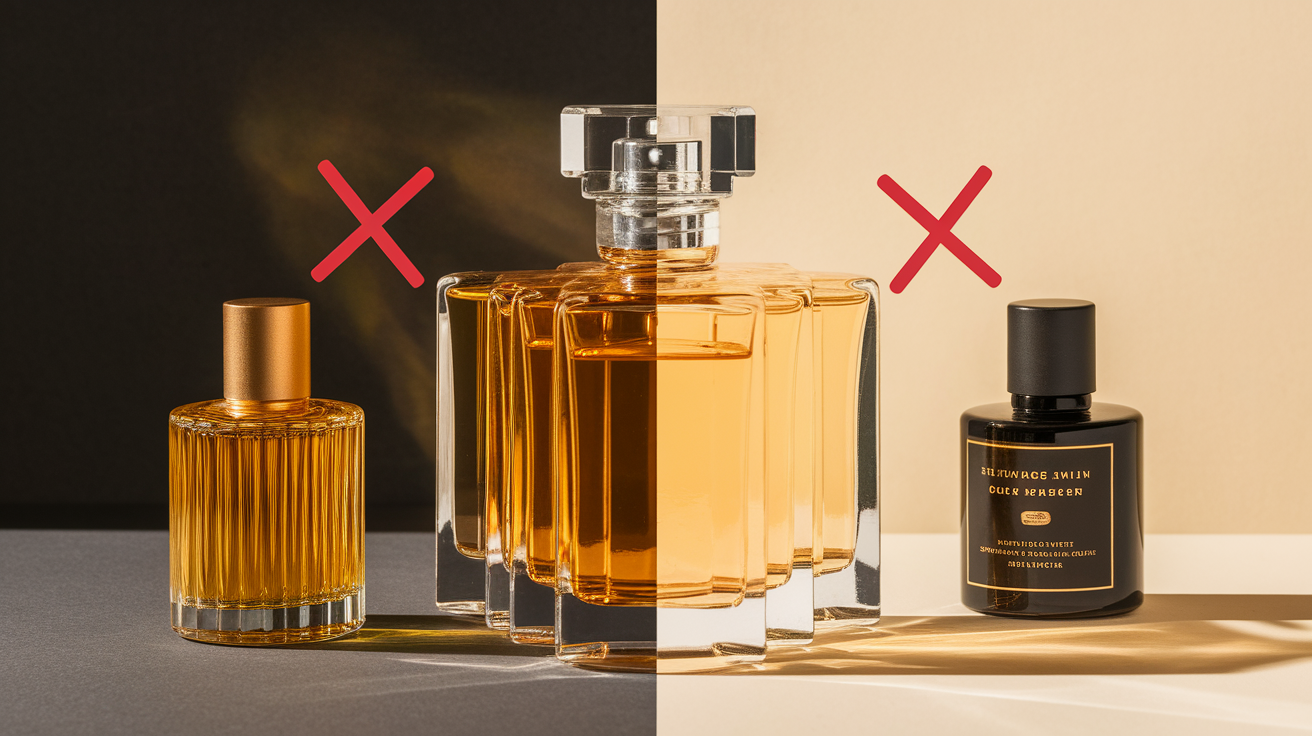
"Should I keep my perfume in the fridge to make it macerate faster?"
I get this question at least twice a week.
The answer surprises people: putting your perfume in the fridge won't improve it. In fact, it might ruin it completely.
And it's not just refrigerator storage. Water baths, shaking bottles daily, leaving them open to "breathe" - I've seen people try everything to "speed up maceration" of perfumes they just bought.
Here's what actually happens when you use these popular methods. Spoiler: none of them work the way you think.
What Maceration Actually Requires
Before we debunk the myths, let's understand what maceration actually is.
Maceration is the process where perfume oils and alcohol molecules reach chemical equilibrium - the heavy aromatic molecules (like oud, amber, musk) fully dissolve into the alcohol carrier.
This happens at the molecular level through:
- Dissolution: Large aromatic molecules slowly diffusing into alcohol
- Integration: Different fragrance components forming stable associations
- Subtle oxidation: Controlled reactions that create new aromatic compounds
What this process needs:
- Consistent cool temperature (15-20°C)
- Complete darkness (UV destroys aromatic molecules)
- Sealed environment (prevents evaporation and contamination)
- Time (4-8 weeks minimum for professional maceration)
Source: Poucher's Perfumes, Cosmetics and Soaps - Butler, 2000
Notice what's NOT on that list: refrigeration, heat, agitation, or air exposure.
Does Perfume Maceration in Fridge Work?
No. Refrigerator storage does not accelerate maceration—it prevents it.
Cold temperatures (4-5°C) slow molecular movement, preventing the heavy aromatic molecules from dissolving into alcohol. Maceration requires 15-20°C for proper molecular integration.
What happens when you macerate perfume in fridge:
- ❌ Molecular kinetic energy drops → dissolution slows to near-zero
- ❌ Temperature cycling (cold → warm → cold) causes condensation
- ❌ Phase separation: oils precipitate from alcohol (cloudiness)
- ❌ Reversible haze forms as ingredients become insoluble
Proper maceration temperature: 15-20°C (cool room temperature, NOT refrigerated)
Bottom line: Fridge storage stalls the chemistry you want while introducing new problems (condensation, phase separation, thermal stress).
The Myths That Destroy Your Perfume
MYTH #1: Refrigerator Storage Accelerates Maceration
THE TRUTH: Cold temperatures actually prevent maceration, not accelerate it.
The Science: Maceration requires molecular movement. At refrigerator temperatures (4-5°C), molecular kinetic energy drops dramatically. The dissolution of heavy base notes into alcohol slows to nearly zero.
Professional maceration happens at 15-20°C - cool enough to prevent degradation, warm enough for molecular integration.
What Actually Happens: Every time you open your fridge, your perfume experiences temperature fluctuations. Warm to cold, cold to warm. This thermal cycling causes:
- Condensation inside the bottle (introducing water droplets)
- Phase separation (oils separating from alcohol)
- Crystallization of some fragrance components (permanent alteration)
A perfume stored at 30°C degrades roughly twice as fast as one stored at 20°C. But refrigeration below 10°C doesn't improve anything - it just stalls the chemistry you actually want.
The Real Danger: Temperature fluctuations are more damaging than consistent heat. Your perfume experiences more stress cycling between 4°C and 25°C twice daily than sitting at constant 20°C.
Sources:
- Understanding Temperature in Perfume Storage - Aroma Explorer
- Should we keep perfume in the fridge? - The National
Cold Storage, Cloudiness & Misunderstood Maceration
"My perfume turned cloudy after being in the fridge. Is the maceration working?"
No. That's not maceration - that's reversible haze from cold temperatures.
Here's what people often confuse with maceration:
When Your Perfume Goes Cloudy From Cold
You put your perfume somewhere cold (fridge, AC room, cold car). It turns milky or cloudy. You think: "The ingredients are mixing! It's macerating!"
Actually: The ingredients are precipitating - coming out of solution because cold temperatures lower solubility.
What's really happening:
- Natural oils, musks, and resins become less soluble when cold
- They form tiny droplets suspended in the alcohol (cloudiness)
- This is a physical change, not a chemical one
- It reverses when you warm the perfume back to room temperature
This isn't damage. It's not maceration. It's just phase separation.
Learn more: Why Perfume Turns Cloudy in Cold Weather (Reversible Haze Explained)
"Is My Cloudy Perfume Ruined?"
If your perfume stayed cloudy after refrigeration, you're probably panicking.
Don't. Most cloudiness is completely reversible.
Quick test:
- Move perfume to room temperature (20-25°C)
- Wait 6 hours
- Check if it cleared up
If it cleared: You had reversible haze. Your perfume is fine.
If it didn't: You might have crystallization (usually harmless) or actual degradation (check the smell).
Complete guide: Is Cloudy Perfume Ruined? How to Fix Cold-Induced Haze Safely
About That Shaking...
"I saw bubbles after shaking. Does that mean it's aerating and macerating?"
No. Those bubbles are introducing oxygen. Oxygen causes oxidation. Oxidation degrades your perfume.
Maceration requires time and chemical equilibrium - not mechanical agitation.
The truth about shaking: Does Shaking Perfume Ruin It? Oxidation, Bubbles & Chemistry Explained
Crystals and Particles: Quality or Problem?
Sometimes you'll see actual crystals or sediment in perfume - especially natural/niche brands.
This isn't necessarily bad. Often it's a sign of real natural ingredients, minimal filtering, and authentic formulation.
How to tell if it's normal or problematic:
- Normal: Perfume smells fine, only visual change, niche/artisanal brand
- Problem: Off smell + color change + crystals all together
Deep dive: Perfume Crystallization Explained: Sediment, Separation & Stability
MYTH #2: Water Baths Speed Up Integration
THE TRUTH: Heating perfume in water baths destroys delicate aromatic molecules.
The Science: Many top and middle notes contain volatile aldehydes and esters that are heat-sensitive. At temperatures above 30°C, these compounds begin degrading.
Research shows that citrus aldehydes can lose up to 40% potency when exposed to heat (30-40°C) for extended periods. Delicate florals (jasmine, rose) undergo thermal degradation at similar temperatures.
What Actually Happens: When you place a perfume bottle in warm water (even "lukewarm" 35-40°C):
- Volatile top notes evaporate faster inside the sealed bottle (creating pressure)
- Alcohol expands (potentially leaking past the spray mechanism)
- Heat-sensitive molecules undergo unwanted chemical reactions
- "Cooked" off-notes develop (burnt wood instead of aged sandalwood)
The Real Danger: You're accelerating the exact degradation reactions that proper maceration is designed to prevent. Controlled maceration prevents oxidation. Heat baths accelerate it.
Source: The Chemistry of Fragrances - Sell, 2006
MYTH #3: Shaking Bottles Daily Helps Integration
THE TRUTH: Vigorous shaking introduces oxygen bubbles that accelerate oxidation.
The Science: Research published in International Journal of Cosmetic Science shows that oxygen exposure accelerates aldehyde degradation. Up to 40% of certain aldehydes convert into acetals after 3 months when exposed to air and heat.
Shaking creates thousands of tiny bubbles throughout the liquid. Each bubble is a reaction site for oxidation - not just at the surface, but distributed throughout the entire volume.
What Actually Happens: Professional perfumers DO gently invert bottles during maceration - but carefully, once weekly, with minimal air exposure. The goal is redistribution without aeration.
Vigorous daily shaking does the opposite:
- Introduces oxygen throughout the liquid (not just the surface)
- Creates foam (alcohol + aromatic oils don't foam naturally - this is oxidation)
- Accelerates reactions that should happen slowly over weeks
The Real Danger: You're turning controlled oxidation (which creates depth) into uncontrolled oxidation (which creates rancidity). There's a reason professional maceration vessels have minimal headspace and inert gas blankets.
Source: Chemical reactions in perfume ageing - Blakeway et al., 1987
MYTH #4: Leaving Bottles Open to "Breathe" Improves Scent
THE TRUTH: Exposure to air causes evaporation of top notes and oxidative degradation.
The Science: Perfume is designed to be a sealed system. The moment you expose it to air:
- Volatile top notes evaporate (bergamot, lemon, fresh spices - gone in hours)
- Alcohol evaporates (changing the concentration ratio of oils to carrier)
- Oxidation begins (especially damaging to citrus and floral components)
Citrus oils can lose 50% of their volatile components within 24 hours when exposed to air at room temperature. After a week, you have a completely different fragrance - and not in a good way.
What Actually Happens: Professional maceration happens in sealed vessels precisely to prevent this. The aromatic molecules need to integrate with alcohol, not evaporate into your room.
Leaving a perfume open "to breathe" is like leaving wine uncorked for a week and wondering why it tastes like vinegar.
The Real Danger: Once the volatile top notes evaporate, you can't get them back. You've permanently altered the fragrance composition. What remains is a heavy, unbalanced base that smells nothing like the original formula.
Sources:
- How Long Does Perfume Last? - Alpha Aromatics
- Perfume and Flavor Materials of Natural Origin - Arctander, 1994
MYTH #5: Sunlight or Heat Helps Maturation
THE TRUTH: UV light and heat are the two fastest ways to destroy perfume chemistry.
The Science: A study on bergamot oil (common top note) showed that UV exposure degraded 83.5% of certain volatile compounds within just a few days. Heat accelerates this exponential degradation.
Aromatic molecules contain unsaturated carbon bonds (C=C double bonds) that are extremely UV-sensitive. When UV hits these bonds:
- Photo-oxidation occurs (molecule breaks apart)
- Color changes (perfume turns darker - this is degradation, not aging)
- Off-notes develop (rancid, metallic, or plastic-like smells)
What Actually Happens: Professional perfume storage is always:
- Dark (amber or opaque bottles, closed cabinets)
- Cool (15-20°C, never above 25°C)
- Sealed (preventing both evaporation and oxidation)
Placing perfume in sunlight or warm areas does the exact opposite of everything professional maceration requires.
The Real Danger: UV degradation is irreversible. Once those molecular bonds break, the original aromatic compound is gone forever. You can't "un-oxidize" a degraded bergamot molecule.
Heat above 30°C accelerates every unwanted reaction: evaporation, oxidation, polymerization (molecules clumping together), and thermal decomposition.
Sources:
What Actually Works: Science-Backed Storage
If all those popular methods are wrong, what should you do?
The Optimal Storage Protocol:
-
Temperature: 15-20°C (cool room temperature, not refrigerated)
- Avoid temperature fluctuations
- Keep away from windows, heaters, and appliances
-
Light: Complete darkness
- Store in original box or closed drawer
- Amber/dark bottles preferred
- Never near windows or direct light
-
Air Exposure: Keep sealed
- Only open to use
- Don't decant unless necessary
- Minimize headspace (air gap at top)
-
Position: Upright storage
- Prevents seal degradation
- Minimizes alcohol contact with spray mechanism
- Reduces risk of leakage
-
Time: Patience
- Professional maceration takes 4-8 weeks
- Can't be rushed without consequences
- Molecular integration happens on its own schedule
Source: Perfumery: Practice and Principles - Calkin & Jellinek, 1994
The Indian Summer Reality: What To Do When Your Room Is 35°C
Here's the problem with "ideal storage conditions": they assume you live in a temperature-controlled environment.
In Indian summers:
- Outside temperature: 40-45°C (Delhi, Rajasthan, interior Maharashtra)
- Inside room temperature: 32-38°C (without AC)
- Inside closed drawer: 28-35°C (slightly cooler, but still hot)
So when the article says "store at 15-20°C," that's great advice - if you have central AC or live in Shimla.
For everyone else, here's the reality: you're choosing between imperfect options, not ideal ones.
Heat Damage vs Refrigerator Damage: Which Is Worse?
Let's compare what actually happens:
Constant 30-35°C storage (hot drawer in Indian summer):
- ❌ Accelerates oxidation (roughly 2x faster than 20°C)
- ❌ Volatile top notes evaporate faster
- ❌ Chemical reactions speed up
- ✅ BUT: No thermal cycling (temperature stays constant)
- ✅ No condensation
- ✅ No phase separation
Refrigerator storage (4-5°C with daily opening):
- ✅ Slows degradation when cold
- ❌ BUT: Thermal cycling 4°C → 25°C → 4°C (twice daily)
- ❌ Condensation forms inside bottle
- ❌ Some components crystallize
- ❌ Oils can separate from alcohol
- ❌ Stress from temperature fluctuations
The verdict: Constant 30°C is better than refrigerator cycling.
Research shows temperature fluctuations cause more damage than moderately elevated constant temperature. A perfume stored at stable 30°C will outlast one cycled between 4°C and 25°C twice daily.
Source: Understanding Temperature in Perfume Storage - Aroma Explorer
Practical Storage Solutions for Indian Climate
Since most people can't maintain 15-20°C year-round, here's a tiered approach:
BEST (if accessible):
- Wine cooler/beverage fridge set to 18°C (no daily access = no thermal cycling)
- AC bedroom maintained at 24-26°C (significantly better than 35°C)
- Interior bathroom cabinet (often 5-8°C cooler than other rooms, no sunlight)
GOOD (achievable for most):
- Coolest room in the house - interior rooms away from external walls
- Inside cupboard or drawer - not near windows, not in kitchen
- Tile floor storage (in sealed box) - tiles stay cooler than wood furniture
- Clay pot storage - traditional Indian cooling (evaporative cooling keeps 2-4°C below room temp)
ACCEPTABLE (damage control):
- Insulated container - cheap thermocol/styrofoam box inside cupboard (reduces temperature by 3-5°C)
- Wrapped in cloth - reduces direct heat exposure
- Deep inside wardrobe - center of mass stays cooler than edges
LAST RESORT (only if room exceeds 38°C):
- Brief refrigeration during peak summer months (May-June)
- BUT: Only open fridge once per day (minimize thermal cycling)
- Remove bottle 30 min before use (let it reach room temp before opening)
- Return immediately after use
- Accept this is damage control, not ideal storage
What Matters Most When You Can't Control Temperature
If your ambient temperature is 30-35°C, prioritize what you CAN control:
1. Darkness (100% achievable)
- UV damage is worse than heat damage
- Store in closed drawer, original box, or opaque container
- Never near windows, never in bathroom with window
2. Sealed container (100% achievable)
- Keep cap tight when not in use
- Prevents evaporation (worse in heat)
- Prevents oxidation from air exposure
3. Minimize temperature fluctuations (more important than absolute temperature)
- Don't move perfume between AC room and hot room daily
- Don't open/close storage location repeatedly
- Consistent 32°C > fluctuating 20°C → 35°C → 20°C
4. Away from direct heat sources (achievable)
- Not near electronics (TV, laptop, phone charger generate heat)
- Not in car (interior can hit 60°C+)
- Not in bathroom near geyser
- Not in kitchen near stove
5. Position in coolest microclimate (achievable)
- Floor level often cooler than shelf level (heat rises)
- Interior walls cooler than exterior walls
- North-facing rooms cooler than south/west-facing
- Bathroom/powder room often cooler than bedroom
The Mumbai/Coastal Humidity Factor
If you're in coastal cities (Mumbai, Chennai, Kolkata), you have a different problem: humidity + heat.
High humidity accelerates degradation differently:
- Moisture can penetrate spray mechanism over time
- Promotes mold in natural ingredients (rare but possible)
- Accelerates certain oxidation reactions
Coastal storage tips:
- Silica gel packets inside storage container (absorbs moisture)
- Check spray mechanism for condensation
- Slightly better to refrigerate in extreme coastal humidity (less water vapor at cold temps)
The Three-Month Rule for Indian Summers
Here's our practical recommendation for Indian climate:
October - February (Pleasant weather, 20-28°C):
- Store normally in cool, dark drawer
- No special precautions needed
- Ideal maceration conditions
March - April (Building heat, 28-35°C):
- Move to coolest location in house
- Use insulated container if needed
- Monitor for any changes in scent
May - June (Peak summer, 35-40°C+):
- Accept you're in damage-control mode
- Choose least-bad option from tiered list above
- Consider refrigeration ONLY if:
- Room exceeds 38°C consistently
- You can limit opening to once daily
- You let bottle reach room temp before opening
July - September (Monsoon, 28-32°C + humidity):
- Back to standard storage
- Use silica gel in coastal areas
- Check for any moisture intrusion
What We Do At House of Sultan
For context, here's how we handle Indian climate in our storage:
Pre-bottling maceration:
- Climate-controlled room at 18°C (air-conditioned 24/7)
- Humidity controlled at 40-50%
- Complete darkness
- Cost: ~₹15,000/month electricity for 400 sq ft room
Post-bottling storage (before sale):
- Same climate-controlled room
- Individual boxes (blocks light)
- Organized by batch date
We don't expect customers to replicate this. It's not economically realistic for personal collections.
But we DO formulate knowing Indian customers will store at 25-35°C. This is why we:
- Use heat-stable fixatives in base notes
- Higher concentration of base notes (compensates for faster top note evaporation)
- Test longevity at 35°C, not just 20°C
- Design for real conditions, not ideal lab conditions
The Honest Truth About Perfume Longevity in Indian Climate
Let's be real: perfume stored at 35°C will degrade faster than perfume stored at 20°C. This is physics. You can't change it.
A perfume might last:
- 5+ years at ideal 15-20°C storage
- 3-4 years at consistent 25-28°C (AC bedroom)
- 2-3 years at consistent 30-35°C (hot drawer)
- 1-2 years with thermal cycling (fridge → room → fridge daily)
But: Most people use up their perfume within 1-2 years anyway. A 100ml bottle at 4 sprays/day = 6 months of use.
So unless you're a collector storing 50 bottles, you'll finish the perfume before heat degradation becomes your main problem.
The goal isn't perfect preservation. The goal is preventing ACCELERATED damage from myths like water baths, leaving bottles open, or excessive thermal cycling.
Store it in the coolest, darkest, most stable place available to you. That's all you can reasonably do.
Why You Can't "Macerate" Store-Bought Perfume
Here's something most people don't realize: the perfume you buy has already been macerated (or deliberately wasn't macerated at all).
If you bought from:
Mass-market brand (Zara, Bath & Body Works):
- Mixed and bottled within days
- Uses synthetic fixatives to fake longevity
- High alcohol content (85-90%) for fast dissolution
- Designed to smell good immediately, not last long
- → Fridge storage won't help - it was never designed for proper maceration
Artisanal/niche brand (including House of Sultan):
- Already macerated for 6-8+ weeks before bottling
- Fully integrated at time of sale
- Optimized for longevity
- → Already done correctly - additional "maceration" just risks degradation
The only time maceration matters for consumers is if you're making your own perfume from raw materials. And even then, you need:
- Climate-controlled environment
- Sealed containers
- Proper formulation knowledge
- 4-8 weeks of patience
You can't "improve" a finished perfume through DIY maceration methods.
How to Tell If Your Perfume Is Degrading
If you've tried any of these myths, here's how to check if you've damaged your perfume:
Visual Signs:
- Color darkened significantly (oxidation)
- Separation visible (oils floating on top)
- Cloudiness (water contamination)
- Sediment at bottom (molecular breakdown)
Scent Signs:
- Smells more alcoholic than before (top notes evaporated)
- Rancid, sour, or metallic notes (oxidation)
- Flat, one-dimensional (volatile components lost)
- "Cooked" or burnt smell (heat damage)
Performance Signs:
- Fades faster than when new (degraded molecules)
- Projects less (volatile compounds gone)
- Smells unbalanced (selective evaporation changed ratio)
The Tissue Test:
- Spray 6 times on white tissue paper
- Place in quiet corner away from heat/light
- Wait 24 hours
- Smell again
If a previously long-lasting perfume now fades within 4-6 hours on tissue, it's degraded.
What Professional Maceration Actually Looks Like
At House of Sultan, here's our actual maceration process:
Week 0: Initial Blend
- Formula mixed in temperature-controlled room (18°C)
- Sealed in glass vessels with minimal headspace
- Stored in complete darkness
Week 1-8: Controlled Integration
- Temperature maintained at 15-20°C
- Gentle inversion once weekly (no shaking)
- No air exposure
- No heat, no light, no temperature fluctuations
Week 4-5: Testing Phase
- Scent evaluation on test strips
- Longevity testing begins
- Molecular integration assessed
Week 6-8: Quality Control
- 24-hour tissue test (must pass)
- Final scent balance verification
- Only then approved for bottling
Week 8+: Bottling
- Transferred to final bottles
- Sealed immediately
- Stored in dark, cool conditions until sale
Notice what we DON'T do:
- ❌ Refrigerate
- ❌ Use water baths
- ❌ Shake vigorously
- ❌ Leave open
- ❌ Expose to heat or light
This isn't gatekeeping. This is chemistry that can't be shortcut.
What This Means For You
Next time you see a TikTok hack about "speeding up perfume maceration":
Ask yourself:
- Does this method involve temperature extremes? → Red flag
- Does it introduce air or agitation? → Red flag
- Does it promise faster results than 4-8 weeks? → Red flag
- Does it involve heat or light? → Red flag
Better approach:
- Store perfume in cool, dark place at 15-20°C
- Keep sealed when not in use
- Avoid temperature fluctuations
- Trust that properly made perfume is already macerated
- If you bought cheap mass-market perfume, no storage method will fix poor formulation
The reality: Proper maceration takes time, controlled conditions, and professional knowledge. Consumer DIY methods don't accelerate this process - they just introduce new ways for chemistry to go wrong.
Your perfume is either:
- Already properly macerated (artisanal brands) → Just store it correctly
- Never macerated (mass-market) → Can't fix this at home
- Degraded from improper storage → Can't reverse this damage
The best thing you can do? Buy from brands that macerate properly before bottling, then store it correctly.
Don't try to "improve" professional chemistry with kitchen experiments.
Frequently Asked Questions
Why did my perfume turn cloudy in the fridge?
Cold temperatures cause natural oils and musks to precipitate out of solution, creating reversible haze. This isn't maceration - it's phase separation. Warm the perfume to room temperature (20-25°C) and wait 6 hours. It should clear up. Learn more about cold-induced cloudiness →
Does cloudiness mean maceration is happening?
No. Cloudiness from cold is a physical change (ingredients precipitating), not chemical integration. Real maceration happens at 15-20°C over 4-8 weeks with sealed storage. Cloudiness just means the perfume got too cold.
Can I fix cloudy perfume by shaking it?
No. Shaking doesn't increase temperature or solubility - it just introduces oxygen which accelerates degradation. To fix cold-induced cloudiness, warm the perfume to room temperature naturally. See the safe methods →
Does shaking perfume speed up maceration?
No. Shaking introduces air bubbles which accelerate oxidation and degradation. Professional maceration requires time and chemical equilibrium - not mechanical agitation. Vigorous shaking is one of the worst things you can do to perfume. Learn about shaking damage →
Is it normal to see crystals or sediment in perfume?
In natural/niche perfumes, yes. Crystallization is often a sign of real natural ingredients and minimal filtering. If the perfume smells normal and only shows visual changes, it's fine. Mass-market perfumes shouldn't crystallize - they're over-stabilized. Understand crystallization →
Can repeated cloudiness from cold damage perfume?
No. Reversible phase changes (dissolved ⇄ precipitated) don't damage molecules. It's like water freezing and thawing - same molecules, different state. But temperature cycling combined with air exposure CAN accelerate oxidation, so minimize opening/closing during temperature changes.
Bottom line: The fridge won't save your perfume. The water bath won't speed it up. Shaking it daily won't improve integration.
The only thing these methods guarantee is oxidation, degradation, and disappointment.
Store your perfume in a cool, dark drawer. Leave it sealed. Give chemistry the time it needs.
That's it. That's the whole secret.
References
- Blakeway et al. (1987). 'Chemical reactions in perfume ageing' - International Journal of Cosmetic Science
- Sell, C.S. (2006). 'The Chemistry of Fragrances' - RSC Publishing
- Butler, H. (2000). 'Poucher's Perfumes, Cosmetics and Soaps' - Kluwer Academic
- Arctander, S. (1994). 'Perfume and Flavor Materials of Natural Origin' - Allured Publishing
- Aroma Explorer (2024). 'Understanding Temperature in Perfume Storage'
- The National (2020). 'Should we keep perfume in the fridge? Scent storage myths debunked'
- Alpha Aromatics (2023). 'How Long Does Perfume Last?'
- Fragrantica (2019). 'Life Span of a Perfume'
- International Fragrance Association (IFRA). 'Guidelines on Fragrance Storage'
- Calkin, R.R. & Jellinek, J.S. (1994). 'Perfumery: Practice and Principles' - Wiley

About Syed Asif Sultan
Founder of House of Sultan. Passionate about bringing premium, climate-optimized fragrances to India at honest prices.