I saw this question in a fragrance WhatsApp group last month.
"I just opened my ₹25,000 Amouage. There are particles floating in it. Like glitter or dust. Is this defective? Should I return it?"
Someone replied asking: "Which one? Does it have oud or sandalwood?"
"Yes, Interlude Man. Heavy oud and amber."
The response: "Then that's normal. Real niche perfumes often have sediment."
They were right.
Turns out crystallization and sediment are common - even expected - in high-quality natural perfumes.
You might have experienced this: visible particles in your perfume. Sediment at the bottom of the bottle. Slight cloudiness that won't go away. Sparkly appearance in bright light.
Is it contamination? Poor quality? Degradation?
Usually, no. It's precipitation - a sign that your perfume contains real natural ingredients, not just synthetic molecules designed to stay perfectly clear.
In this post, I'll explain exactly what crystallization is, why it happens, how it's different from other perfume problems, and when sediment indicates quality versus actual damage.
Let's start with what's actually happening in that bottle.
What Is Crystallization in Perfume?
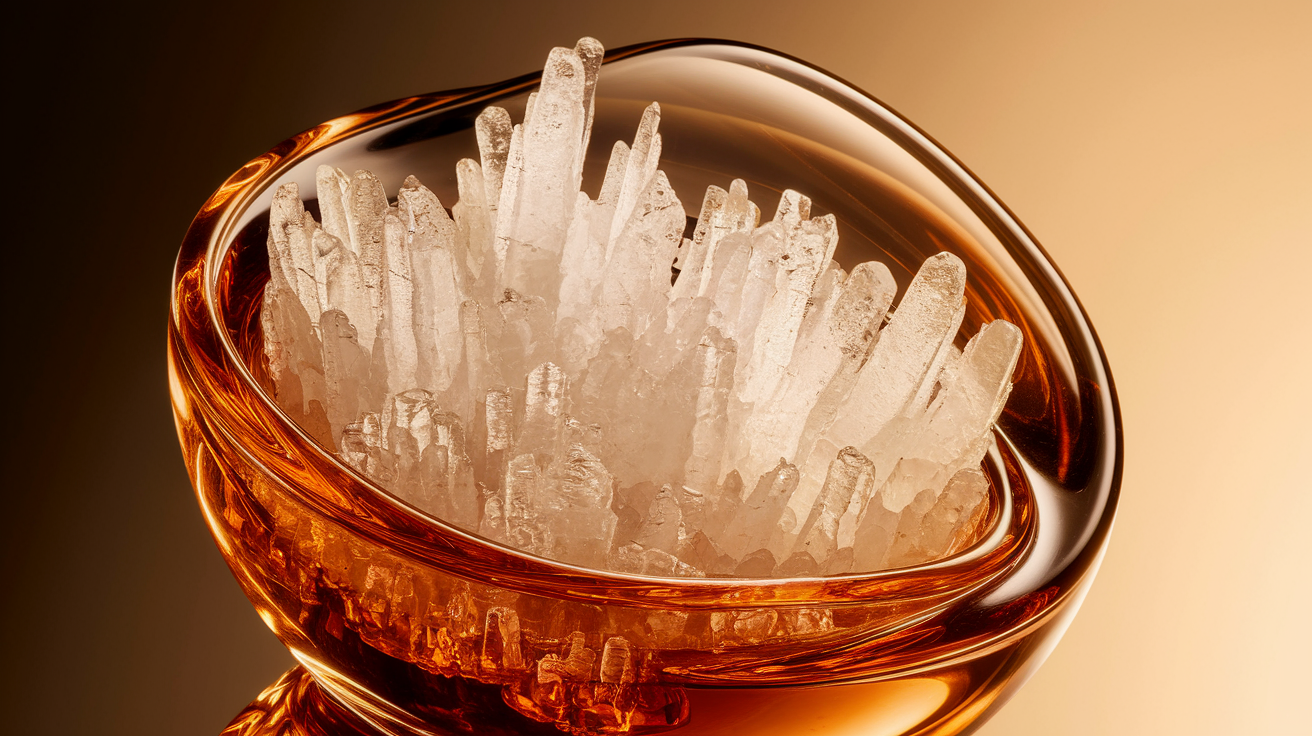
Crystallization is when dissolved ingredients come out of solution and form visible solid particles.
Think of it like sugar in iced tea. At room temperature, sugar dissolves completely. But make the tea too cold or too concentrated, and sugar crystals form.
Same principle in perfume.
The process:
Step 1: Everything is dissolved
- Fragrance molecules suspended in alcohol
- Solution is crystal clear
- No visible particles
Step 2: Solubility threshold is exceeded
- Temperature drops, OR
- Ingredients are at saturation point, OR
- Alcohol evaporates slightly (concentration increases)
Step 3: Precipitation begins
- Molecules start clumping together
- Tiny particles form
- You see cloudiness or sparkles
Step 4: Crystals grow
- Particles grow larger over time
- Some sink to bottom (sediment)
- Some float suspended in liquid
Crystallization is particularly common in perfumes with high concentrations of:
- Natural essential oils
- Resinous materials
- Waxy compounds
- Poorly-soluble synthetics
Why Perfume Crystallizes
Several factors can trigger crystallization:
1. Cold Temperature
We covered this in detail here: Why Perfume Turns Cloudy in Cold Weather
Quick version:
- Cold decreases solubility
- Ingredients can't stay dissolved
- They precipitate as crystals
Reversibility: Often reversible by warming.
2. High Concentration of Natural Ingredients
Some ingredients are barely soluble even at room temperature.
Examples:
- Benzoin resin: Waxy, resinous character
- Labdanum: Sticky, high-molecular-weight compounds
- Natural oud oil: Complex mixture, some compounds insoluble
- Sandalwood: Santalol can crystallize at high concentrations
If your perfume has 10-20% of these ingredients, crystallization is almost guaranteed eventually.
3. Evaporation Over Time
Alcohol evaporates faster than fragrance oils.
If a bottle is:
- Opened repeatedly
- Stored for years
- Has a loose cap
Some alcohol evaporates. This concentrates the remaining ingredients. Higher concentration = lower solubility = crystallization.
4. Age
Some ingredients become less soluble over time as they oxidize or polymerize.
Vanilla, for example, can form vanillin crystals after 2-3 years. This is normal, not degradation.
5. Formulation at Saturation Limit
Some perfumers intentionally formulate at the maximum solubility threshold - using as much of a prized ingredient as possible.
This creates perfumes that are "on the edge" of precipitation. Temperature changes or time can push them over.
Niche perfumers especially do this. It's a deliberate choice: maximize ingredient richness, accept visual imperfection.
Types of Crystallization & Sediment
Not all crystallization looks the same.
Type 1: Suspended Particles (Sparkle Effect)
Appearance:
- Tiny particles throughout liquid
- Looks sparkly in light
- Doesn't settle
- Sometimes called "shimmer"
Cause:
- Very fine crystallization
- Ingredients barely insoluble
- Cold-induced precipitation
Common in:
- Natural oud perfumes
- High-resin oriental scents
- Poorly-filtered niche perfumes
Is it a problem? No. Purely cosmetic. Perfume works fine.
Type 2: Bottom Sediment
Appearance:
- Particles settled at bottom
- Clear liquid on top
- May look like sand or powder
Cause:
- Heavier crystals sinking
- Wax precipitation
- Natural ingredients settling over time
Common in:
- Aged perfumes (2+ years)
- Oil-based attars
- Cold-stored perfumes
Is it a problem? No. Just gravity. Perfume works fine.
Type 3: Floating Particles
Appearance:
- Visible chunks or flakes
- Suspended mid-liquid
- May look waxy or oily
Cause:
- Wax precipitation from natural oils
- Resin particles
- Sometimes pollen or plant debris (in natural extracts)
Common in:
- Artisanal/small-batch perfumes
- Minimally-filtered natural perfumes
- Perfumes with CO2 extracts
Is it a problem? Usually no. Sign of minimal processing.
Type 4: Cloudiness That Won't Clear
Appearance:
- Milky or hazy
- Doesn't have distinct particles
- Doesn't clear when warmed
Cause:
- Permanent precipitation
- Emulsion breaking (rare)
- Micelles forming (surfactant-based perfumes)
Common in:
- Old perfumes
- Poorly-formulated perfumes
- Water-contaminated perfumes
Is it a problem? Maybe. Check smell and other signs.
How to Tell: Quality vs. Damage
Crystallization can be normal (quality) or a sign of problems.
Here's how to tell:
Signs of NORMAL Crystallization (Quality Indicator)
✓ Perfume smells normal
- No off-notes
- No rancidity
- Smells as expected
✓ Only visual issue
- No smell change
- No color change
- Just particles visible
✓ High-quality natural brand
- Niche perfumer
- Known for natural ingredients
- Artisanal production
✓ Particles are uniform
- Look like crystals or powder
- Consistent size/color
- Not organic-looking
✓ Product description mentions it
- "May show natural sediment"
- "Minimal filtration"
- "Contains natural precipitation"
Verdict: This is fine. It's a feature, not a bug.
Signs of PROBLEMATIC Crystallization (Degradation)
✗ Off smell
- Rancid
- Sour
- Significantly different
✗ Color change
- Darkened significantly
- Cloudy + brown
- Separated layers
✗ Multiple issues
- Sediment + smell change + color change
- All happening together
✗ Cheap mass-market perfume
- Not expected to crystallize
- Heavily stabilized
- If it shows sediment, something went wrong
✗ Organic-looking particles
- Fuzzy
- Growing
- Look like mold (extremely rare)
Verdict: This might be degradation or contamination.
The Niche Perfume Paradox
Here's something interesting:
High-quality niche perfumes are MORE likely to show crystallization than cheap mass-market perfumes.
Why?
Mass-Market Perfumes Are Over-Stabilized
Commercial perfumes undergo:
- Multiple filtrations (removes all particles)
- Chill-filtration (removes anything that might precipitate)
- Addition of stabilizers (keeps everything dissolved)
- Only highly-soluble ingredients used
Result: Crystal clear. Forever. Never shows sediment.
But also: Less ingredient richness. More synthetic. More processed.
Niche Perfumes Embrace Imperfection
Many niche/artisanal perfumers:
- Minimal filtration (retain character)
- Use barely-soluble natural ingredients
- Accept visual imperfection
- Prioritize smell over cosmetic clarity
Result: May show sediment. May crystallize. May look "imperfect."
But also: Richer smell. More natural. Less processed.
Examples of prestigious perfumes known to crystallize:
- Many Serge Lutens perfumes (natural sediment)
- Some Amouage releases (oud precipitation)
- Artisanal attars (wax crystals normal)
- Vintage Guerlain (aged precipitation)
These aren't defects. They're signs of ingredient quality.
Does Crystallization Affect Perfume Performance?
Short answer: Rarely.
What crystallization does:
✓ Makes it look less perfect
Particles are visible. Looks "impure." May bother some people.
✓ Slightly changes top spray
If particles are at the top, first spray might include a tiny bit of sediment. Barely noticeable.
What crystallization does NOT do:
✗ Change the smell (if smell is the same, performance is the same)
✗ Reduce longevity (the molecules are still there, just in solid form)
✗ Affect projection (once sprayed, solid particles dissolve on skin)
✗ Make it unusable (it still works perfectly)
The precipitated ingredients are chemically unchanged. They're just in solid form instead of dissolved.
When you spray, they land on skin, warm up, and release scent normally.
Think of instant coffee. Solid granules. Add water? Dissolved coffee. Same compounds, different state.
Can You Fix or Prevent Crystallization?
Can you fix it? Sometimes.
Should you try? Depends.
Method 1: Warming (For Cold-Induced Crystallization)
If crystallization happened because of cold:
- Warm perfume to 25-30°C
- Wait 24-48 hours
- Gently swirl (don't shake)
- Check if crystals dissolved
Success rate: 50-70% for cold-induced crystallization.
Method 2: Accept It
For natural sediment in niche perfumes:
Don't fix it. It's normal. It's supposed to be there.
Trying to "fix" it often makes things worse:
- Heating can degrade fragrance
- Filtering removes character
- Adding solvents changes smell
Leave it alone.
Method 3: Prevention (If You Want Clear Perfume)
To minimize crystallization:
- Store at stable room temperature (20-25°C)
- Avoid temperature swings
- Keep bottle upright (sediment stays at bottom)
- Don't refrigerate
- Use within 2-3 years
But remember: preventing crystallization means buying over-filtered, over-stabilized perfumes. That's fine if you prefer clarity. But you're trading off some ingredient richness.
Crystallization vs. Cloudiness vs. Separation
Let's clarify the differences:
Crystallization
- Visible solid particles
- Can be sparkly or powdery
- Often settles to bottom
- Particles are distinct
Cloudiness (Reversible Haze)
- Milky or foggy appearance
- No distinct particles
- Often from cold temperatures
- Usually reversible
See: Why Perfume Turns Cloudy in Cold Weather
Separation
- Distinct layers form
- Oil on top, water/alcohol on bottom
- Clear boundary between phases
- Emulsion has broken
These are three different phenomena. They can happen simultaneously, but they have different causes.
What Different Ingredients Look Like When Crystallized
Vanillin (Vanilla)
- White needle-like crystals
- Settles to bottom
- Common in aged perfumes
- Looks like sugar crystals
Santalol (Sandalwood)
- Waxy white particles
- Cloudy appearance
- Can redissolve when warm
- Looks like coconut oil when cold
Benzoin/Labdanum Resin
- Dark amber particles
- Sticky-looking
- Doesn't redissolve easily
- Looks like small amber beads
Natural Oud Particles
- Dark brown specks
- Some float, some sink
- Original plant debris
- Looks like tea leaves
Coumarin
- White crystalline powder
- Settles quickly
- Smells like tonka/hay
- Looks like fine sugar
Knowing what crystallized can help you identify if it's normal or problematic.
When Should You Worry?
Don't worry if:
- ✓ Perfume smells normal
- ✓ Only visual change
- ✓ Niche/natural/artisanal brand
- ✓ Particles look crystalline (not organic)
- ✓ Brand literature mentions sediment
Do worry if:
- ✗ Smell has changed significantly
- ✗ Color darkened dramatically
- ✗ Particles look fuzzy or growing
- ✗ Multiple signs of degradation
- ✗ Happened suddenly after contamination
Crystallization alone is not a concern.
Crystallization + off smell + color change = degradation.
What This Means For You
If you see particles or sediment in your perfume:
1. Don't panic
Crystallization is common in natural perfumes. It's often expected, not a defect.
2. Check the smell
If it smells normal, it's fine. Particles are just cosmetic.
3. Check the brand
Niche/artisanal brands often have sediment. Mass-market brands shouldn't.
4. Keep or return based on expectations
If you bought a ₹15,000 niche perfume and it has natural sediment - that's normal. Keep it.
If you bought a ₹2,000 mass-market perfume and it has particles - that's unusual. Consider returning.
5. Store properly to minimize (if you want)
Stable temperature. Keep upright. Minimize temperature swings.
But honestly, if a perfume is going to crystallize, it's going to crystallize. That's the nature of natural ingredients.
Key Takeaways
Crystallization in perfume:
- ✓ Usually harmless
- ✓ Common in natural/niche perfumes
- ✓ Sign of real ingredients (not over-processing)
- ✓ Doesn't affect smell or performance
- ✓ Purely cosmetic issue
Causes:
- Cold temperatures
- High natural ingredient concentration
- Age
- Alcohol evaporation
- Formulation at saturation
When it's normal:
- Perfume smells fine
- Only visual change
- High-quality natural brand
- Uniform crystalline particles
When it's a problem:
- Off smell + crystallization
- Color change + particles
- Multiple degradation signs
- Organic-looking growth
What to do:
- Check smell first
- Try warming if cold-induced
- Accept it if it's normal sediment
- Store properly to minimize
Bottom line: Most crystallization is normal. It's a sign you bought a perfume with real natural ingredients, not over-processed synthetic soup.
Embrace the imperfection. That's what makes natural perfumery interesting.
Further Reading
Want to understand more about perfume stability and storage?
- Why Perfume Turns Cloudy in Cold Weather (Reversible Haze Explained) - When cloudiness is temporary
- Is Cloudy Perfume Ruined? How to Fix Cold-Induced Haze Safely - Troubleshooting cloudiness
- Does Shaking Perfume Ruin It? Oxidation, Bubbles & Chemistry Explained - Why gentle swirling is better than vigorous shaking
- Stop Putting Your Perfume in the Fridge: Maceration Myths - Complete guide to storage myths and crystallization prevention
Looking for perfumes made with real natural ingredients? Browse our climate-optimized collection →
References
- [Formulation Stability in Natural Perfumes - Journal of Cosmetic Science](https://onlinelibrary.wiley.com/journal/14682494) - How natural ingredients affect formulation stability
- [Precipitation in Fragrance Products - International Journal of Cosmetic Science](https://onlinelibrary.wiley.com/journal/14682494) - Crystallization and sediment formation mechanisms
- [IFRA Natural Ingredient Guidelines](https://ifrafragrance.org/safe-use/standards) - Quality standards for natural materials in perfumery
- [Solubility of Cosmetics Ingredients - ResearchGate](https://www.researchgate.net/publication/282526727_Solubility_of_cosmetics_ingredients_in_6_different_solvents_and_applicability_to_skin_bioavailability_assays) - Solubility behavior in cosmetic formulations
- [Perfume & Fragrance Engineering - PMC](https://pmc.ncbi.nlm.nih.gov/articles/PMC8196857/) - Chemical engineering perspective on fragrance formulation
- [Temperature Effects on Solubility - Chemistry LibreTexts](https://chem.libretexts.org/Bookshelves/Physical_and_Theoretical_Chemistry_Textbook_Maps/Supplemental_Modules_(Physical_and_Theoretical_Chemistry)/Equilibria/Solubilty/Temperature_Effects_on_Solubility) - How temperature affects compound solubility

About Syed Asif Sultan
Founder of House of Sultan. Passionate about fragrance chemistry and transparency in perfumery.