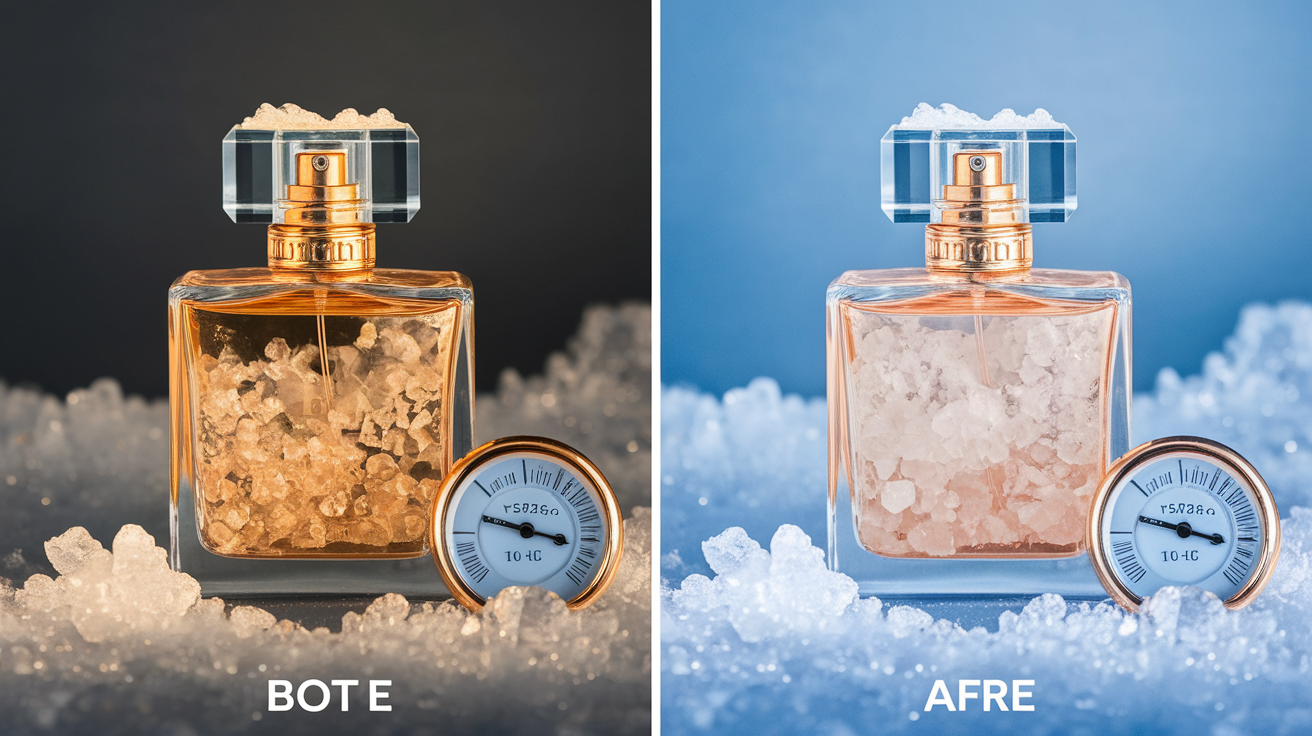
"Is my perfume ruined?"
I see this question constantly in fragrance WhatsApp groups during Delhi winters.
Last week alone, three people posted panicked photos in a collector group I'm in. Rasasi Hawas Fire. Dior Sauvage. Versace Eros. All turned milky-white overnight after being left in cold rooms.
"Should I throw it away?" "Can I fix it?" "Will it smell different now?"
The answer to all three: It's fine. It's not ruined.
You've probably experienced this too: Perfume that goes cloudy in AC. Or turns hazy in your car during winter. Or gets milky-white streaks when temperatures drop.
The panic is real. But the damage isn't.
What you're seeing is reversible haze - a completely harmless phase change that happens when certain ingredients get cold. In this post, I'll explain exactly why perfumes turn cloudy in cold weather, which ingredients cause it, and why it's not damage.
Let's start with what's actually happening at the molecular level.
What Is Reversible Haze in Perfume Cold Storage?
Reversible haze (also called reversible turbidity) is cloudiness that appears when perfume is stored cold and disappears when warmed.
It happens because natural oils, musks, and resins have temperature-dependent solubility - they dissolve in alcohol at room temperature but precipitate out when cold.
Quick facts:
- ✅ Harmless - Not damage or degradation
- ✅ Reversible - Clears when warmed to 20-25°C
- ✅ Common - Normal for natural/niche perfumes
- ✅ Physical change - Not chemical alteration
How to fix: Move perfume to room temperature, wait 2-6 hours. Cloudiness clears as ingredients redissolve.
Why it happens: Cold temperatures (below 15°C) decrease solubility of heavy aromatic molecules. They form microscopic droplets (haze) or crystals (sediment). Warming reverses the process.
What Causes Cloudiness in Perfume?
Perfume is a solution. Fragrance molecules dissolved in alcohol (usually ethanol).
When everything is dissolved, the liquid is crystal clear. You can see right through it.
But some fragrance ingredients - especially natural oils, musks, and resins - have low solubility at cold temperatures.
Here's what happens:
At room temperature (20-25°C):
- All ingredients stay dissolved in alcohol
- Solution is clear
- No visible particles
At cold temperature (0-15°C):
- Some ingredients become less soluble
- They start to precipitate out of solution
- You see cloudiness, haze, or white streaks
This phenomenon is called cold-induced turbidity or reversible haze. The keyword is "reversible."
When you warm the perfume back to room temperature, those ingredients dissolve again. Clarity returns.
Think of it like honey. Cold honey crystallizes and goes cloudy. Warm it up? Clear liquid again. Same principle.
The cloudiness isn't contamination. It's not spoilage. It's just ingredients temporarily coming out of solution.
Why Cold Temperatures Trigger Haze
Temperature affects solubility.
Most fragrance ingredients dissolve better in warm alcohol than cold alcohol. This is basic chemistry - increasing temperature generally increases solubility for most substances.
When you cool a perfume:
1. Molecular movement slows down
Molecules move slower at lower temperatures. This reduced kinetic energy makes it harder for them to stay suspended in solution.
2. Intermolecular forces strengthen
At cold temperatures, the fragrance molecules start clumping together. These clusters become visible as haze.
3. Solubility threshold drops
Every ingredient has a temperature-dependent solubility limit. Below a certain temperature, the alcohol can't hold as much of that ingredient dissolved.
Research on essential oil solubility in ethanol shows dramatic temperature dependence: solubility increases from 40 g/L at 20°C to 140 g/L at 60°C - a 3.5x difference. When temperature drops, that process reverses, and ingredients precipitate out.
That's why your perfume might be perfectly clear at 25°C but cloudy at 5°C. The alcohol literally can't hold all those molecules dissolved when cold.
Which Ingredients Are Most Affected?
Not all fragrance ingredients cause cloudiness. Some stay perfectly dissolved no matter how cold it gets.
Ingredients that commonly precipitate when cold:
Natural Oils & Extracts
- Sandalwood oil: High in santalol (large molecules)
- Oud oil: Contains complex resinous compounds
- Patchouli: Heavy sesquiterpenes
- Vetiver: Vetiverol and other sesquiterpenes
These are large, complex molecules with inherently low solubility in cold alcohol.
Musks
- Natural musks: Animal-derived (now rarely used)
- Synthetic musks: Especially macrocyclic musks like Muscenone
Musks have a waxy character that solidifies at cold temperatures.
Resins & Balsams
- Benzoin resin
- Labdanum
- Frankincense
- Myrrh
These contain resinous compounds that are barely soluble even at room temperature. Cold pushes them over the edge.
Why This Matters for Your Perfume
If your perfume contains a lot of natural ingredients or rich base notes, it's MORE likely to go cloudy when cold.
A fresh citrus cologne? Probably won't haze - those molecules are small and stay dissolved.
A heavy oud-sandalwood-amber perfume? Will almost certainly go cloudy in cold temperatures - those are big, poorly-soluble molecules.
This is actually a sign of quality. More natural ingredients = more likely to haze when cold.
Is This Different from Crystallization?
Yes. Cloudiness and crystallization are related but different.
Cloudiness (Reversible Haze):
- Liquid looks milky or foggy
- No visible solid particles
- Caused by microscopic droplets
- Reversible upon warming
Crystallization:
- Visible solid particles or crystals
- Settles at bottom of bottle
- Caused by ingredient precipitating fully
- May or may not redissolve
Cloudiness is the early stage. The ingredients are starting to come out of solution but haven't formed solid crystals yet.
Crystallization is the advanced stage. Solid particles have formed.
Both are usually harmless. Both are usually reversible. But crystallization looks more dramatic.
We'll cover crystallization in detail in a separate post: Perfume Crystallization Explained.
Does Cloudiness Mean Your Perfume Is Damaged?
No.
Let me be clear: reversible haze is not damage.
Your perfume is not:
- Spoiled
- Contaminated
- Ruined
- Degraded
- Chemically altered
It's just cold.
The fragrance molecules are all still there. The structure hasn't changed. The smell hasn't changed (once it warms up).
This is purely a physical change, not a chemical one. Like ice melting to water - same molecules, different state.
Signs of actual damage (not haze):
- Off smell: Rancid, sour, vinegar-like
- Color change: Yellow → brown or clear → amber (oxidation)
- Separation: Oil layer on top, water layer on bottom (emulsion breaking)
- Persistent cloudiness: Doesn't clear up after 24 hours at room temperature
If you see any of these, that might be actual degradation. But simple cold-induced haze? Totally normal.
How to Safely Return Perfume to Clarity
If your perfume has gone cloudy from cold, here's what to do:
DO:
-
Move it to room temperature (20-25°C)
- Just leave it on a shelf
- Don't do anything else
- Wait 2-6 hours
-
Be patient
- Warming takes time
- Larger bottles take longer
- Don't rush it
-
Shake gently (optional)
- Only after it's warmed up
- Very gentle swirl
- Helps remix if ingredients separated
DON'T:
-
Heat it
- No hot water bath
- No radiator
- No direct sunlight
- Heat can degrade fragrance molecules
-
Shake vigorously while cold
- Won't help
- Might introduce air bubbles
- Can accelerate oxidation
-
Add anything
- No more alcohol
- No fixatives
- Nothing
-
Worry
- Seriously
- It's fine
Timeline:
- Small bottles (30ml): 1-2 hours
- Standard bottles (50-100ml): 2-4 hours
- Large bottles (100ml+): 4-8 hours
If it hasn't cleared after 24 hours at room temperature, then you might have actual crystallization or separation. See: Is Cloudy Perfume Ruined?
Can You Prevent Cloudiness?
Yes, but you probably don't want to.
How to prevent cold-induced haze:
- Store perfume at constant warm temperature (20-25°C)
- Avoid refrigeration (except as last resort during extreme heat 38°C+)
- Avoid cold cars or cold rooms in hill stations/winter
- Keep away from direct AC vents
But here's the thing: preventing haze means limiting temperature changes. And temperature changes aren't actually bad for perfume.
The bigger enemy is:
- Heat (breaks down molecules)
- Light (causes oxidation)
- Air exposure (oxidation again)
Cold isn't harmful. It just causes temporary cosmetic cloudiness.
So don't stress about it. If your perfume goes cloudy in winter or in AC, just let it warm up naturally.
Why Some Perfumes Never Go Cloudy
You might have noticed: some perfumes never haze, no matter how cold they get.
Perfumes that stay clear in cold:
Synthetic Fragrances
- Made with small, highly-soluble aroma chemicals
- No natural oils or musks
- Stay dissolved at all temperatures
Fresh/Citrus Scents
- Top-note heavy
- Light molecules (limonene, linalool, citral)
- Very soluble even when cold
Mass-Market Perfumes
- Heavily filtered
- Stabilizers added
- Designed to never show cloudiness (customer complaints)
Alcohol-Heavy Formulas
- 80-90% alcohol (vs standard 70-80%)
- More solvent = better solubility
- But also evaporates faster
Perfumes that often go cloudy:
Natural/Niche Perfumes
- Heavy on natural oils
- Minimal filtering
- Accept cloudiness as normal
Oud/Amber/Wood Scents
- Big molecules
- Resinous character
- Low solubility in cold
Oil-Based Perfumes (Attars)
- Not alcohol-based
- Different solubility rules
- Can show separation when cold
At House of Sultan, our perfumes contain significant natural base notes. If they go slightly cloudy in extreme cold, that's expected. We don't over-filter or add synthetic stabilizers just to prevent harmless haze.
What This Means For You
If your perfume goes cloudy in cold weather:
1. Don't panic
It's reversible. It's harmless. It's normal.
2. Let it warm up
Room temperature for a few hours. That's it.
3. Don't take drastic action
No heating. No shaking. No throwing away expensive perfume.
4. Expect it with natural perfumes
The more natural ingredients, the more likely you'll see this. It's actually a good sign - means the perfume isn't over-processed.
5. Store properly going forward
Not because cold causes damage (it doesn't), but to avoid the cosmetic issue of cloudiness:
- Room temperature (18-25°C)
- Away from windows (temperature fluctuates)
- Not in bathroom (humidity changes)
- Not in car (extreme temperature swings)
When to Actually Worry
Cloudiness from cold = fine.
But here are signs of actual problems:
Red flags:
- Cloudiness persists after 24 hours at room temperature
- Perfume smells different (rancid, sour, off)
- Color has permanently changed (oxidation)
- Oil and water layers separated (emulsion broke)
- Visible mold or growth (rare but possible if water contamination)
If you see these, read our detailed guide: Is Cloudy Perfume Ruined? How to Fix Cold-Induced Haze Safely
Otherwise, if it's just temporary cloudiness from being cold? You're fine. Your perfume is fine. Everything is fine.
Key Takeaways
Cloudiness from cold is:
- ✅ Reversible
- ✅ Harmless
- ✅ Normal for natural perfumes
- ✅ Not a sign of damage
To fix it:
- ✅ Warm to room temperature (20-25°C)
- ✅ Wait 2-6 hours
- ✅ Done
Don't:
- ❌ Heat the perfume
- ❌ Shake it vigorously
- ❌ Throw it away
- ❌ Worry
Cold-induced haze is a cosmetic issue, not a chemistry problem. Your fragrance molecules are all still there, unchanged, ready to smell amazing once the temperature normalizes.
Next time you see milky perfume on a cold morning, you'll know: it's just reversible phase separation. Give it time. It'll clear up.
Further Reading
Want to understand more about perfume storage and stability?
- Is Cloudy Perfume Ruined? How to Fix Cold-Induced Haze Safely - What to do if cloudiness won't go away
- Perfume Crystallization Explained: Sediment, Separation & Stability - When solid particles appear
- Does Shaking Perfume Ruin It? Oxidation, Bubbles & Chemistry Explained - Why you shouldn't shake cold perfume
- Stop Putting Your Perfume in the Fridge: Maceration Myths - Complete guide to perfume storage myths
Looking for perfumes designed for Indian conditions? Browse our climate-optimized collection →
References
- [Preferential Solubilization of Fragrances in Micelles - IntechOpen](https://www.intechopen.com/chapters/89153) - Phase separation and turbidity in fragrance formulations
- [Temperature Effects on Solubility - Chemistry LibreTexts](https://chem.libretexts.org/Bookshelves/Physical_and_Theoretical_Chemistry_Textbook_Maps/Supplemental_Modules_(Physical_and_Theoretical_Chemistry)/Equilibria/Solubilty/Temperature_Effects_on_Solubility) - How temperature affects solubility of compounds
- [Essential Oil Solubility in Alcohol - ScienceDirect](https://www.sciencedirect.com/science/article/abs/pii/S0260877406001178) - Temperature-dependent oil solubility in ethanol: 40 g/L at 20°C to 140 g/L at 60°C
- [Solubility of Cosmetics Ingredients - ResearchGate](https://www.researchgate.net/publication/282526727_Solubility_of_cosmetics_ingredients_in_6_different_solvents_and_applicability_to_skin_bioavailability_assays) - Solubility behavior in cosmetic formulations
- [Perfume & Fragrance Engineering - PMC](https://pmc.ncbi.nlm.nih.gov/articles/PMC8196857/) - Chemical engineering perspective on fragrance formulation stability

About Syed Asif Sultan
Founder of House of Sultan. Passionate about fragrance chemistry and transparency in perfumery.