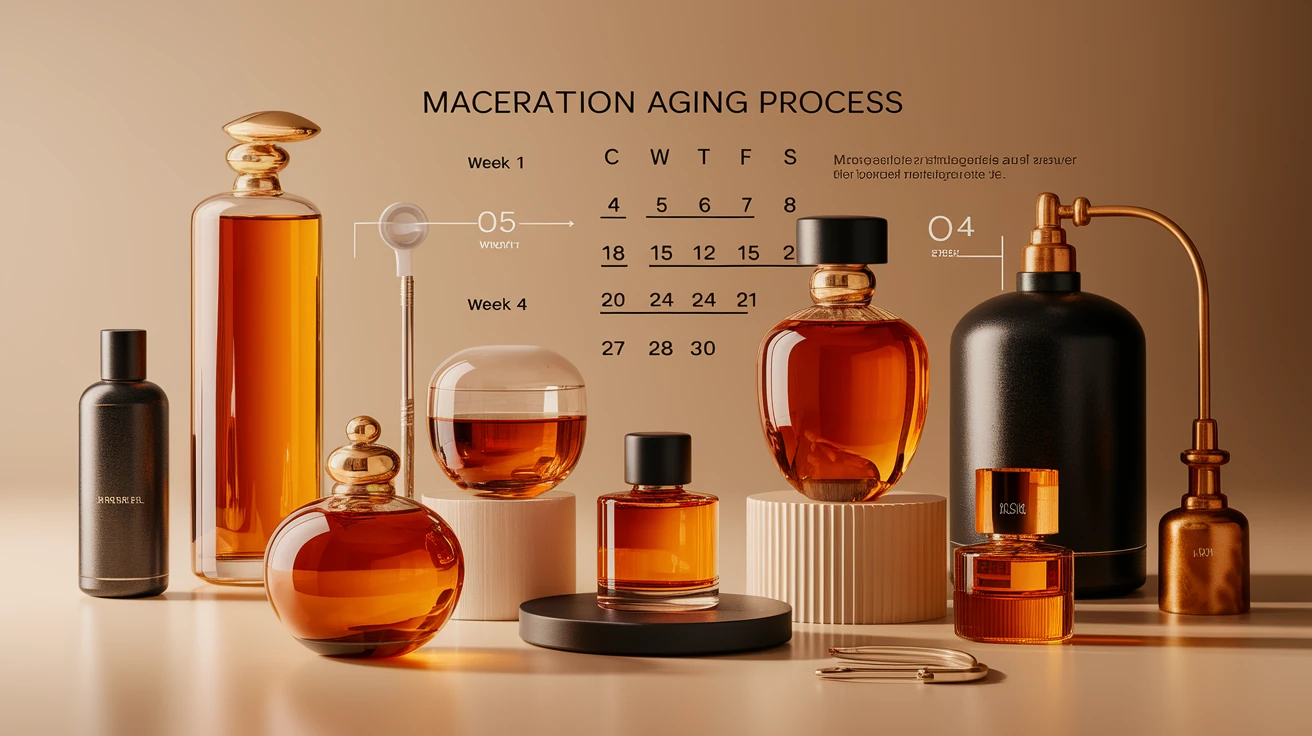
I learned about maceration the hard way.
Six years ago, I made my first "complete" perfume blend. Took me three weeks to get the formula right - the perfect balance of oud, rose, and sandalwood. Mixed it all together, filled a bottle, wore it the next day.
It smelled like cleaning alcohol with a hint of disappointment.
The ingredients were expensive. The formula was mathematically correct. But I'd skipped the most important step: letting it sit.
What Actually Happens During Maceration
When you first mix perfume oils with alcohol, you get what perfumers call a "raw blend." It smells harsh. The alcohol dominates. The different notes don't talk to each other - they just exist in the same space, like strangers in an elevator.
Here's what's happening at a molecular level:
Your perfume is made of hundreds of different aromatic molecules. Some are tiny (like limonene from citrus - molecular weight around 136). Some are massive (like β-caryophyllene from oud - molecular weight 204+).
When you first mix them, the small molecules zip around in the alcohol. The big ones... don't. They're not fully dissolved yet. They're suspended, waiting.
Maceration is giving those big molecules time to actually dissolve.
Think of it like making chai. If you drop a tea bag in water and immediately pull it out, you get brown water. Leave it for 5 minutes? You get chai. The tannins need time to diffuse from the leaves into the water.
Same principle, but with perfume it takes weeks instead of minutes.
The Three Stages of Maceration
Week 1: The Alcohol Shock
First few days after mixing, the alcohol is aggressive. It's grabbing onto whatever molecules it can reach. Your perfume smells sharp, one-dimensional, and nothing like what you designed.
This is normal. Don't panic. Don't add more ingredients.
Week 2-4: The Integration
Around week 2, something shifts. The heavy base notes (oud, amber, musk) start emerging. Not because they appeared out of nowhere - they were always there - but because they're finally dissolving into the alcohol properly.
The perfume starts smelling less "alcoholic" and more "perfume-like."
Week 5-8: The Harmony
This is where magic happens. All the notes start working together. Top notes soften. Middle notes develop depth. Base notes reveal complexity they didn't have in raw material form.
Some molecules even undergo slow chemical reactions during this period, creating new aromatic compounds that weren't in your original ingredients.
For example: vanilla absolute + alcohol + time = trace amounts of vanillin glucoside, which has a creamier scent than pure vanilla.
Why Indian Climate Changes Everything
Mumbai in summer is 35°C with 80% humidity.
In those conditions, perfume chemistry speeds up. Molecules move faster. Reactions happen quicker. Sounds good, right?
Wrong.
Faster isn't better in maceration.
Heat makes volatile molecules (your top notes - bergamot, lemon, fresh spices) evaporate during the maceration period itself. Volatile citrus oils can be lost during hot-climate maceration.
Plus, heat accelerates oxidation. Some delicate florals (jasmine, rose) can degrade if macerated at elevated temperatures for extended periods.
Professional maceration for hot climates:
- Climate-controlled storage (typically 15-20°C)
- Extended timeline compared to temperate climate standards
- Regular monitoring to check volatile loss
- Inert atmosphere when possible to prevent oxidation
Proper maceration at controlled temperatures allows base note molecules to fully integrate, resulting in better longevity even in hot conditions.
The Questions Nobody Answers About Maceration
"Can I speed it up with heat?"
No. Tried it. Disaster.
Heating alcohol above 25°C during maceration destroys delicate top notes and creates "cooked" off-notes in your base. Your perfume will smell like burnt wood instead of aged sandalwood.
"Does shaking the bottle help?"
Actually, yes - but carefully.
Once a week during maceration, we gently invert each vessel 10 times. This helps redistribute molecules without introducing air bubbles (which cause oxidation).
Never shake vigorously. You're not making a cocktail.
"How do I know when it's done?"
The 24-hour tissue test. Spray a tissue. Wait 24 hours. If you can still smell it clearly after a full day, the base notes have integrated properly.
If it fades after 4-6 hours, macerate another week and test again.
"Why don't Zara/Bath & Body Works do this?"
They can't.
They produce 10,000+ bottles per batch. Storing that much product for 6-8 weeks requires:
- Climate-controlled warehouses
- Inventory capital (you've spent money but can't sell yet)
- Quality control testing at multiple stages
- Risk management (longer storage = more can go wrong)
So they skip it. They add synthetic fixatives to make the scent "stick" without proper maceration. They boost alcohol content to 85-90% to force faster dissolution. They use aroma chemicals that smell good immediately but have no depth.
The result: perfumes that smell fine in-store but disappear on your skin in 2 hours.
What Happens If You Skip Maceration
The difference between fresh-mixed and properly macerated perfume is significant.
Fresh blend (mixed recently):
- Strong alcohol smell dominates
- Top notes overwhelming, base notes barely perceptible
- Fades quickly (often within 2-4 hours)
- Smells flat, one-dimensional
- Harsh, unbalanced character
Properly macerated blend (6-8 weeks):
- Balanced from application
- All notes present and harmonious
- Lasts significantly longer (8-12+ hours for well-formulated perfumes)
- Evolves naturally over time
- Smooth, integrated character
This isn't subjective preference. This is molecular chemistry. Properly macerated perfumes have fully integrated base molecules that bind to skin oils and evaporate slowly. Fresh blends have incompletely dissolved components that disappear rapidly as alcohol evaporates.
Professional Maceration Standards
Industry best practices for artisanal perfume maceration:
- Initial blend - Formula mixed, sealed in appropriate vessels
- Week 1 - Visual inspection for separation or precipitation
- Week 2-4 - Periodic gentle agitation (minimal oxygen exposure)
- Week 4-5 - Initial scent evaluation on test strips
- Week 5-7 - Longevity testing
- Week 6-8+ - Final quality check before bottling
Timeline varies by formulation:
- Heavy oud-based perfumes: Typically longer maceration (8-10 weeks) due to high molecular weight compounds
- Lighter citrus-forward formulations: Can complete faster (6-7 weeks) as smaller molecules integrate more quickly
- Floral compositions: Medium timeline (6-8 weeks)
The heavier the base note molecules, the longer they need to fully dissolve and integrate.
How to Test This Yourself
If you're buying perfumes, here's how to tell if it was properly macerated:
Spray it on a tissue (not your skin yet).
Wait 30 minutes. Smell it.
Properly macerated perfume will smell balanced - top, middle, and base notes all present but harmonious.
Rushed perfume will smell like:
- Strong alcohol (even after 30 min)
- One note dominating everything
- Harsh, sharp, "chemically"
Now wait 4 hours. Smell again.
Macerated: Base notes emerging, still pleasant Rushed: Faded significantly, might be completely gone
This is why we guarantee 24-hour longevity. We know our macerations work because we test every single batch this way before it reaches you.
The Real Reason We Wait
Here's the truth: maceration is expensive and annoying.
We have to:
- Store hundreds of liters of perfume for 6-8 weeks before we can sell it
- Maintain climate-controlled storage (electricity bills in Mumbai are brutal)
- Test repeatedly (labor cost)
- Risk entire batches if something goes wrong during maceration
- Turn down customers who want bulk orders "next week"
We do it anyway because:
1. It's the only way to make perfume that lasts in Indian climate. You can't fake proper molecular integration. Every shortcut I've tried has failed.
2. The difference is blindingly obvious. Once you smell a properly macerated oud blend, mass-market perfumes smell like bad photocopies.
3. Our reputation depends on it. If we sell you perfume that fades in 3 hours, you'll never buy from us again. Better to wait 8 weeks per batch and deliver something that actually works.
What This Means for You
Artisanal perfumes that undergo proper maceration have fully integrated molecules - base notes have dissolved completely, creating smooth, long-lasting fragrances.
The maceration process allows:
- Oud molecules to dissolve slowly in alcohol over weeks
- Vanilla to undergo subtle oxidation reactions
- Sandalwood to integrate with base musks
- All components to reach chemical equilibrium
This is why properly macerated perfumes smell different from mass-market alternatives. It's not magic or secret formulas.
It's chemistry that was given sufficient time to complete.
Understanding the difference:
Mass-market perfumes often prioritize speed:
- Mixed and bottled within days
- Smell acceptable initially
- Fade quickly (often 2-4 hours)
Artisanal macerated perfumes prioritize quality:
- Macerate for 6-8+ weeks
- Develop complexity over time
- Last significantly longer (8-12+ hours)
The trade-off is time versus longevity. Proper maceration can't be rushed without compromising final performance.
References
- Butler, H. (ed.) (2000). Poucher's Perfumes, Cosmetics and Soaps (10th ed.). Kluwer Academic/Springer, Dordrecht. ISBN: 0-7514-0479-9
- Arctander, S. (1960). Perfume and Flavor Materials of Natural Origin. Published by author, Elizabeth, NJ (Reprinted 1994 by Allured Publishing)
- Sell, C.S. (2006). The Chemistry of Fragrances: From Perfumer to Consumer (2nd ed.). Royal Society of Chemistry, Cambridge. ISBN: 0-85404-824-7
- Calkin, R.R. & Jellinek, J.S. (1994). Perfumery: Practice and Principles. John Wiley & Sons, New York. ISBN: 0-471-58154-9

About Syed Asif Sultan
Founder of House of Sultan. Passionate about bringing premium, climate-optimized fragrances to India at honest prices.