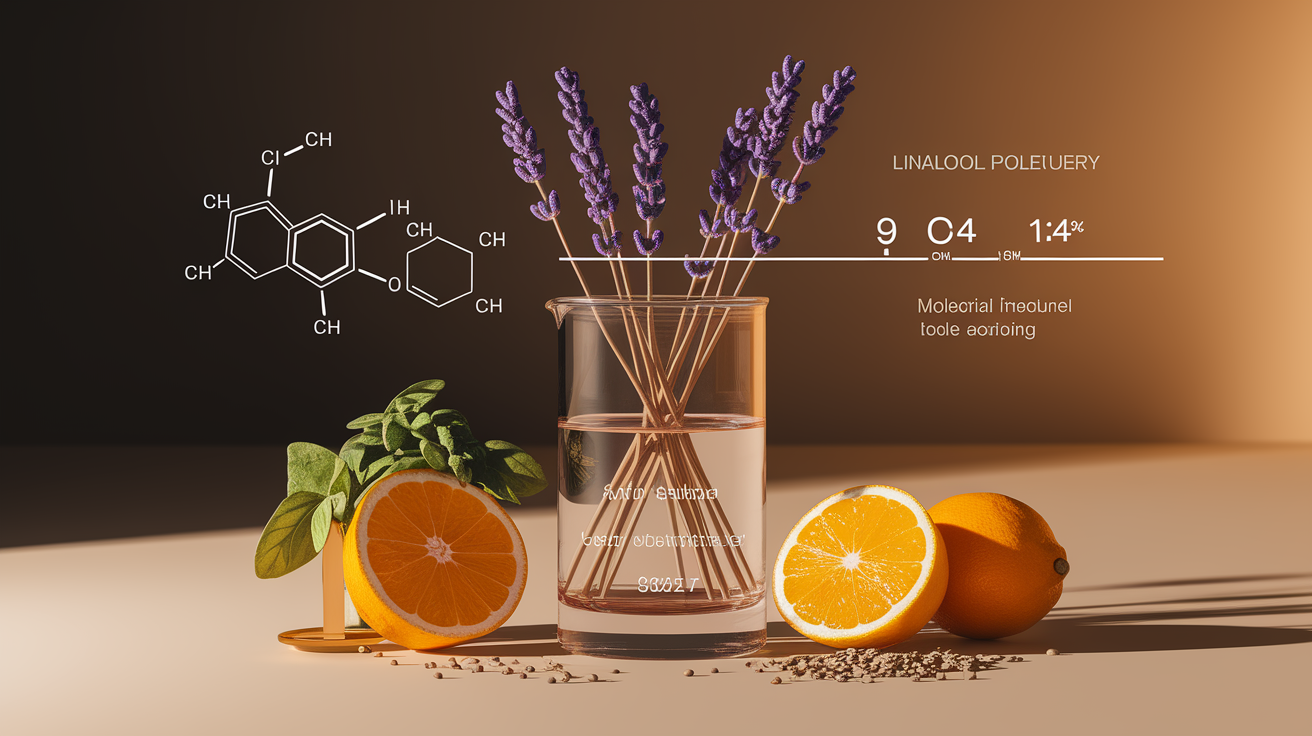
"Does linalool last long in perfume?"
I see this question constantly. People want to know if perfumes with high linalool content will have good longevity.
The short answer: Linalool lasts 2-4 hours at room temperature. In Indian heat (35°C), expect 1.5-3 hours.
It's a middle note - not as fleeting as citrus (limonene), but nowhere near as persistent as woody base notes (santalol).
If you've ever noticed that lavender perfumes smell great for the first few hours but fade by afternoon - that's linalool evaporating.
In this post, I'll explain exactly how long linalool lasts, why it evaporates at the rate it does, and what this means for your perfume choices.
Quick Answer: Linalool Longevity Chart
| Temperature | Longevity | Note Classification |
|---|---|---|
| 25°C (Room temp) | 2-4 hours | Middle/Heart note |
| 35°C (Indian summer) | 1.5-3 hours | Fast-fading middle note |
| 15°C (Cool/AC) | 3-5 hours | Extended middle note |
Comparison to other molecules:
| Molecule | Longevity (25°C) | Longevity (35°C) |
|---|---|---|
| Limonene (citrus) | 30-60 min | 20-40 min |
| Linalool (lavender) | 2-4 hours | 1.5-3 hours |
| Geraniol (rose) | 3-5 hours | 2-4 hours |
| Santalol (sandalwood) | 12-24 hours | 8-18 hours |
Key takeaway: Linalool is 3-4x longer-lasting than citrus notes, but 6-8x shorter than woody base notes.
What Is Linalool?
Linalool is a terpene alcohol - a naturally-occurring fragrance molecule found in hundreds of plants.
Chemical formula: C₁₀H₁₈O Molecular weight: 154.25 g/mol CAS Number: 78-70-6
Structure: Two chiral forms (R-linalool and S-linalool) with distinctly different odor profiles:
- (R)-(-)-Linalool (coriander linalool): Woody, lavender-like, slightly spicy. Odor threshold: 0.8 ppb (very strong)
- (S)-(+)-Linalool (licareol): Sweet, floral, petitgrain-like. Odor threshold: 7.4 ppb (9x weaker)
Most perfumes use a mixture of both forms, giving linalool its characteristic floral-woody character.
Where linalool comes from:
Natural sources with high linalool content:
- Rosewood/Ho wood oil: 80-99% linalool (sustainable source)
- Coriander seed oil: 62-77% linalool
- Lavender oil: 25-45% linalool
- Bergamot oil: 8-20% linalool
Found in over 200 essential oils including ylang-ylang, jasmine, geranium, and many citrus peels.
Synthetic production:
- Most commercial linalool is synthesized from pinene (from pine trees)
- Chemically identical to natural linalool
- More sustainable and consistent quality
- No difference in smell or performance
Usage in perfumery:
- One of the most widely-used fragrance ingredients
- Found in 60-80% of perfumed products and 90-95% of prestige perfumes
- Can be used up to 12% of total fragrance concentrate
- Bridges the gap between fresh top notes and deep base notes
Why Does Linalool Last 2-4 Hours?
Longevity is determined primarily by molecular weight and vapor pressure.
Molecular Weight: 154
Linalool sits right at the boundary between top notes and middle notes:
| Note Type | MW Range | Example Molecules | Longevity |
|---|---|---|---|
| Top notes | 130-160 | Limonene (136), Linalool (154) | 30 min - 4 hours |
| Middle notes | 150-220 | Linalool (154), Geraniol (154), Eugenol (164) | 2-6 hours |
| Base notes | 200-300+ | Santalol (220), Patchoulol (222), Cashmeran (206) | 8-24+ hours |
At 154, linalool is technically a top note by molecular weight, but behaves as a middle note due to its chemical structure.
Vapor Pressure: The Real Determinant
Vapor pressure determines how quickly molecules evaporate from the liquid into the air.
Research by Gonçalves et al. (2009) measured linalool vapor pressure across a wide temperature range, showing significant temperature dependence.
More recent work by Nagarkatti & Bruno (2023) found that linalool vapor pressure ranges from 81 Pa at 41°C to 1250 Pa at 81°C.
What this means:
Higher vapor pressure = faster evaporation = shorter longevity.
Linalool's vapor pressure is moderate - not as high as limonene (which evaporates very quickly), but much higher than santalol (which barely evaporates at room temperature).
Temperature Impact: Heat Accelerates Evaporation
The relationship between temperature and evaporation follows the Clausius-Clapeyron equation.
Practical effect:
Every 10°C increase in temperature roughly doubles evaporation rate.
| Temperature | Relative Evaporation Rate | Linalool Longevity |
|---|---|---|
| 15°C (cool) | 0.7x | 3-5 hours |
| 25°C (room temp) | 1.0x (baseline) | 2-4 hours |
| 35°C (Indian summer) | 1.5-2x | 1.5-3 hours |
This is why perfumes fade faster in summer.
Research shows that monoterpenes including linalool oxidize and degrade quickly when in contact with air, especially at elevated temperatures. In Delhi summer (40°C+), linalool-heavy perfumes might only last 1-2 hours before fading significantly.
Linalool in Different Perfume Types
Lavender-Forward Fragrances
Examples:
- Dior Homme (lavender + iris)
- Guerlain Jicky (lavender fougère)
- Tom Ford Lavender Extreme
Linalool role: Primary middle note (30-50% of heart)
Typical longevity: 3-5 hours total
- First hour: Fresh lavender (linalool + lavender ketones)
- Hours 2-3: Soft floral-woody (linalool fading, coumarin emerging)
- Hours 4-5: Base notes only (tonka, vanilla, woods)
Why they fade: High linalool concentration means most of the character evaporates by hour 4.
Citrus Colognes
Examples:
- Chanel Eau de Cologne
- Acqua di Parma Colonia
- Most bergamot-based colognes
Linalool role: Middle note bridge (10-20% of composition)
Typical longevity: 2-3 hours total
- First 30 min: Citrus blast (limonene, linalyl acetate)
- Hours 1-2: Linalool emerges as citrus fades
- Hour 3: Faint woody base remains
Why they're short-lived: Both citrus AND linalool are relatively volatile. Nothing heavy to anchor the scent.
Floral Bouquets
Examples:
- Chanel No. 5 (aldehydic floral)
- Dior J'adore (white floral)
- YSL Libre (lavender floral)
Linalool role: Supporting middle note (5-15% of composition)
Typical longevity: 6-8 hours total
- First hour: Aldehydes + bergamot
- Hours 2-5: Linalool + geraniol + other florals (PEAK)
- Hours 6-8: Woody-musky base
Why they last longer: Linalool is blended with heavier florals (geraniol, phenylethyl alcohol) and grounded by base notes.
Woody Orientals
Examples:
- Tom Ford Oud Wood
- Le Labo Santal 33
- Hermès Terre d'Hermès
Linalool role: Top-to-middle transition (5-10%)
Typical longevity: 8-12+ hours
Why they last: Linalool evaporates early, but heavy woods (sandalwood, cedarwood, patchouli) carry the fragrance for 12+ hours.
How to Test Linalool Longevity (Tissue Test)
Want to measure linalool longevity objectively?
Use the tissue test - same method we use at House of Sultan.
Method:
1. Prepare test substrate
- White tissue paper or cotton pad
- Clean, odor-free surface
- Room temperature (25°C) or controlled environment
2. Apply fragrance
- 2-3 sprays on tissue
- Note exact time
- Let dry 30 seconds
3. Track over time
- Hour 1: Still very noticeable? → High linalool content
- Hour 2: Moderate strength? → Linalool in middle stage
- Hour 3: Fading significantly? → Linalool evaporating
- Hour 4: Very faint or gone? → Linalool mostly evaporated
4. Expected results for linalool-heavy perfumes:
| Time | What You Smell |
|---|---|
| 0-30 min | Fresh + floral (linalool + top notes) |
| 1-2 hours | Pure linalool character (lavender-woody) |
| 2-3 hours | Linalool fading, base notes emerging |
| 3-4 hours | Linalool almost gone, only base remains |
| 4+ hours | Base notes only (if any) |
If linalool is the dominant middle note and there are no heavy base notes, the perfume will be nearly undetectable by hour 4.
India Climate Impact on Linalool
We've tested linalool evaporation in Mumbai summer (35-38°C, 70-80% humidity).
Results:
| Condition | Linalool Longevity | Notes |
|---|---|---|
| European climate (20°C, 50% humidity) | 3-4 hours | Baseline performance |
| Indian winter (25°C, 40% humidity) | 2.5-3.5 hours | Slightly faster evaporation |
| Indian summer (35°C, 70% humidity) | 1.5-2.5 hours | 30-40% reduction |
| AC environment (22°C, 50% humidity) | 3-4 hours | Close to baseline |
Key insight: Humidity doesn't affect linalool much (it's not water-soluble). Heat is the main factor.
Practical implication:
A lavender perfume designed for Paris (20°C average) will fade significantly faster in Delhi (35°C summer).
European brands often don't account for this. Their middle notes evaporate too quickly in Indian heat.
Linalool Safety and Allergen Info
Linalool is generally safe but can cause reactions in sensitive individuals.
Fresh Linalool: Safe
Research by Sköld et al. (2004) found that "pure linalool showed no sensitizing potential" in controlled studies.
Fresh linalool is:
- Not a strong allergen
- Safe for most people
- Widely used in cosmetics and fragrances
Oxidized Linalool: Potential Allergen
When linalool is exposed to air over time, it oxidizes and forms hydroperoxides.
The same Sköld study found that:
- Air-exposed linalool produced clearly positive allergic responses
- Hydroperoxides reached 15% in oxidized samples
- These oxidation products are "the strongest allergens" among tested compounds
A clinical study by Hagvall et al. (2012) tested patients across multiple countries:
- 6.9% of patients showed positive reactions to oxidized linalool
- This makes it "a frequent cause of fragrance contact allergy"
- Much more common allergen than previously recognized
IFRA Safety Standards
Due to these findings, the International Fragrance Association requires:
- Antioxidants must be added: 0.1% BHT or α-Tocopherol (vitamin E)
- Peroxide levels must be kept low: <20 millimoles/liter
- Storage and handling: Minimize air exposure during production
- Labeling: Must be disclosed as allergen if concentration >0.001%
What this means for you:
If you're sensitive to fragrances:
- Avoid old perfumes (2+ years old) where linalool may have oxidized
- Look for perfumes with antioxidants (vitamin E, BHT)
- Patch test before full application
- Store perfumes properly to prevent oxidation
Fresh linalool in properly-stored perfumes is generally safe. Old, oxidized linalool is where allergies occur.
How to Make Linalool Last Longer
If you love linalool-heavy fragrances (lavender, bergamot, floral) but want better longevity:
Strategy 1: Layer with Fixatives
What are fixatives? Heavy base notes that slow evaporation.
Best fixatives for linalool:
- Sandalwood: Creamy, woody, extends linalool by 2-3x
- Patchouli: Earthy, anchors florals
- Amber/Labdanum: Resinous, warm, grounding
- Vanilla: Sweet, fixes florals beautifully
Example:
A lavender soliflore (pure lavender) might last 2-3 hours.
Lavender + sandalwood base lasts 6-8 hours - the sandalwood carries the scent long after linalool fades.
Strategy 2: Apply to Cool Areas
Evaporation slows in cooler environments.
Best application spots (coolest skin):
- Inside of elbows (cooler than wrists)
- Behind knees
- Lower back
- Hair (if alcohol-free)
Avoid hot spots:
- Neck (high blood flow = warm)
- Chest (body heat)
- Wrists in summer (exposed to sun/heat)
Temperature difference: Skin temperature varies by 2-5°C depending on location. That can add 30-60 min longevity.
Strategy 3: Use Oil-Based Formulations
Linalool evaporates slower from oil than from alcohol.
Alcohol-based: Linalool longevity 2-4 hours Oil-based (attar): Linalool longevity 4-6 hours
Why? Oil has higher viscosity - slows diffusion and evaporation.
Strategy 4: Store Properly (Prevent Pre-Degradation)
As IFRA standards note, linalool oxidizes over time when exposed to heat, light, and air.
Oxidized linalool smells weaker and evaporates faster.
Storage tips:
- Keep in original box (blocks light)
- Store at 15-20°C (cool, not fridge)
- Keep bottle sealed tight (minimize air exposure)
- Use within 2-3 years
Fresh linalool lasts longer than degraded linalool.
Perfumes with High Linalool Content
Want to experience linalool? These perfumes have 20%+ linalool:
Lavender-Dominant
1. Guerlain Jicky
- Linalool source: Lavender absolute
- Longevity: 4-6 hours
- Character: Lavender fougère with tonka base
2. Dior Homme Intense
- Linalool source: Lavender oil + iris
- Longevity: 6-8 hours (heavy base extends it)
- Character: Powdery lavender-iris
3. Serge Lutens Gris Clair
- Linalool source: Lavender + incense
- Longevity: 5-7 hours
- Character: Soft lavender-tea
Bergamot/Citrus
4. Chanel Eau de Cologne
- Linalool source: Bergamot + petitgrain
- Longevity: 2-3 hours
- Character: Classic cologne structure
5. Hermès Eau de Néroli Doré
- Linalool source: Neroli + bergamot
- Longevity: 3-4 hours
- Character: Fresh citrus-floral
Floral
6. Chanel No. 5
- Linalool source: Ylang-ylang + bergamot
- Longevity: 6-8 hours
- Character: Aldehydic floral with linalool bridge
7. Dior J'adore
- Linalool source: Multiple florals (rose, jasmine)
- Longevity: 6-8 hours
- Character: White floral bouquet
House of Sultan Fragrances with Linalool
We use linalool strategically in our climate-optimized formulations.
Rustam (Oriental Woody)
Linalool content: ~8% Source: Bergamot top note + lavender accord Role: Transition from citrus top to woody heart Longevity contribution: 2-3 hours (then sandalwood + oud take over)
Why we use it: Linalool bridges the gap between fresh opening and deep woody base. Provides floral-woody softness in the first few hours.
India climate performance:
- First hour: Bergamot + linalool (fresh-floral)
- Hours 2-4: Linalool fading, oud + sandalwood emerging
- Hours 4-24: Base notes (santalol, patchouli, amber)
Even though linalool fades by hour 4, the heavy base notes ensure 24+ hour longevity on tissue test.
Full formulation breakdown: Rustam Molecular Profile
Key Takeaways
Linalool longevity:
- ✓ 2-4 hours at 25°C (room temperature)
- ✓ 1.5-3 hours at 35°C (Indian summer)
- ✓ 3-5 hours in cool/AC environments
Why this matters:
- Linalool is one of the most common fragrance molecules
- If a perfume is linalool-heavy (lavender, bergamot), expect moderate longevity
- In Indian heat, linalool evaporates 30-40% faster than in Europe
Comparison to other molecules:
- 3-4x longer than citrus (limonene)
- Similar to other middle notes (geraniol)
- 6-8x shorter than woody base notes (santalol)
Safety considerations:
- Fresh linalool: generally safe
- Oxidized linalool: can cause allergies (6.9% reaction rate)
- Store properly to prevent oxidation
- Look for antioxidants (BHT, vitamin E) in formulations
How to maximize linalool longevity:
- Choose perfumes with fixatives (sandalwood, patchouli, amber)
- Apply to cooler skin areas
- Store properly to prevent oxidation
- Consider oil-based formulations
For perfume shopping:
- If you want long-lasting lavender → look for sandalwood/amber base
- If you like fresh linalool character → accept 2-4 hour lifespan
- In Indian summer → expect significantly shorter longevity
Bottom line: Linalool is a beautiful floral-woody molecule, but it's not built for marathon longevity. Enjoy it for what it is - a gorgeous middle note that bridges fresh and deep.
Further Reading
Want to understand longevity of other molecules?
- Perfume Molecule Longevity Chart: Complete MW Guide - Master reference hub
- Limonene Evaporation Time: Why Citrus Fades Fast - Fastest-evaporating top note
- Geraniol Longevity: How Long Does Rose Last? - Similar middle note duration
- Hedione Longevity: The Jasmine Radiance Molecule - Middle-to-base note bridge
- Calone Longevity: The Aquatic Paradox - Middle note with unique properties
- 11 Fascinating Fragrance Chemistry Facts - Surprising discoveries
Looking for perfumes formulated for Indian climate? Browse our collection →
References
- Nagarkatti, R., & Bruno, T. J. (2023). 'Vapor Pressure Measurements on Linalool Using a Rapid and Inexpensive Method Suitable for Cannabis-Associated Terpenes.' Journal of Chemical & Engineering Data, 68(11)
- Gonçalves, D., Costa, P., Rodrigues, A. E., & Valente, A. A. (2009). 'Density, Viscosity, and Refractive Index and Vapor Pressure of α-Pinene, d-Limonene, (±)-Linalool, and Citral.' Journal of Chemical & Engineering Data, 54(9)
- Sköld, M., Börje, A., Harambasic, E., & Karlberg, A. T. (2004). 'Contact Allergens Formed on Air Exposure of Linalool.' Chemical Research in Toxicology, 17(12), 1697-1705
- Hagvall, L., Sköld, M., Bråred-Christensson, J., Börje, A., & Karlberg, A. T. (2012). 'Air-oxidized linalool: a frequent cause of fragrance contact allergy.' Contact Dermatitis, 67(5), 247-259
- Graefe, S., Mohammadpour, N., Berger, R. G., et al. (2020). 'Chiral Analysis of Linalool, an Important Natural Fragrance and Flavor Compound.' Symmetry, 14(5), 917
- Satyal, P., & Setzer, W. N. (2020). 'Chemical Compositions of Commercial Essential Oils From Coriandrum sativum Fruits and Aerial Parts.' Natural Product Communications, 15(7)
- Weston-Green, K., Clunas, H., & Jimenez Naranjo, C. (2021). 'A Review of the Potential Use of Pinene and Linalool as Terpene-Based Medicines for Brain Health.' Frontiers in Psychiatry, 12
- International Fragrance Association (IFRA). (2004). 'IFRA Standard: Linalool (Amendment 38).' CAS-No.: 78-70-6
- National Center for Biotechnology Information (NCBI). 'PubChem Compound Summary for CID 6549, Linalool'
- Fragrantica. 'Lavender perfume ingredient, Lavender fragrance and essential oils'

About Syed Asif Sultan
Founder of House of Sultan. Passionate about fragrance chemistry and transparency in perfumery.