"Why does my citrus perfume disappear so fast?"
This is the #1 question I get about cologne longevity.
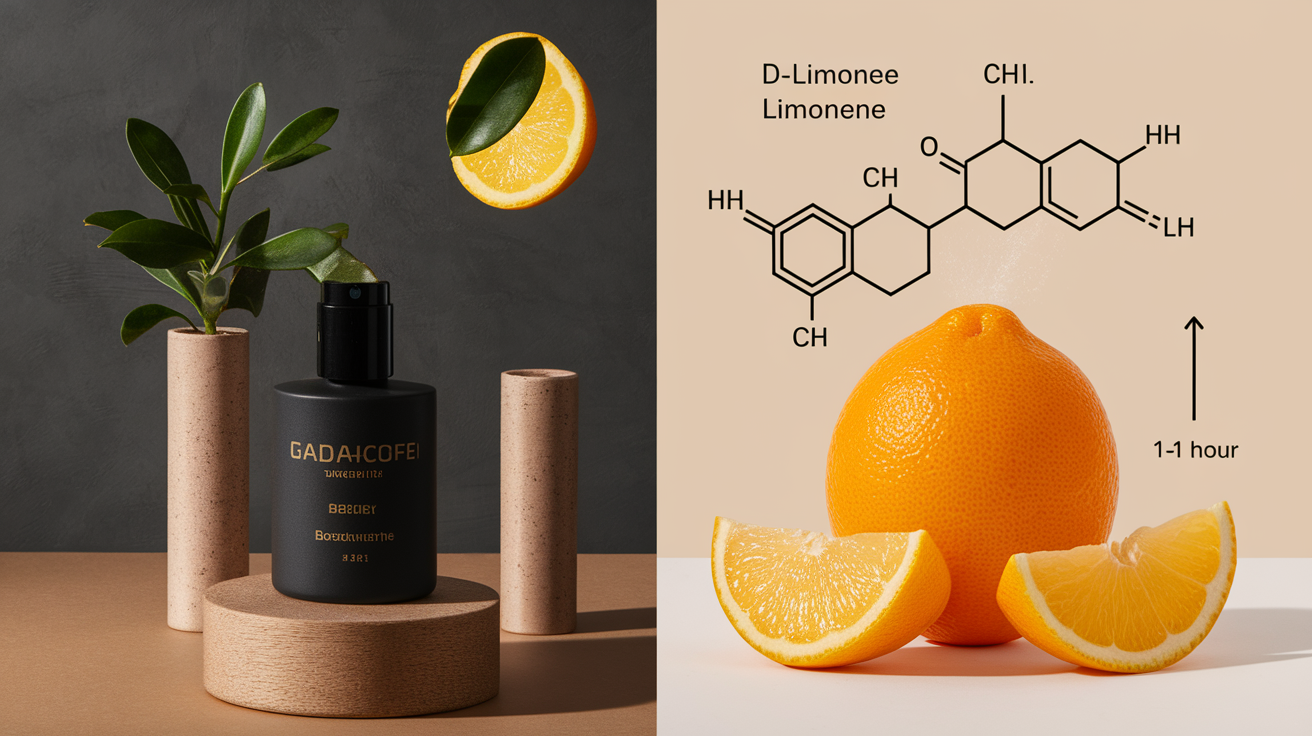
The short answer: Limonene - the main molecule in citrus oils - evaporates in 30-60 minutes at room temperature. In Indian summer heat, expect 20-40 minutes max.
It's the fastest-evaporating common perfume molecule. Not "short-lived." Not "moderate longevity." We're talking 30 minutes and it's mostly gone.
If you've ever sprayed a fresh lemon cologne and wondered why it smelled amazing for 20 minutes then vanished - that's limonene doing what it does best: disappearing into thin air.
In this post, I'll explain exactly why limonene evaporates so fast, how it compares to other molecules, and why citrus colognes are intentionally ephemeral.
Quick Answer: Limonene Evaporation Time Chart
| Temperature | Evaporation Time | Note Classification |
|---|---|---|
| 25°C (Room temp) | 30-60 minutes | Fast top note |
| 35°C (Indian summer) | 20-40 minutes | Ultra-fast top note |
| 15°C (Cool/AC) | 45-90 minutes | Extended top note |
Comparison to other molecules:
| Molecule | MW | Evaporation Time (25°C) | Evaporation Time (35°C) |
|---|---|---|---|
| Limonene (citrus) | 136 | 30-60 min | 20-40 min |
| Linalool (lavender) | 154 | 2-4 hours | 1.5-3 hours |
| Geraniol (rose) | 154 | 3-5 hours | 2-4 hours |
| Santalol (sandalwood) | 220 | 12-24 hours | 8-18 hours |
Key takeaway: Limonene evaporates 4-8x faster than linalool, 6-10x faster than geraniol, and 24-48x faster than santalol.
It's not even close.
What Is Limonene?
Limonene is a monoterpene hydrocarbon - the simplest class of fragrance molecules.
Chemical formula: C₁₀H₁₆ Molecular weight: 136.24 g/mol (lowest of common perfume molecules) CAS Numbers: 5989-27-5 (d-limonene), 5989-54-8 (l-limonene)
Structure: Two enantiomers with completely different smells:
- d-Limonene: Sweet, fresh, orange scent (most common in perfumery)
- l-Limonene: Pine, turpentine, harsh (rarely used intentionally)
Most citrus perfumes use d-limonene exclusively.
Where limonene comes from:
Citrus peel oils contain the highest concentrations:
- Orange peel oil: 90-98% d-limonene
- Grapefruit peel oil: 85-95% limonene
- Lemon peel oil: 65-75% limonene
- Lime oil: 50-65% limonene
- Bergamot oil: 30-40% limonene
Limonene is the most abundant terpene in nature - produced by over 300 plant species.
Usage in perfumery:
- Top note only (too volatile for anything else)
- Citrus cologne openings (30-40% of composition)
- Fresh aromatic accents (10-25%)
- Provides immediate "fresh burst" that disappears quickly
Why Limonene Evaporates in 30-60 Minutes
Three factors make limonene the fastest-evaporating perfume molecule:
1. Lowest Molecular Weight: 136
Among common perfume molecules, limonene has the lowest molecular weight:
| Molecule Type | MW Range | Example Molecules | Evaporation Time |
|---|---|---|---|
| Ultra-fast top notes | 130-140 | Limonene (136) | 30-60 min |
| Fast top notes | 140-160 | Linalool (154) | 2-4 hours |
| Middle notes | 150-220 | Geraniol (154), Eugenol (164) | 3-6 hours |
| Base notes | 200-300+ | Santalol (220), Patchoulol (222) | 8-24+ hours |
At 136, limonene is in a class by itself. There are very few perfume molecules lighter than this.
2. Highest Vapor Pressure: 200 Pa
NIST data shows limonene vapor pressure at 25°C is 200 Pa.
Comparison to other molecules:
| Molecule | Vapor Pressure (25°C) | Relative Evaporation Rate |
|---|---|---|
| Limonene | 200 Pa | 12.5x faster than linalool |
| Linalool | ~16 Pa | Baseline |
| Geraniol | ~8 Pa | 0.5x (half as fast as linalool) |
| Santalol | ~0.2 Pa | 0.0125x (80x slower than linalool) |
Higher vapor pressure = molecules escape into air more easily = faster evaporation.
Limonene's vapor pressure is 12.5x higher than linalool - explaining why it disappears so much faster.
3. Low Activation Energy of Evaporation
Research using thermogravimetric analysis measured limonene's activation energy of evaporation at 49.7-57.3 kJ/mol (depending on air flow conditions).
This is the energy barrier that must be overcome for a molecule to escape from liquid to gas phase.
Lower activation energy = easier evaporation = shorter longevity.
Translation: Limonene doesn't need much energy to evaporate. Room temperature is more than enough.
Temperature Impact: Why Indian Heat Kills Citrus
The relationship between temperature and evaporation follows the Clausius-Clapeyron equation.
Practical effect:
Every 10°C increase roughly doubles evaporation rate.
| Temperature | Relative Evaporation Rate | Limonene Evaporation Time |
|---|---|---|
| 15°C (cool) | 0.6x | 45-90 minutes |
| 25°C (room temp) | 1.0x (baseline) | 30-60 minutes |
| 35°C (Indian summer) | 2.0-2.5x | 20-40 minutes |
| 40°C (Delhi peak summer) | 2.5-3x | 15-30 minutes |
This is why citrus colognes are unbearable in Indian summer.
A cologne designed for Paris (20°C average) might last 45-60 minutes on skin.
Same cologne in Delhi summer (40°C)? You're lucky to get 15-20 minutes.
Studies on citrus oil evaporation confirm: "The rapid removal of the monoterpene hydrocarbons, particularly those more volatile than limonene...occurs during evaporation of citrus oils."
In hot, humid environments (Mumbai summer: 35-38°C, 70-80% humidity), limonene evaporates so fast that the "top note" phase is essentially over before you finish getting dressed.
The Limonene Oxidation Problem
Limonene doesn't just evaporate fast. It also oxidizes - and oxidized limonene smells terrible.
Fresh Limonene: Sweet Orange
- Bright, fresh, sparkling
- Sweet citrus character
- Clean, uplifting
- What you smell when you peel an orange
Oxidized Limonene: Harsh Turpentine
- Sharp, chemical, unpleasant
- Turpentine-like character
- Metallic, harsh
- What old citrus perfumes smell like
What causes this transformation?
Research on limonene stability found that limonene is prone to autoxidation upon prolonged air exposure.
The study tracked limonene exposed to air for 48 weeks:
- Weeks 0-34: Stable, no significant oxidation
- Week 34: Autoxidation begins
- Weeks 34-48: Rapid formation of oxidation products
The autoxidation mechanism involves successive events of O₂ addition and H migration, leading to the formation of highly oxidized products (HOPs).
Primary oxidation products:
- Limonene hydroperoxides
- Carvone (caraway smell)
- p-Cymene (harsh, turpentine character)
- Limonene oxide (metallic, chemical)
Timeline:
| Time | Smell Character |
|---|---|
| Fresh (0-6 months) | Bright orange, fresh citrus |
| Slight oxidation (6-18 months) | Still mostly fresh, slight flatness |
| Moderate oxidation (18-36 months) | Noticeable harshness, less fresh |
| Heavy oxidation (36+ months) | Turpentine, unpleasant, ruined |
This is why:
- Citrus perfumes have shorter shelf lives than woody perfumes
- Old bottles of Acqua di Gio smell harsh and chemical
- Fresh citrus oils are so much better than old stock
IFRA standards restrict limonene use "because of potential sensitization...depending on its general susceptibility to oxidize."
The oxidation products are what cause skin sensitization - not fresh limonene itself.
Limonene in Different Perfume Types
Pure Citrus Colognes (Ephemeral by Design)
Examples:
- Chanel Eau de Cologne
- Acqua di Parma Colonia
- 4711 Original Eau de Cologne
Limonene content: 30-40% of total composition Typical longevity: 1-3 hours MAX
- First 30-60 min: Pure citrus blast (limonene dominates)
- Hour 1-2: Fading citrus, light florals emerging
- Hour 2-3: Barely there woody base (if any)
Why so short? These are designed to be ephemeral. The cologne structure philosophy embraces impermanence. You're supposed to reapply.
Fragrance community consensus: "Citrus notes are almost all super unstable and can only be used as a top note, lasting 5 to 40 minutes at very best for high-quality realistic citruses."
Fresh Aromatic (Citrus + Woody Base)
Examples:
- Dior Eau Sauvage
- Hermès Eau d'Orange Verte
- Tom Ford Neroli Portofino
Limonene content: 15-25% Typical longevity: 3-5 hours
- First 30-60 min: Citrus opening (limonene + bergamot)
- Hours 1-3: Aromatic heart (lavender, herbs)
- Hours 3-5: Woody-musky base
Why longer? Heavy base notes (ambroxan, hedione, woody synthetics) anchor the scent after limonene evaporates.
Floral Citrus (Neroli/Petitgrain Style)
Examples:
- Jo Malone Orange Blossom
- Hermès Eau de Néroli Doré
- Tom Ford Neroli Portofino Forte
Limonene content: 10-15% Typical longevity: 4-6 hours
- First 30 min: Bright citrus (limonene)
- Hours 1-4: Floral heart (neroli, orange blossom)
- Hours 4-6: Soft woody-musky base
Why longer? Heavier floral molecules (linalool, linalyl acetate, indole) provide substance after citrus fades.
Woody Citrus (Citrus as Accent Only)
Examples:
- Tom Ford Oud Wood
- Le Labo Bergamote 22
- Hermès Terre d'Hermès
Limonene content: 5-10% Typical longevity: 6-10+ hours
- First 15-30 min: Citrus spark (limonene as accent)
- Hours 1-8: Woody-spicy heart dominates
- Hours 8-10+: Deep woody-amber base
Why longest? Limonene is just a fleeting opening. Heavy woods (sandalwood, cedarwood, vetiver) carry the fragrance all day.
How to Test Limonene Evaporation (Tissue Test)
Want to see how fast limonene really evaporates?
Method:
-
Spray pure citrus oil or cologne on white tissue
- 2-3 sprays
- Note exact time
- Let dry 30 seconds
-
Track over time:
| Time | What You Smell |
|---|---|
| 0-10 min | Intense citrus blast (limonene peak) |
| 10-20 min | Still strong citrus |
| 20-30 min | Fading noticeably |
| 30-45 min | Very faint citrus |
| 45-60 min | Barely detectable or gone |
| 60+ min | Only heavier notes remain (if any) |
Expected result: In a pure citrus cologne, limonene will be 80-90% evaporated by 45-60 minutes.
Compare to linalool: Do the same test with lavender oil (high linalool). You'll still smell it strongly after 2-3 hours.
Compare to sandalwood: Sandalwood oil will still be noticeable after 12-24 hours.
This objective test demonstrates why molecular weight and vapor pressure govern volatility.
India Climate Impact on Citrus Perfumes
We've tested citrus colognes in Mumbai and Delhi conditions:
| Condition | Limonene Evaporation Time | Notes |
|---|---|---|
| European climate (20°C, 50% humidity) | 45-75 minutes | Baseline performance |
| Indian winter (25°C, 40% humidity) | 35-60 minutes | Slightly faster |
| Indian summer (35°C, 70% humidity) | 20-40 minutes | 40-50% reduction |
| Delhi peak summer (40°C+) | 15-30 minutes | 60-70% reduction |
| AC environment (22°C, 50% humidity) | 40-70 minutes | Close to baseline |
Key insight: Heat is the dominant factor. Humidity has minimal effect on limonene (it's not water-soluble).
Practical implication:
Acqua di Gio designed for Milan summer (28°C average) will perform okay.
Same perfume in Mumbai summer (35-38°C, 80% humidity)? The citrus opening is gone before you walk out the door.
Why European citrus colognes fail in India:
- Formulated for 15-25°C environments
- Limonene concentration optimized for cooler climates
- No compensation for accelerated evaporation in heat
- Result: 15-20 minute lifespan in Indian summer
This is why we anchor even citrus openings with heavy base notes in our India-formulated perfumes.
Why Citrus Colognes Are Intentionally Ephemeral
Here's the truth: citrus perfumes are designed to be short-lived.
The cologne structure philosophy embraces impermanence:
Traditional Cologne Structure:
- 70-80% alcohol (higher than parfum's 60-70%)
- 10-15% fragrance concentration (lower than EDP's 15-20%)
- Heavy top note composition (60-70% top notes vs typical 20-30%)
Design intention:
- Refreshing splash, not lingering scent
- Meant to be reapplied throughout the day
- Light, ephemeral, non-invasive
- "Eau" (water) philosophy - fleeting like water
Historical context:
18th-19th century colognes (4711, Farina) were designed for:
- Frequent reapplication (carried in pocket)
- Hygienic refreshment (when bathing was rare)
- Social appropriateness (strong scents were vulgar)
Modern citrus colognes maintain this tradition.
If you want long-lasting citrus:
Don't buy traditional colognes. Look for:
- Fresh aromatic EDTs (citrus + lavender + woods)
- Woody citrus EDPs (citrus as accent only)
- Floral citrus perfumes (neroli/orange blossom heart)
These use limonene for the opening spark, then rely on heavier molecules for longevity.
How to Make Limonene Last Longer (Hint: You Can't)
Let's be honest: you can't make limonene itself last longer.
Its molecular weight (136) and vapor pressure (200 Pa) are fixed properties. No amount of layering or application technique will change how fast it evaporates.
What you CAN do:
1. Accept the Ephemerality
Citrus notes are meant to be fleeting. That's their charm.
- Spray more frequently (every 2-3 hours)
- Carry a travel atomizer
- Embrace the refreshing burst → fade cycle
2. Choose Citrus Perfumes with Woody Bases
Look for perfumes where limonene is just the opening, not the main act:
- Terre d'Hermès: Citrus spark → woody-mineral heart
- Dior Eau Sauvage: Bergamot opening → hedione + oakmoss base
- Le Labo Bergamote 22: Bergamot → woody-amber base
These last 6-10 hours because the base notes carry the scent after limonene evaporates.
3. Layer with Fixatives
Apply a woody or musky base layer first:
- Sandalwood oil or perfume
- Ambroxan-heavy scent
- Woody/resinous attar
Then spray citrus cologne on top.
The base will persist after citrus fades, creating the illusion of longer-lasting citrus.
4. Apply to Fabric (Slight Improvement)
Limonene evaporates slightly slower from fabric than from skin:
- Spray on collar, cuffs, scarf
- Textile fibers slow diffusion slightly
- Might extend lifespan by 10-20 minutes
But honestly? It's still going to be gone in an hour.
Limonene Safety and IFRA Standards
Fresh limonene is generally safe. Oxidized limonene can cause sensitization.
Fresh Limonene: Generally Safe
Pure, fresh d-limonene is widely used in:
- Perfumes (up to 30-40% in colognes)
- Food flavoring (orange, lemon flavors)
- Household cleaners (citrus scent)
- Personal care products
It's one of the most common fragrance molecules.
Oxidized Limonene: Potential Allergen
IFRA restricts limonene use "because of potential sensitization...depending on its general susceptibility to oxidize."
The problem isn't limonene itself - it's the oxidation products (hydroperoxides).
IFRA requirements:
- Limit limonene concentration in certain product categories
- Add antioxidants to prevent oxidation
- Label as potential allergen if concentration >0.001%
- Store properly to minimize oxidation
What this means for you:
If you're sensitive to fragrances:
- Avoid old citrus perfumes (2+ years old)
- Look for freshly-produced bottles
- Test for oxidation: harsh turpentine smell = oxidized
- Choose perfumes with added antioxidants (BHT, vitamin E)
Fresh citrus from reputable brands is generally safe. Old, oxidized citrus oils are where problems occur.
Famous Citrus Perfumes (All Limonene-Heavy)
These iconic perfumes all rely heavily on limonene for their opening:
1. Acqua di Gio (Giorgio Armani)
- Bergamot + neroli opening (high limonene)
- Longevity: 4-6 hours (marine-floral base extends it)
- Limonene fades in first 30-45 min
2. Dior Eau Sauvage
- Lemon + bergamot blast
- Longevity: 6-8 hours (hedione + oakmoss base)
- Classic example of citrus + fixative structure
3. Dolce & Gabbana Light Blue
- Lemon + apple opening
- Longevity: 3-5 hours
- Very short citrus phase, then soft floral
4. Tom Ford Neroli Portofino
- Bergamot + orange + lemon
- Longevity: 4-6 hours
- Pure citrus cologne style
5. Chanel Eau de Cologne
- Lemon + bergamot + neroli
- Longevity: 2-3 hours
- Traditional cologne structure (intentionally short)
6. Hermès Eau d'Orange Verte
- Orange + lemon + mint
- Longevity: 4-5 hours
- Woody-spicy base extends beyond limonene
All of these smell incredible for the first 30-60 minutes (limonene phase), then transition to whatever base notes the perfumer included.
House of Sultan and Limonene
We use limonene strategically in climate-optimized formulations.
Rustam (Oriental Woody)
Limonene content: ~5% (bergamot top note) Role: Brief opening spark Longevity: Limonene fades in 20-30 min (Indian heat), then oud + sandalwood take over
Why we use it: That initial citrus burst provides freshness and brightness, signaling "this is a perfume" to the nose.
But we know it'll be gone in 30 minutes. That's why Rustam's core is built on:
- Oud (MW ~220-240): 8-12 hour longevity
- Sandalwood (MW 220): 12-24 hour longevity
- Patchouli (MW 222): 10-18 hour longevity
- Amber base: 8-16 hour longevity
India climate performance:
- First 20-30 min: Bergamot spark (limonene)
- Hours 1-4: Oud + lavender heart
- Hours 4-24: Sandalwood + amber base
The limonene opening is intentionally brief. The real fragrance begins after it evaporates.
Full formulation: Rustam Molecular Profile
Key Takeaways
Limonene evaporation time:
- ✓ 30-60 minutes at 25°C (room temperature)
- ✓ 20-40 minutes at 35°C (Indian summer)
- ✓ Fastest-evaporating common perfume molecule
Why it evaporates so fast:
- Lowest molecular weight (136)
- Highest vapor pressure (200 Pa - 12.5x higher than linalool)
- Low activation energy of evaporation
- Temperature exponentially accelerates evaporation
Oxidation problem:
- Fresh limonene: sweet orange, bright citrus
- Oxidized limonene (34+ weeks): harsh turpentine, unpleasant
- Old citrus perfumes smell terrible due to oxidation products
Comparison to other molecules:
- 4-8x faster than linalool (lavender)
- 6-10x faster than geraniol (rose)
- 24-48x faster than santalol (sandalwood)
For perfume shopping:
- Pure citrus colognes: accept 1-3 hour lifespan
- Want longer citrus? → Choose woody citrus or fresh aromatics
- In Indian summer: citrus openings last 15-30 min max
- Traditional colognes are designed to be ephemeral (not a defect)
Bottom line: Limonene is beautiful but fleeting. It's the opening spark, not the lasting flame. Choose perfumes accordingly.
Further Reading
Want to understand longevity of other molecules?
- Perfume Molecule Longevity Chart: Complete MW Guide - Master reference hub
- Linalool Longevity: How Long Does Linalool Last? - Middle note comparison
- Geraniol Longevity: How Long Does Rose Last? - Floral middle note
- Calone Longevity: The Aquatic Molecule - Fresh marine character
- Hedione Longevity: The Jasmine Radiance Effect - Diffusive middle note
- 11 Fascinating Fragrance Chemistry Facts - Surprising discoveries
Looking for perfumes that last in Indian heat? Browse our collection →
References
- Kang, J. W., et al. (2009). 'Density, Viscosity, and Vapor Pressure of α-Pinene, d-Limonene, (±)-Linalool, and Citral.' Journal of Chemical & Engineering Data, 54(11)
- Rodríguez-García, I., et al. (2020). 'Kinetic Treatment of Evaporation via Thermogravimetric Analysis: The Case of d-Limonene.' Industrial & Engineering Chemistry Research, 59(26)
- Zhang, S., et al. (2024). 'Unraveling the Autoxidation Mechanisms of Limonene, α-Pinene, and β-Pinene: A Computational Study.' The Journal of Physical Chemistry A
- Kern, S., et al. (2014). 'Stability of limonene and monitoring of a hydroperoxide in fragranced products.' Flavour and Fragrance Journal, 29(5)
- Komiya, M., Takeuchi, T., & Harada, E. (2006). 'Changes in the Composition of Aromatherapeutic Citrus Oils during Evaporation.' PMC/PubMed
- Turek, C., & Stintzing, F. C. (2013). 'Stability of Essential Oils: A Review.' Comprehensive Reviews in Food Science and Food Safety, 12(1)
- (2022). 'Study of the Thermodynamic Equilibrium of Fragrance Mixtures, Limonene, Linalool and Geraniol.' American Journal of Engineering and Applied Sciences, 15(2), 160-177
- (1999). 'Thermal Degradation of Terpenes: Camphene, Δ³-Carene, Limonene, and α-Terpinene.' Environmental Science & Technology
- NIST Chemistry WebBook. 'D-Limonene.' National Institute of Standards and Technology
- International Fragrance Association (IFRA). 'IFRA Standard: Limonene.' 48th Amendment

About Syed Asif Sultan
Founder of House of Sultan. Passionate about fragrance chemistry and transparency in perfumery.