"Why does Hedione last longer than linalool but shorter than sandalwood?"
If you've ever worn Dior Eau Sauvage, Chanel Chance, or Acqua di Gio and noticed a glowing, diffusive quality that makes the fragrance feel larger than it is—you're experiencing Hedione's radiance effect.
The short answer: Hedione lasts 4-8 hours on skin at 25°C (3-6 hours in 35°C Indian heat) due to molecular weight 226.31 and extremely low vapor pressure (0.09-0.21 Pa). It's a middle-to-base note that creates the "halo effect" perfumers describe.
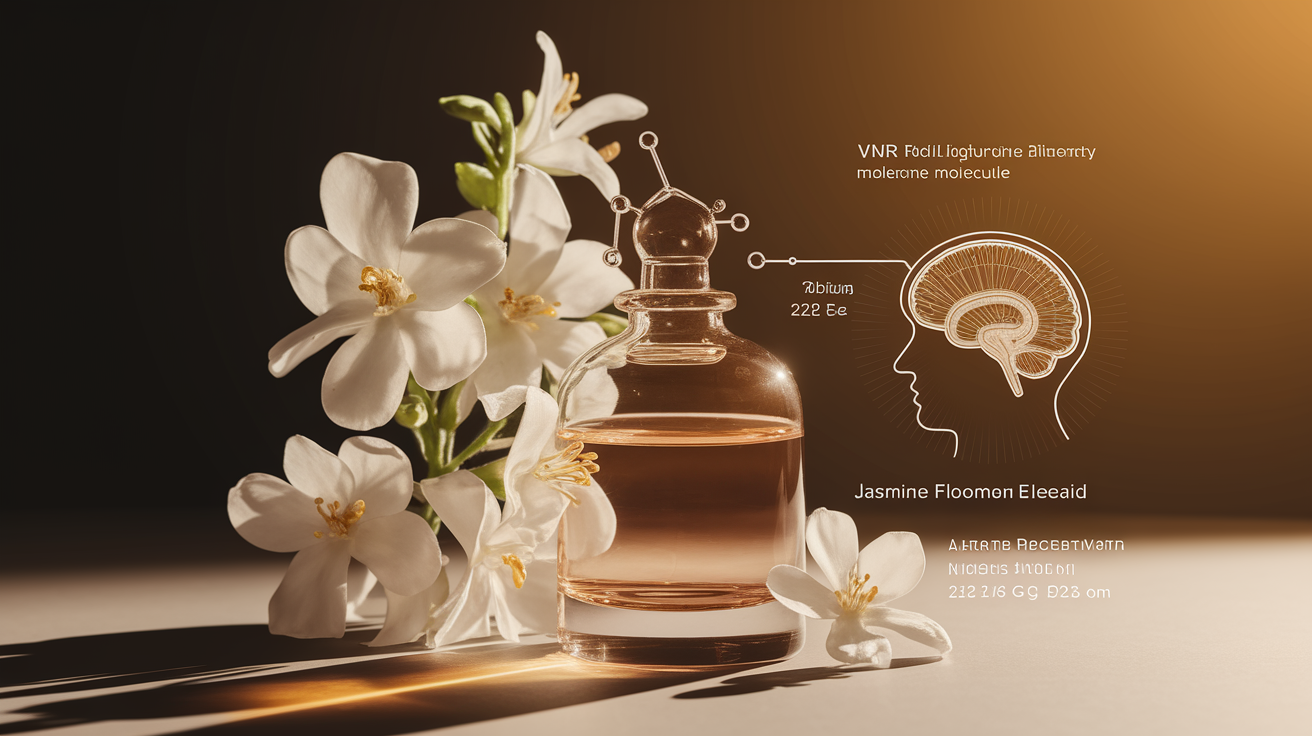
But here's what makes Hedione truly unique: A 2015 NeuroImage study discovered that Hedione activates the VN1R1 pheromone receptor in humans, "exhibiting significantly enhanced activation in limbic areas (amygdala, hippocampus) and eliciting a sex-differentiated response in hypothalamic regions associated with hormonal release."
Translation: Hedione doesn't just smell good—it activates different brain pathways than regular florals.
In this post, I'll explain why Hedione lasts 4-8 hours (not 2-4 like linalool or 12-24 like sandalwood), the science behind its unique "radiance" effect, how it performs in Indian climate, and why it's "probably the most widely used aroma chemical in all of perfumery."
Quick Answer: Hedione Longevity Chart
| Temperature | Hedione Longevity | Note Classification |
|---|---|---|
| 15°C (Cool/AC) | 6-10 hours | Middle-to-base note |
| 25°C (Room temp) | 4-8 hours | Middle note with fixative properties |
| 35°C (Indian summer) | 3-6 hours | Reduced but still longer than typical florals |
Comparison to other molecules:
| Molecule | MW | Longevity (25°C) | Longevity (35°C) | Character |
|---|---|---|---|---|
| Limonene (citrus) | 136 | 30-60 min | 20-40 min | Top note |
| Linalool (lavender) | 154 | 2-4 hours | 1.5-3 hours | Middle note |
| Hedione (jasmine) | 226 | 4-8 hours | 3-6 hours | Middle-to-base note |
| Santalol (sandalwood) | 220 | 12-24+ hours | 8-18 hours | Base note |
Key takeaway: Hedione lasts 2-3x longer than typical middle notes (linalool, geraniol) but shorter than heavy base notes (sandalwood, patchouli). Its unique brain-activating properties make it irreplaceable in modern perfumery.
What Is Hedione?
Hedione is the trade name for methyl dihydrojasmonate—a synthetic molecule related to natural methyl jasmonate (which comprises 2-3% of jasmine absolute).
Chemical formula: C₁₃H₂₂O₃ Molecular weight: 226.31 g/mol CAS Number: 24851-98-7 Appearance: Clear to pale yellow oily liquid
Discovery timeline (per Perfumer & Flavorist):
- 1957: Edouard Demole at Firmenich discovers methyl jasmonate in jasmine absolute
- 1958: First synthesis of Hedione (hydrogenated version) accomplished
- 1959: Methyl jasmonate synthesized
- 1960: Patents filed by Firmenich SA
- 1962: Scientific publications released
- 1966: Dior Eau Sauvage launches with 2.5% Hedione—groundbreaking usage
Etymology: Named from Greek ἡδονή (hedone) meaning "pleasure"—the same root as "hedonism." In Greek mythology, Hedone was the goddess of pleasure, daughter of Eros (love) and Psyche (soul).
Odor profile: Fresh, citric, slightly floral with a lightweight, pleasant, somewhat airy character. Perfumer & Flavorist notes that Hedione is "less overwhelmingly sweet, and initially elusive" compared to natural methyl jasmonate.
Why "Hedione" and not just "jasmine"?
As Basenotes perfumers observe: "Hedione is a strange molecule, most people are disappointed when they first smell it, but it is what it does to fragrance that is its strength."
It's not a jasmine replacement—it's a radiance and diffusion molecule that happens to be jasmine-derived.
Why Hedione Lasts 4-8 Hours
Molecular Weight (226.31 g/mol)
MW 226.31 puts Hedione in middle-to-base note territory:
- Top notes: MW 80-150 (last 1-2 hours)
- Middle notes: MW 150-220 (last 2-6 hours)
- Hedione: MW 226 (lasts 4-8 hours) - bridges middle and base
- Base notes: MW 220-350+ (last 8-24+ hours)
Hedione is 47% heavier than linalool (MW 154) and 66% heavier than limonene (MW 136)—explaining why it outlasts typical florals and citrus by 2-4 hours.
Extremely Low Vapor Pressure
Chemical database measurements show:
- Vapor pressure at 20°C: 0.09 Pa
- Vapor pressure at 25°C: 0.21 Pa
For comparison, linalool has vapor pressure ~200-300 Pa at 25°C. That means Hedione's vapor pressure is ~1000x lower than linalool.
Lower vapor pressure = slower evaporation = longer longevity.
Boiling point: 309-314°C at atmospheric pressure (extremely high—another indicator of low volatility)
Substantivity: 70+ Hours on Blotter
Industry testing shows Hedione lasts greater than 70 hours on a smelling strip (some sources cite up to 2 weeks).
Why the difference between blotter (70+ hours) and skin (4-8 hours)?
- Skin oils accelerate evaporation - lipophilic molecules like Hedione dissolve into sebum, increasing surface area and evaporation rate
- Body heat - skin temperature (32-37°C) higher than room temperature (20-25°C)
- Movement and airflow - wearing perfume on skin creates more air circulation than static blotter
- Absorption - some fragrance absorbs into skin layers vs. staying on blotter surface
Still, 4-8 hours on skin is excellent for a middle note—most florals fade in 2-4 hours.
The Radiance Effect: VN1R1 Pheromone Activation
This is what makes Hedione special beyond just longevity.
The 2015 NeuroImage Study
Wallrabenstein et al. (2015) published groundbreaking research in the peer-reviewed journal NeuroImage:
Key findings:
- Hedione activates the VN1R1 receptor in human olfactory epithelium
- VN1R1 is one of five remaining vomeronasal-type receptors in humans (evolutionary remnants of pheromone detection)
- When participants smelled Hedione (vs. control fragrance phenylethyl alcohol), brain scans showed "significantly enhanced activation in limbic areas (amygdala, hippocampus)"
- Sex-differentiated response in hypothalamic regions associated with hormonal release
What this means:
Hedione activates brain regions involved in emotion, memory, motivation, and hormonal regulation—not just the standard olfactory pathways.
This is the scientific basis for what perfumers have observed for decades: Hedione makes fragrances feel more "radiant," "diffusive," "present"—it's literally activating different neural circuits.
The "Halo Effect" Mechanism
Perfumers describe Hedione's effect as an "invisible glow" or "perfumed air." Here's the mechanism:
Chemical/Physical:
- Hedione's bicyclic structure allows easy interaction with olfactory receptors
- It creates "space between each molecule in a blend" (per perfumery education sources)
- This molecular spacing enhances diffusion without increasing strength
- Result: fragrance feels like it's floating around the wearer
Neurological:
- VN1R1 activation → enhanced limbic response → fragrance feels more emotionally resonant
- Sex-differentiated hypothalamic response → potential pheromone-like signaling
- Stronger memory/emotion associations than typical florals
Practical result: Fragrances with Hedione project better, transition smoother between notes, and create an impression of "radiance" without weight or cloying sweetness.
As perfumer Jean-Claude Ellena put it: "Hedione is not a component. It's support." He used Hedione in all his Hermès formulas as an alternative to musks.
Temperature Impact: India Climate Performance
How does Hedione perform in hot weather?
| Temperature | Estimated Longevity | Notes |
|---|---|---|
| 15°C (Cool/AC) | 6-10 hours | Slower evaporation, extended wear |
| 25°C (Room temp) | 4-8 hours | Standard performance |
| 35°C (Indian summer) | 3-6 hours | ~25-37% reduction |
| 40°C (Delhi peak summer) | 3-5 hours | Noticeable but still longer than typical florals |
Why temperature matters:
Vapor pressure increases exponentially with temperature. Every 10°C increase roughly doubles evaporation rate for most molecules.
Comparison at 35°C (Mumbai/Delhi summer):
| Molecule | 25°C Longevity | 35°C Longevity | % Reduction |
|---|---|---|---|
| Limonene | 30-60 min | 20-40 min | 50% |
| Linalool | 2-4 hours | 1.5-3 hours | 37.5% |
| Hedione | 4-8 hours | 3-6 hours | 25-37% |
| Santalol | 12-24 hours | 8-18 hours | 33% |
Hedione's low starting vapor pressure (0.09-0.21 Pa) means it's less temperature-sensitive than lighter molecules. Even when hot, it still outlasts typical middle notes by 2-3 hours.
Practical implication for Indian climate: Hedione-heavy fragrances (Eau Sauvage, Acqua di Gio, CK One) perform well in hot weather—expect 3-6 hour longevity vs. 4-8 hours in cooler climates.
Hedione vs. Natural Jasmine & Other Jasmonates
Hedione vs. Natural Methyl Jasmonate
| Property | Hedione (Methyl Dihydrojasmonate) | Methyl Jasmonate (Natural) |
|---|---|---|
| Source | 100% synthetic | 2-3% of jasmine absolute |
| Odor | Less sweet, subtle, airy | Deep, fatty, floral, magnolia-like |
| Cost | Economical (~$50-100/kg) | Expensive (~$500-1000/kg) |
| Usage level | 1-50% (extraordinary range) | 5-10% typical (too strong at high%) |
| Diffusion | Excellent "halo effect" | Concentrated, less diffusive |
Perfumer & Flavorist explains: "Perfumers were struck by methyl jasmonate's exquisite jasmine, deep, fatty, floral and authentic aspects, and unanimously preferred it to its dihydroanalogue hedione, which was less overwhelmingly sweet, and initially elusive."
But over time, perfumers discovered Hedione's unique strength: radiance and diffusion at concentrations impossible with methyl jasmonate.
Hedione vs. Other Synthetic Jasmine Molecules
Splendione (Firmenich's synthetic methyl jasmonate):
- Closer to natural jasmine smell
- "Smells nicer than Hedione" per many perfumers
- More expensive, used at lower concentrations
- Less radiance/diffusion effect
Jasmonyl (Givaudan) and Jasmelia (IFF):
- Pyran derivatives with jasmine-lactone character
- Celery/mushroom undertones
- Different odor profile than Hedione
- Less widely used
Why Hedione dominates: Cost-effectiveness + extensive formulation history + unique radiance effect + extraordinary usage flexibility (1-50%).
Now: Hedione is "probably the most widely used aroma chemical in all of perfumery."
Famous Perfumes Featuring Hedione
Eau Sauvage (Dior, 1966) - The Breakthrough
Created by legendary perfumer Edmond Roudnitska, Eau Sauvage was the first masculine fragrance for Christian Dior.
Formula: Classic cologne (bergamot + lemon) + strong dose of Hedione (~2.5%) + oakmoss base
Innovation: Perfume historians note that "Roudnitska saw the nucleus of the first masculine perfume for Dior... The secret to Eau Sauvage's continued success is Roudnitska's pioneering use of the molecule hedione."
Effect: The Hedione created a "lighting up" effect—bergamot and lemon felt more radiant, diffusive, and elegant than typical citrus colognes. The fragrance had presence without weight.
Legacy: Established Hedione as a perfumery staple. Before Eau Sauvage, Hedione was barely used; after 1966, it became essential.
CK One (Calvin Klein, 1994) - The Unisex Revolution
Hedione's role: Bridges green tea top note → amber base Effect: Lifts bergamot, lemon, mandarin; smooths transitions
The transparent, airy quality of CK One owes much to Hedione's diffusion properties.
Acqua di Gio (Armani, 1996) - The Aquatic Icon
Hedione's role: Amplifies aquatic accord diffusion Effect: Enhances citrus radiance (bergamot, neroli, green tangerine); boosts marine freshness
Hedione makes the fragrance feel like it's surrounding you, not just sitting on skin.
J'adore (Dior, 1999) - The Floral Masterpiece
Created by Calice Becker.
Hedione's role: Amplifies luminosity of ylang-ylang, Damascus rose, jasmine Effect: Boosts diffusion and longevity; creates "golden" radiant quality
Other Notable Uses
- Chanel Chance Eau Tendre: Jasmine-grapefruit radiance
- Hermès fragrances (Jean-Claude Ellena era): Hedione in all formulas as musk alternative
- Most modern designer fragrances: Some level of Hedione for diffusion enhancement
Usage Levels: 1-50% (Extraordinary Range)
This is unusual. Most fragrance ingredients have narrow usage windows:
- Linalool: 5-15% typical
- Geraniol: 5-15% typical
- Iso E Super: 5-20% typical
- Hedione: 1-50% (per formulation guidelines)
Why such flexibility?
| Hedione % | Effect |
|---|---|
| 1-3% | Subtle background radiance, barely noticeable as distinct note |
| 5-10% | Clear jasmine character, good diffusion, signature presence |
| 10-20% | Dominant radiance, strong "halo effect," airy/transparent style |
| 20-50% | Experimental, very diffusive, "perfumed air" sensation |
Hedione doesn't become overwhelming at high concentrations—it just creates more transparency and diffusion.
IFRA standards: Generous allowance for fine fragrance (no restrictive limits found in public documents)
Cis vs. Trans Isomers: High Cis Variants
Hedione has two stereoisomers: cis and trans.
Standard Hedione: 9:1 trans:cis mixture
Key difference: Chemistry research shows the cis-isomer has a detection threshold seventy times lower than trans-isomer—meaning it's 70x more potent.
High Cis variants:
- Cepionate: 30% cis
- Kharismal: 60% cis
- Hedione HC: 75% cis
Odor difference:
- Cis-isomer: More radiant, airy, diffusive floral character
- Trans-isomer: Warmer, more rounded character
Stability challenge: Cis-isomers are thermodynamically less stable and will isomerize to trans form over time. High Cis variants require cool, dark storage.
Most perfumers use: Standard Hedione (9:1 trans:cis) for cost, stability, and proven performance.
How to Maximize Hedione Longevity
Hedione already lasts 4-8 hours, but you can extend it:
1. Layer with Fixatives
Apply base notes first:
- Sandalwood (creamy + jasmine synergy)
- Patchouli (earthy depth)
- Vanilla (sweet fixative)
Then apply Hedione-rich fragrance on top. Combined longevity: 8-12+ hours.
2. Higher Concentration Formulas
- Eau de Toilette (5-15%): 3-6 hours
- Eau de Parfum (15-20%): 6-10 hours
- Perfume/Extrait (20-30%+): 10-15 hours
More Hedione molecules = longer perceived presence.
3. Apply to Cooler Skin Areas
- Inside elbows (cooler than wrists)
- Behind ears
- Back of knees
Cooler areas = slower evaporation = 30-60 min extra longevity.
4. Oil-Based vs. Alcohol-Based
- Alcohol-based EDT/EDP: 4-8 hours (standard)
- Oil-based attar: 6-10 hours (slower evaporation)
Oil formulations extend Hedione's release.
Key Takeaways
Hedione longevity:
- ✓ 4-8 hours at 25°C (room temperature)
- ✓ 3-6 hours at 35°C (Indian summer)
- ✓ 6-10 hours at 15°C (cool weather)
- ✓ 70+ hours on paper/blotter
Why it lasts:
- Molecular weight 226.31 (middle-to-base note territory)
- Vapor pressure 0.09-0.21 Pa (1000x lower than linalool)
- Chemical stability (resistant to oxidation and photodegradation)
The radiance effect:
- Activates VN1R1 pheromone receptor in human brain (2015 NeuroImage study)
- Enhanced limbic activation (emotion, memory, motivation)
- Sex-differentiated hypothalamic response
- Creates "halo effect" through molecular spacing and diffusion
- "Invisible glow" around fragrance
Usage:
- Most widely used aroma chemical in perfumery
- Can be used 1-50% (extraordinary range vs. typical 5-15%)
- Featured in Eau Sauvage, CK One, Acqua di Gio, J'adore, countless others
- Named from Greek "hedone" (ἡδονή) = pleasure
Comparison:
- 2-3x longer than typical middle notes (linalool, geraniol)
- Shorter than heavy base notes (sandalwood, oud)
- Less temperature-sensitive than lighter florals
India climate:
- Performs well in hot weather (25-37% longevity reduction vs. 50% for citrus)
- 3-6 hour longevity at 35°C still excellent for middle note
Bottom line: Hedione is the pleasure molecule that lasts 4-8 hours while creating radiance, diffusion, and unique brain activation. It's not just synthetic jasmine—it's the backbone of modern airy, transparent perfumery.
Further Reading
Want to understand longevity of other molecules?
- Perfume Molecule Longevity Chart: Complete MW Guide - Master reference hub
- Linalool Longevity: Lavender's 2-4 Hour Lifespan - Similar middle note duration
- Geraniol Longevity: How Long Does Rose Last? - Floral middle note comparison
- Calone Longevity: The Aquatic Molecule - Fresh marine character
- Cashmeran Longevity: Velvety Woody Musk - Longer-lasting base note
- 11 Fascinating Fragrance Chemistry Facts - Surprising discoveries
Looking for perfumes formulated for Indian climate? Browse our collection →
References
- Wallrabenstein, I., Gerber, J., Rasche, S., et al. (2015). 'The smelling of Hedione results in sex-differentiated human brain activity.' NeuroImage, 113, 365-373
- Demole, E. (1962). 'Research on jasmine absolute composition.' Firmenich SA, Geneva
- Tamura et al. 'General enantioselective approach to jasmonoid fragrances.' Journal of Organic Chemistry
- Perfumer & Flavorist. 'Let There Be Light: 50 Years of Hedione'
- Perfumer & Flavorist. 'The Chemistry and Creative Legacy of Methyl Jasmonate and Hedione'
- PubChem. 'Compound Summary for CID 102861, Methyl Dihydrojasmonate'
- ChemicalBook. 'Methyl dihydrojasmonate chemical properties'
- The Good Scents Company. 'Methyl dihydrojasmonate hedione database'
- Fragrantica. 'Hedione perfume ingredient profile'
- Basenotes Community Forum. 'Hedione discussions and effects'
- University of Bristol. 'Jasmine - Molecule of the Month'
- Scentspiracy. 'Hedione usage and formulation guidelines'

About Syed Asif Sultan
Founder of House of Sultan. Passionate about fragrance chemistry and transparency in perfumery.