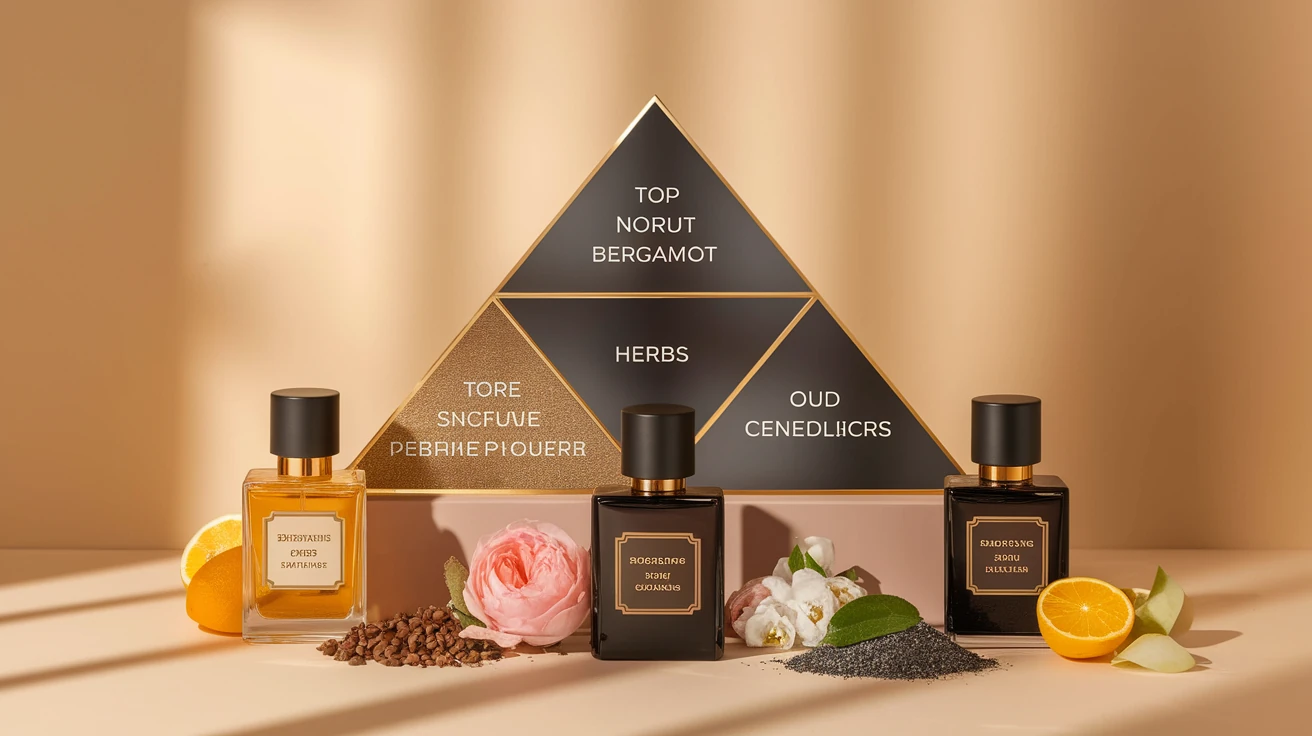
Three months into learning perfumery, I made my first "complete" fragrance.
Mixed bergamot, jasmine, and sandalwood in what I thought were perfect proportions. Sprayed it on my wrist at 9 AM. Smelled incredible - bright, fresh, elegant.
By 9:30 AM, the bergamot was gone. Just... vanished.
By 11 AM, only jasmine remained.
By 3 PM, pure sandalwood. A completely different perfume.
I thought I'd done something wrong. Turns out, I'd done everything right.
That's the perfume pyramid. And if you don't understand it, you'll never know why your ₹8,000 Dior smells like three different fragrances throughout the day.
What the Perfume Pyramid Actually Is
Every fragrance has three layers:
Top Notes (0-30 minutes): What you smell immediately when you spray. Bergamot, lemon, fresh herbs, aldehydes.
Heart Notes (30 minutes - 4 hours): What emerges after top notes fade. Jasmine, rose, lavender, spices.
Base Notes (4+ hours): What remains at the end. Sandalwood, oud, amber, vanilla, musk.
This isn't marketing. It's chemistry.
Each layer is defined by one thing: molecular weight.
The Science: Molecular Weight Determines Everything
Here's what perfume brands never explain:
Light molecules evaporate fast. Heavy molecules evaporate slow.
That's it. That's the entire pyramid.
Let me show you actual molecular weights:
Top Notes (Light - Evaporate in 30 minutes):
- Limonene (citrus): 136 g/mol
- Linalool (lavender): 154 g/mol
- Bergamot acetate: 196 g/mol
Heart Notes (Medium - Last 2-4 hours):
- Linalyl acetate (jasmine): 196 g/mol
- Geraniol (rose): 154 g/mol
- Eugenol (clove): 164 g/mol
Base Notes (Heavy - Last 12-24+ hours):
- Santalol (sandalwood): 220 g/mol
- Patchouli alcohol: 222 g/mol
- β-caryophyllene (oud): 204 g/mol
Notice the pattern?
The heavier the molecule, the slower it evaporates. A 136 g/mol citrus molecule zips off your skin in minutes. A 220 g/mol sandalwood molecule takes hours.
This is basic physics: vapor pressure is inversely proportional to molecular weight.
Translation: Heavy things don't fly away easily.
Why Your Perfume Smells Different After 2 Hours
Most people think their perfume "faded."
Wrong. It evolved.
When you first spray a well-made perfume, you smell all three layers at once - but the top notes dominate because they're hitting your nose first (high volatility = aggressive projection).
After 30 minutes, top notes have mostly evaporated. Now you smell primarily heart notes, with base notes emerging underneath.
After 4 hours, only base notes remain - the heavy molecules that take all day to evaporate.
This is the intended design.
A good perfume tells a story:
- Opening: Fresh, bright, attention-grabbing (top notes)
- Middle: Complex, floral or spicy, the "personality" (heart notes)
- Dry-down: Warm, woody, sensual, intimate (base notes)
If your perfume smells exactly the same from hour 1 to hour 8, it's either:
- Made entirely of base notes (linear fragrance)
- Synthetic fixatives masking the evolution
- Low quality (all molecules evaporating at once)
The Indian Climate Problem
Here's where it gets tricky.
At 35°C (typical Mumbai afternoon), molecular movement increases by 15-20% compared to 20°C (European climate).
This speeds up the entire pyramid.
What takes 30 minutes in Paris takes 20 minutes in Delhi. What lasts 4 hours in London lasts 2.5 hours in Chennai.
European perfumes are formulated for 15-25°C. We live in 30-40°C year-round.
This is why every international perfume you buy feels "weak" in India. It's not weak - it's just evaporating twice as fast as intended.
Our Solution for Indian Heat
At House of Sultan, we compensate by:
-
Reducing top note concentration: 10-15% instead of 20-25%
- Top notes evaporate so fast in heat that high concentration is wasted
- We use just enough for initial impression
-
Increasing heart note duration: 35-40% instead of 30%
- Heart notes become the "stable middle phase"
- Where the fragrance spends most of its life
-
Boosting base note weight: 45-50% instead of 40%
- Heavy molecules resist Indian heat better
- This is why our fragrances last 24+ hours on tissue
Standard European pyramid:
- Top: 20-30%
- Heart: 40-50%
- Base: 30-40%
House of Sultan pyramid (climate-adjusted):
- Top: 10-15%
- Heart: 35-40%
- Base: 45-50%
Same ingredients. Different proportions. Radically different longevity in 35°C heat.
The Three Layers in Detail
Top Notes: The 30-Minute Sprint
These are your attention-grabbers. Bright, fresh, immediate.
Common top note materials:
- Citrus oils (bergamot, lemon, orange, grapefruit)
- Fresh herbs (basil, mint, rosemary)
- Light spices (pink pepper, cardamom)
- Aldehydes (that "Chanel No. 5 sparkle")
Why they disappear fast:
Small molecules = high vapor pressure = aggressive evaporation.
Limonene (136 g/mol) has a boiling point of 176°C. At skin temperature (32-35°C), it's constantly evaporating - just slowly.
But in hot, humid India? That evaporation accelerates. A 35°C day with 80% humidity creates the perfect storm for top note loss.
The bergamot test:
Pure bergamot oil on skin:
- 20°C (Paris): Detectable for ~45 minutes
- 35°C (Mumbai): Detectable for ~20 minutes
Same oil. Same concentration. Completely different performance based on temperature alone.
This is why cheap perfumes use synthetic "super citrus" molecules - they're designed to last longer than natural bergamot. But they smell harsh, one-dimensional, "fake."
We use real bergamot in Sinbad (our citrus-forward blend) - but we compensate with higher heart note concentration so the fragrance doesn't collapse after 30 minutes.
Heart Notes: The 4-Hour Story
This is the soul of the perfume. Where the real artistry lives.
Common heart note materials:
- Florals (jasmine, rose, ylang-ylang, iris)
- Spices (cinnamon, clove, nutmeg)
- Fruity esters (peach, plum, apricot)
- Green notes (violet leaf, geranium)
Why they last longer:
Medium molecular weight = moderate vapor pressure = controlled evaporation.
Jasmine's key molecule, linalyl acetate (196 g/mol), has a boiling point of 220°C. At skin temperature, it evaporates slowly - giving you 2-4 hours of wear.
The jasmine curve:
Real jasmine absolute:
- 0-30 min: Masked by top notes, barely detectable
- 30 min - 2 hours: Full bloom, dominant smell
- 2-4 hours: Fading gracefully into base
- 4+ hours: Merged with sandalwood/oud, unrecognizable
This curve is perfection. It's how perfume is supposed to work.
But most brands rush it. They use synthetic "super jasmine" (hedione, methyl dihydrojasmonate) that projects aggressively from minute one.
Result? Smells great in-store. Becomes a chemical headache after 30 minutes. Fades completely by hour 2.
We use natural jasmine sambac (from Madurai, India) in small quantities - just enough to create depth without overwhelming. Paired with rose absolute and a hint of cardamom.
The heart notes in Rustam (our signature oud blend) last 6-8 hours in Indian heat. Not because we use more jasmine, but because we balance it correctly with base notes.
Base Notes: The 24-Hour Foundation
These are your staying power. The molecules that linger on clothes for days.
Common base note materials:
- Woods (sandalwood, cedarwood, oud, vetiver)
- Resins (amber, benzoin, frankincense)
- Musks (synthetic white musk, ambroxan)
- Vanilla (vanillin, ethyl vanillin)
Why they last all day:
Heavy molecular weight = low vapor pressure = extremely slow evaporation.
Santalol (220 g/mol) has a boiling point above 300°C. At skin temperature, it barely evaporates at all. This is why sandalwood can last 24+ hours on fabric.
The oud test:
Pure agarwood oil (oud) on tissue:
- Day 1: Strong, resinous, almost medicinal
- Day 3: Mellowed, woody, warm
- Day 7: Still detectable if you press nose to paper
This is real longevity. This is why base notes cost 10-50x more than top notes by weight.
Cheap perfumes use "ISO E Super" (synthetic woody molecule) as base. It's cheap (₹800/kg vs ₹12,000/kg for real sandalwood), projects well, lasts long.
But it smells identical in every perfume. No depth. No character. Just "generic woody smell."
We use:
- Sandalwood: 70% Australian plantation + 30% synthetic santalol (sustainability + cost balance)
- Oud: Grade A plantation agarwood, steam-distilled (₹12,000/kg)
- Vanilla: Real vanilla absolute from Madagascar (₹8,500/kg)
These aren't cheap. But they're the reason our base notes smell rich, complex, natural - instead of flat and synthetic.
How to Read a Fragrance Pyramid (Practical Test)
Here's how to actually experience the pyramid in any perfume:
The 8-Hour Test:
- 9 AM: Spray perfume on wrist
- 9:05 AM: First impression = top notes (bright, fresh, citrusy)
- 9:30 AM: Top notes fading = heart notes emerging
- 11 AM: Pure heart notes (floral, spicy, complex)
- 2 PM: Heart notes fading = base notes dominating
- 5 PM: Pure base notes (woody, warm, musky)
- 9 PM: Deep base notes (skin scent, intimate)
- Next morning: Faint trace on clothes = only heaviest base molecules
If your perfume doesn't follow this curve, it's either:
- All top notes (cheap, fades in 2 hours)
- All base notes (linear, boring, never evolves)
- Badly balanced (smells great for 30 min, then collapses)
A well-made perfume should tell a story across 8+ hours.
The Pyramid in Rustam (Our Formulation)
Let me show you our actual pyramid for Rustam:
Top Notes (12%):
- Pink pepper (molecular weight 136): 4%
- Bergamot (limonene, MW 136): 5%
- Cardamom (cineole, MW 154): 3%
Heart Notes (38%):
- Rose absolute (geraniol, MW 154): 12%
- Saffron (safranal, MW 150): 8%
- Jasmine sambac (linalyl acetate, MW 196): 10%
- Cedarwood (cedrol, MW 222): 8%
Base Notes (50%):
- Agarwood/Oud (sesquiterpenes, MW 204): 20%
- Sandalwood (santalol, MW 220): 15%
- Amber accord (labdanum, MW 306): 10%
- Vanilla absolute (vanillin, MW 152): 5%
Notice the distribution: Only 12% top notes. Heavy bias toward base.
This is climate compensation. In 35°C Mumbai heat, this pyramid becomes:
- Top notes: 20 minutes
- Heart notes: 4-6 hours
- Base notes: 18-24 hours on tissue
If we used the European standard (25% top, 45% heart, 30% base), the same heat would give us:
- Top notes: 15 minutes (wasted excess)
- Heart notes: 2-3 hours (too short)
- Base notes: 6-8 hours (nowhere near 24)
Molecular weight distribution matters more than ingredient quality for longevity.
Common Pyramid Mistakes (What Brands Get Wrong)
Mistake 1: Too Many Top Notes
Walk into any department store. Spray Zara/H&M/Bath & Body Works.
First impression: "Wow, this smells amazing!"
30 minutes later: Almost gone.
2 hours later: Completely gone.
Why? They loaded 30-40% top notes to create a strong "first spray" impression. You smell it in-store, buy it immediately.
But there's no foundation. No base notes. Nothing to anchor those light molecules.
It's like building a house with just a roof - looks good initially, collapses immediately.
Mistake 2: Skipping Heart Notes
Budget brands often go:
- 20% top notes (cheap citrus synthetics)
- 10% heart notes (minimal, just for label)
- 70% base notes (ISO E Super, cheap woody synthetic)
Result: Smells fresh for 30 minutes, then becomes "generic department store smell."
No story. No evolution. Just top notes → nothingness → synthetic wood.
Heart notes are expensive (jasmine absolute: ₹18,000/kg, rose absolute: ₹25,000/kg). So budget brands minimize them.
But heart notes are the personality. Without them, every perfume smells identical.
Mistake 3: Synthetic Base Notes Only
ISO E Super, Ambroxan, Cashmeran - these are the three molecules in 80% of modern perfumes.
They're cheap, safe, last long, project well.
They're also boring.
Real sandalwood costs ₹12,000/kg. Synthetic santalol costs ₹2,400/kg.
Real oud costs ₹50,000/kg (wild) or ₹12,000/kg (plantation). Synthetic oud costs ₹800/kg.
Guess which one most brands use?
You can't smell the difference in-store (first 30 seconds = top notes anyway). But after 4 hours? The synthetic base smells flat, one-dimensional, chemically.
We use hybrid: natural base notes + small amount of synthetics for fixation. Best of both worlds.
How We Test Our Pyramid
Every batch of House of Sultan perfume goes through the same test:
The 24-Hour Multi-Point Evaluation:
9 AM: Spray on 3 test strips
- Strip 1: Evaluate at 30 min (top note fade)
- Strip 2: Evaluate at 4 hours (heart note dominance)
- Strip 3: Evaluate at 24 hours (base note persistence)
Pass/Fail Criteria:
- Top notes must be present but not overwhelming at 5 minutes
- Heart notes must be clearly detectable at 2-4 hours
- Base notes must be recognizable at 24 hours
If any strip fails, entire batch rejected. We re-macerate, adjust proportions, test again.
This is why our perfumes cost ₹1,199 instead of ₹299. Testing + time + quality control.
What This Means for You
Next time you test a perfume, don't judge it in 30 seconds.
Do this instead:
- Spray on wrist
- Wait 30 minutes (let top notes fade)
- Smell again (is there depth? complexity? or just "alcohol smell"?)
- Wait 4 hours (is anything left? or completely gone?)
- Check clothes next morning (can you still detect base notes?)
If it passes all 5 checkpoints, it's well-made.
If it fails at step 3 or 4, it's poorly balanced - no matter how good it smelled initially.
This is why we guarantee 24-hour longevity. We know our pyramid works because we test it obsessively.
The Real Reason Pyramids Matter
Most people think perfume is about "smelling good."
Wrong. Perfume is about change.
A perfume that smells the same from hour 1 to hour 8 is boring. Linear. One-dimensional.
A perfume that evolves - bright → floral → woody - is interesting. Complex. Worth wearing.
The pyramid creates that evolution. Light molecules evaporate first (top notes). Medium molecules emerge (heart notes). Heavy molecules remain (base notes).
It's chemistry creating art.
And if you understand this, you'll never waste money on a fragrance that "smells great in-store" but disappears in 2 hours.
Next time you spray Rustam, pay attention:
- 0-20 minutes: Pink pepper, bergamot, cardamom (the greeting)
- 20 minutes - 4 hours: Rose, saffron, jasmine (the conversation)
- 4-24 hours: Oud, sandalwood, amber (the memory)
Three different fragrances. One bottle. That's the pyramid.
And that's why you can wear it at 9 AM and still smell it on your shirt the next morning.
The chemistry works. You just needed to understand it.
References
- Sell, C.S. (2006). The Chemistry of Fragrances: From Perfumer to Consumer (2nd ed.). Royal Society of Chemistry, Cambridge. ISBN: 0-85404-824-7
- Turin, L. & Sanchez, T. (2008). Perfumes: The A-Z Guide. Viking Press, New York. ISBN: 978-0-670-01865-1
- Calkin, R.R. & Jellinek, J.S. (1994). Perfumery: Practice and Principles. John Wiley & Sons, New York. ISBN: 0-471-58154-9
- Ohloff, G., Pickenhagen, W., & Kraft, P. (2011). Scent and Chemistry: The Molecular World of Odors. Wiley-VCH, Zurich. ISBN: 978-3-906390-36-2

About Syed Asif Sultan
Founder of House of Sultan. Passionate about bringing premium, climate-optimized fragrances to India at honest prices.