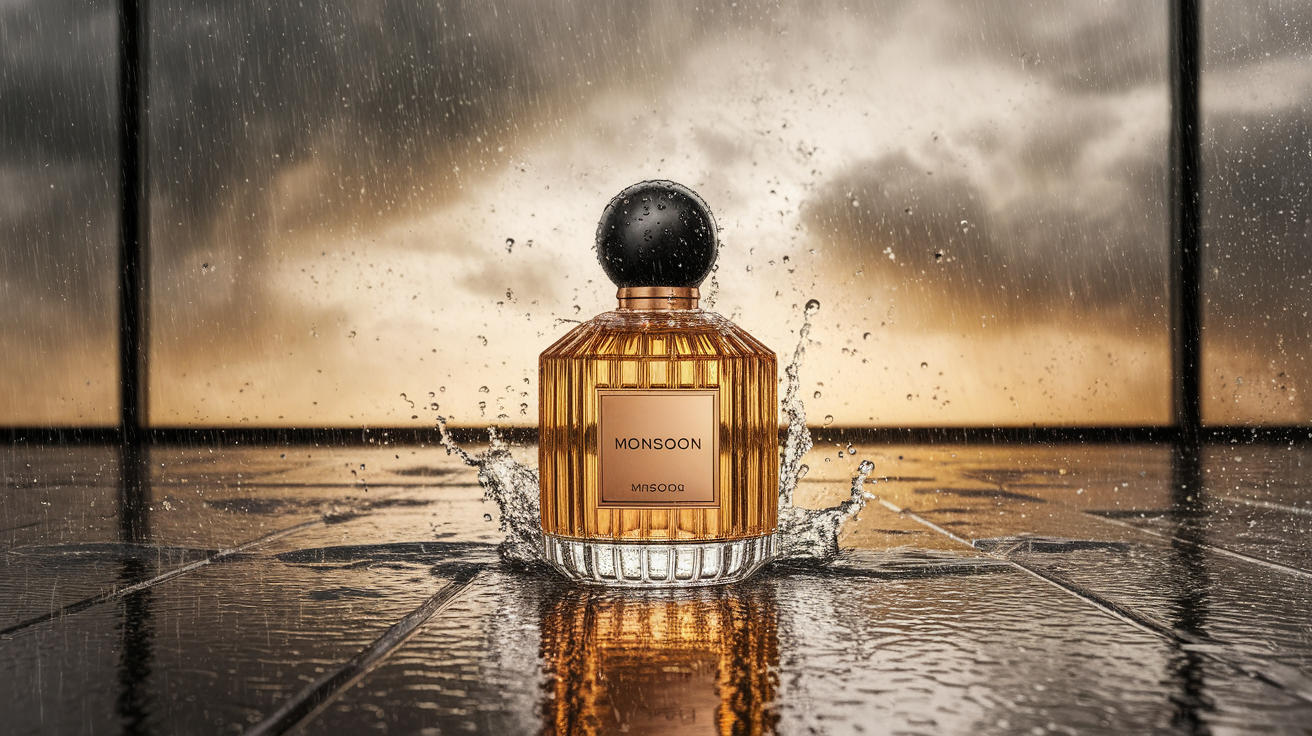
July in Mumbai. 89% humidity hangs in the air like a wet blanket. You walk out of your air-conditioned apartment wearing that ₹15,000 Tom Ford that smells sophisticated in the store. Thirty minutes later, it's not just weak—it smells completely different. That bright bergamot opening? Barely detectable. That subtle amber base you liked? Overwhelming everyone in the elevator.
What changed? Your perfume didn't go bad. The monsoon rewrote its chemistry.
At 90% humidity, your perfume doesn't just last less—it develops backwards. Top notes get suppressed. Base notes amplify. What was balanced becomes heavy. What was fresh becomes cloying.
This guide will explain exactly why this happens, which fragrances actually survive India's monsoon season, and which traditional Indian perfumes have solved this problem for centuries.
The Science: How 90% Humidity Rewrites Perfume Chemistry
You know perfume is supposed to develop in three stages: top notes (first 15 minutes) → middle notes (next 3-4 hours) → base notes (final 6-8 hours). Clean progression. Predictable.
That's in normal humidity (40-60%). At 90% monsoon humidity, all bets are off.
What Happens to Perfume at 90% Humidity
Research by JK Aromatics explains the mechanism: "Humidity affects how volatile compounds in perfume evaporate. The water vapor in the air slows down evaporation for some molecules and speeds it up for others."
Here's what this means in practice:
Top Notes (Light Molecules: Citrus, Aldehydes, Fresh Notes)
- In normal humidity: Evaporate cleanly in 15-30 minutes, creating bright opening
- At 90% humidity: "Top notes can actually get suppressed in very humid conditions"
- Result: Your fresh opening smells muted or disappears entirely
Base Notes (Heavy Molecules: Oud, Amber, Vanilla, Musk)
- In normal humidity: Emerge gradually after 4-6 hours, subtle and balanced
- At 90% humidity: "Middle and base notes become more prominent"
- Result: Heavy notes that should be subtle become OVERWHELMING within 1-2 hours
JK Aromatics describes the problem: "This creates an imbalanced fragrance development. Heavy fragrances feel overwhelming rather than fresh."
Real User Experiences from Basenotes
The fragrance community on Basenotes confirms this dramatically:
"If a sudden rainstorm rolls through, the fragrance can project suddenly like a monster."
One user reported wearing Kouros in rainy, super humid conditions: "Turned fecal/rancid even in open air" - describing how natural animalic notes can smell completely different at extreme humidity.
Another Basenotes discussion notes: "Very humid days often limit wearers to aquatics or fresh fragrances outdoors" - explaining why heavy perfumes become unwearable during monsoon.
India's Monsoon Humidity: The Official Data
How humid is "monsoon humid"? Let's look at the actual data:
Mumbai (Peak Monsoon):
- July average: 89% humidity
- Range: 73.8% to 96.3% during monsoon months
- When rain starts in June: Humidity jumps from 60% to 90%
Delhi (Monsoon Season):
- September average: 82% humidity
- Range: 55.4% to 98.2% during monsoon
- Massive jump from normal 46% average
The Bottom Line: When Indian Climate data shows monsoon winds bringing "humidities of more than 80% with heavy squally showers," your perfume is operating in conditions it wasn't designed for—unless it's specifically engineered for extreme humidity.
Oil-Based vs Alcohol-Based Perfumes in Monsoon: The 2-3x Performance Gap
Here's a fact that changes everything about monsoon fragrance selection: Oil-based attars last 2-3 times longer than alcohol-based perfumes in high humidity.
The Research: Why Oils Outlast Alcohol in Moisture
[Kannauj Heaven's longevity study](https://kannauj heaven.com/blogs/news/the-longevity-battle-perfume-vs-attar) reveals the performance gap:
Oil-based perfumes: "Evaporate slower, allowing fragrance to cling to skin for long-lasting"
Alcohol-based perfumes: "Exhibit rapid evaporation with longevity typically reduced to moderate longevity"
Performance gap: Oil-based lasts 2-3x longer in monsoon humidity.
Why This Happens: The Science
Noorson's fragrance longevity research explains the moisture resistance:
"Oil-based attars are more resilient in wet weather. Unlike alcohol, oils do not evaporate quickly in moisture-heavy air and cling to skin while diffusing slowly for a steady, long-lasting scent."
Think about it: Alcohol evaporates at 78°C. In 90% humidity, the air is already saturated with water vapor. Alcohol-based perfumes evaporate into this moisture-heavy air and get diluted, dispersed, washed away by rain.
Oil-based attars? They sit on your skin, gradually releasing fragrance molecules without rapid evaporation. The humidity can't dilute what isn't evaporating quickly.
The Traditional Indian Wisdom
There's a reason attars have been the traditional perfume format in India for centuries. Multiple Indian perfume sources note: "Traditional Indian oil-based perfumes loved for centuries, especially in climates like India's where humidity is a way of life."
Indian perfumers knew about monsoon humidity long before Western perfume houses existed. They engineered oil-based solutions specifically for these conditions.
Practical Monsoon Longevity Data
Sac Herbal's attar performance study provides real-world data:
"Indian attars with rich bases of sandalwood or vetiver can often still be smelled on the skin 8 to 10 hours after application."
Compare that to alcohol-based perfumes during monsoon: moderate longevity typical, often less if you get caught in rain.
The Cultural Heritage: Mitti Attar - India's Traditional Rain Perfume
Before we talk about modern perfume recommendations, let's explore the perfume that has captured the monsoon experience for centuries: Mitti Attar, the traditional Indian perfume that literally smells like rain.
What is Mitti Attar (Petrichor Perfume)?
"Mitti means 'earth' - mitti attar loosely translates to the smell of rain-soaked earth" - Outlook Traveller
You know that smell when the first drops of monsoon rain hit dry earth? That fresh, earthy, almost electric scent? Scientists call it "petrichor." In Kannauj, India's perfume capital, they've been capturing it in bottles for centuries.
Kannauj: India's Perfume Capital for 400+ Years
Atlas Obscura's feature on Indian rain perfume explains Kannauj's unique position:
"Generations of perfumers have used kulhads and other clay materials to capture mitti attar. The fragrance is made only here in Kannauj using a special, centuries-old technique."
Kannauj, a small town in Uttar Pradesh, became India's perfume capital because of innovations like mitti attar. The Better India reports: "After centuries of incessant efforts, ancient Indian scientists and perfumers were successful in capturing this unique scent in a bottle."
The Traditional Production Method: Deg & Bhapka Technique
How do you capture the smell of rain? With a production method that hasn't changed in 400 years:
Step 1: Earthenware Preparation Sun-baked clay pots (kulhads) and water are poured into copper vats called "degs"
Step 2: Sealing The vats are sealed shut with mud - no modern machinery
Step 3: Distillation A cow-dung fire is lit underneath. The heat creates steam that carries fragrance molecules from the earthenware.
Step 4: Condensation The Better India describes: "Steam carries the fragrant molecules from the earthenware through bamboo pipe into the bhapka, where it condenses over Mysore Sandalwood Oil."
Result: An oil-based attar that captures geosmin - the actual chemical molecule responsible for the rain scent.
Why Mitti Attar is Perfect for Monsoon
- Oil-based resilience: lasts throughout the day longevity even in 90% humidity
- Monsoon nostalgia: Captures the actual smell of rain (geosmin molecule)
- Moisture-resistant: Won't wash away in rain like alcohol-based perfumes
- Traditional wisdom: Engineered specifically for Indian monsoon over centuries
We're not saying mitti attar is the "best" monsoon perfume - but it represents centuries of Indian perfume wisdom about humidity-resistant formulations.
What Works in 90% Humidity (Research-Backed Recommendations)
Based on research from JK Aromatics, Basenotes community discussions, and oil-based attar performance data, here's what actually survives monsoon conditions:
Category 1: Light Aquatic Fragrances (Basenotes-Verified)
Why these work at 90% humidity:
- Synthetic aquatic molecules don't "turn" like natural ingredients
- JK Aromatics recommends: "Aquatic fragrances create clean, transparent, fresh impressions using stable synthetic molecules"
- Won't amplify into overwhelming projection when humidity hits
Specific Basenotes-verified recommendations:
- L'Eau d'Issey: "Stands up to high heat and humidity without becoming cloying or breaking down"
- Un Jardin sur le Nil: Specifically mentioned for humid tropical climates
- Fresh aquatics with marine, cucumber, sea salt notes: Stable performance in moisture
Longevity: moderate longevity in 90% humidity (alcohol-based), longer if EDT concentration
Category 2: Citrus EDT Concentrations (Not EDP!)
Why citrus works in monsoon:
JK Aromatics explains: "Citrus is naturally refreshing and works WITH humidity rather than against it. Bergamot, lemon, grapefruit, mandarin cut through humidity providing burst of freshness."
Critical concentration requirement:
"Eau de Toilette (5-15%) is the sweet spot for monsoon - strong enough to perform, light enough to avoid suffocation in extreme humidity."
Why EDT, not EDP?
- EDT (5-15% concentration): Balanced projection even when amplified by 90% humidity
- EDP (15-20% concentration): Too concentrated - becomes overwhelming when amplified
- Think of it this way: Humidity amplifies by 50-100%, so EDP performs like Parfum at 90% humidity
Best citrus notes for monsoon:
- Bergamot (aromatic citrus)
- Grapefruit (bitter freshness)
- Mandarin (sweet citrus without heaviness)
- Yuzu (Japanese citrus with green character)
Longevity: 3-5 hours in monsoon (short, but that's the trade-off for comfort)
Category 3: Oil-Based Vetiver Attars (Performance + Tradition)
Why vetiver attars are ideal for monsoon:
Basenotes users specifically recommend vetivers for humidity: "Vetivers among the few fragrances that really stand up to high heat and humidity."
Performance advantages:
- Oil-based longevity: lasts throughout the day vs 3-7 for alcohol-based
- Moisture-resistant: Noorson confirms oils "do not evaporate quickly in moisture-heavy air"
- Earthy monsoon character: Green, fresh, grounded - matches the rainy environment
- Community-verified: Multiple fragrance enthusiasts confirm performance
Why vetiver specifically?
- Green, fresh character feels appropriate during rain
- Earthy without being heavy
- Works in Mumbai humidity per our previous research
- Traditional Indian ingredient with proven monsoon performance
Longevity: lasts throughout the day even in 90% humidity
Category 4: Petrichor/Mitti Attars (Cultural + Functional)
Why mitti attar is functionally perfect for monsoon:
- Captures the season: Geosmin molecule = actual rain scent
- Oil-based resilience: Sandalwood base lasts lasts throughout the day in humidity
- Monsoon nostalgia: Cultural connection to the season
- Traditional engineering: Made specifically for Indian monsoon for centuries
Performance: Research shows sandalwood-based attars last lasts throughout the day on skin even in humid conditions.
Who should wear this:
- Anyone who loves the monsoon season
- Those seeking maximum longevity without reapplication
- Cultural appreciation for traditional Indian perfumery
- Natural petrichor lovers
What to AVOID in 90% Monsoon Humidity
Based on JK Aromatics research and Basenotes user experiences, these fragrance categories fail in extreme humidity:
❌ Heavy Oud-Based Perfumes
Research says:
JK Aromatics warns: "Heavy fragrances become overwhelming; musk and amber notes intensify excessively" in humid conditions.
Why ouds fail at 90% humidity:
- Oud (MW 204-220 g/mol) + 90% humidity = extreme amplification
- What smells balanced in air-conditioning becomes oppressive outdoors
- Projection increases 50-100% vs normal conditions
Exception: Very light oud EDT might work, but avoid EDP/Parfum concentrations entirely during monsoon.
❌ Sweet Gourmand Fragrances
Research says:
JK Aromatics explicitly warns: "Gourmand fragrances with strong vanilla, caramel, or sugary notes feel sticky and cloying in humid monsoon air, as these rich scents amplify in dampness."
Our Mumbai humidity research confirmed this with Basenotes data: "Sugary gourmands tend to get cloying in heat."
Why sweet notes fail:
- Humidity amplifies sweet molecules
- Creates "sticky" olfactory impression that matches physical stickiness of monsoon
- Becomes oppressive within 1-2 hours
Avoid: Vanilla, caramel, toffee, tonka bean, sweet fruits during June-September
❌ EDP/Parfum Concentrations (Use EDT Instead)
Research says:
JK Aromatics is clear: "EDT (5-15%) is the sweet spot for monsoon. Lighter formulations work better than traditional Eau de Parfum."
Why concentration matters at 90% humidity:
- 90% humidity amplifies projection by 50-100%
- EDP (15-20%) + 100% amplification = Parfum-strength projection
- Result: Overwhelming to you and everyone around you
The rule: If you love a fragrance, buy the EDT version for monsoon, not EDP
❌ Certain Natural Ingredients That "Turn"
Warning from Basenotes:
One user reported wearing Kouros in rainy super humid conditions - it "turned fecal/rancid even in open air."
Why some naturals smell different at 90% humidity:
- Animalic notes (civet, castoreum, certain musks) develop differently in extreme moisture
- Humidity can bring out indolic, fecal facets that are subtle in normal conditions
- Not all fragrances, but natural-heavy compositions can be risky
Safe approach: Stick to clean synthetics or proven naturals (vetiver, citrus, green notes) during monsoon
House of Sultan for Monsoon (Honest Assessment)
Let's be completely honest about which House of Sultan perfumes work during India's monsoon season - and which should wait until October.
Rustam (WORKS WITH CRITICAL ADJUSTMENTS)
Composition: Grapefruit + Yuzu + Ginger + Cedarwood + Vetiver + Amber
Why Rustam can work for monsoon:
- Fresh citrus opening: Grapefruit + yuzu = JK Aromatics' recommended citrus notes that "cut through humidity"
- Vetiver base: Basenotes-verified to "stand up to high heat and humidity"
- Aromatic ginger: JK Aromatics recommends aromatic herbs for monsoon
- Not too heavy: Won't become overwhelming when amplified
Honest monsoon performance:
- First 2 hours: Fresh citrus feels appropriate in rain
- Hours 2-6: Spicy-woody heart stays balanced in humidity
- Hours 6-10: Vetiver + cedar base survives moisture
- Total: lasts throughout the day in 90% humidity
CRITICAL APPLICATION ADJUSTMENT FOR MONSOON:
Here's the honest truth: Rustam at normal 2-3 sprays will be TOO STRONG during monsoon.
Normal conditions: 2-3 sprays Monsoon (90% humidity): 1-2 sprays MAXIMUM
Why? Because research shows "humidity amplifies fragrances. What seems light indoors becomes intense when stepping into 90% humidity."
If you wear Rustam during monsoon:
- Start with 1 spray on pulse points
- Test after 30 minutes
- Only add second spray if needed
- Never exceed 2 sprays during June-September in Mumbai/coastal areas
Sinbad (AVOID DURING MONSOON)
Composition: Oud + Incense + Rose + Raspberry + Amber + Benzoin
Why Sinbad doesn't work for monsoon:
Sinbad is engineered for extreme dry heat (Delhi summer at 42°C + 25% humidity), not humid heat (Mumbai monsoon at 32°C + 89% humidity).
JK Aromatics' explicit warning applies directly: "Heavy fragrances become overwhelming; musk and amber notes intensify excessively" in humid conditions.
What will happen if you wear Sinbad at 89% humidity:
- Heavy oud + amber base (60%+ of formula) will project 2-3x stronger than intended
- What's balanced and sophisticated in air-conditioning becomes oppressive outdoors
- You'll overwhelm yourself and everyone within 10 meters
Honest assessment: Sinbad is a phenomenal perfume - for the right conditions. Monsoon is NOT those conditions.
When to wear Sinbad:
- Post-monsoon (October onwards) - humidity drops to 65-70%
- Mumbai winter (December-February, 62% humidity) - our Mumbai research confirms this window
- Delhi year-round (average 46% humidity)
- Bangalore year-round (moderate 24°C makes heavy fragrances work)
Monsoon alternative: Wait until September ends. Your patience will be rewarded - Sinbad shines in post-monsoon conditions.
Antar (AVOID DURING MONSOON)
Composition: Cardamom + Toffee + Caramel + Vanilla + Amberwood
Why Antar doesn't work for monsoon:
JK Aromatics' warning about gourmands applies directly to Antar: "Gourmand fragrances with strong vanilla, caramel, or sugary notes feel sticky and cloying in humid monsoon air."
Our previous Mumbai research confirmed with Basenotes data: "Sugary gourmands tend to get cloying in heat."
What will happen at 90% humidity:
- Caramel + vanilla + toffee notes will amplify
- Creates "sticky" olfactory impression matching physical stickiness of monsoon
- Becomes oppressive within 1-2 hours
Honest assessment: Antar is a cool-weather perfume. Save it for when the air is crisp.
When to wear Antar:
- Delhi winter (December-February)
- Bangalore year-round (moderate climate allows gourmands)
- Post-monsoon evenings (October-November)
- Any air-conditioned environment year-round
Practical Monsoon Application Strategy (Make Any Perfume Last Longer)
Even if you choose the right perfume for monsoon, application matters. Here's how to maximize longevity and avoid overwhelming projection:
Rule 1: Use 50% Less Perfume Than Normal
Research basis:
JK Aromatics states: "Humidity amplifies fragrances. What seems light indoors becomes intense when stepping into 90% humidity. Start with less perfume than you think you need."
Application adjustment:
- Normal conditions: 2-3 sprays
- Monsoon (80-90% humidity): 1-2 sprays MAXIMUM
- Test after 30 minutes before adding more
- Remember: You can always add more, can't remove
Rule 2: Focus on Pulse Points, Skip Clothing
Research basis:
"Damp clothes hold and amplify scent. Spray less on clothes during monsoon and focus more on skin." - Multiple Indian perfume sources
Why this matters during monsoon:
- Clothing absorbs rainwater + perfume = extremely strong projection
- Damp fabric holds fragrance molecules longer
- Skin allows natural development even in extreme humidity
Best pulse points for monsoon:
- Inner wrists (minimal rain contact)
- Behind ears (protected area)
- Back of neck (if hair covers it)
Avoid during monsoon:
- Chest spray (clothing area)
- Outer clothing
- Any area likely to get rained on
Rule 3: Consider Oil-Based Attars for Maximum Longevity
Research basis:
Performance data shows: Oil-based attars last long-lasting vs alcohol-based moderate longevity in monsoon humidity.
Practical benefit:
- Apply oil-based vetiver or mitti attar once in morning
- Lasts through entire monsoon day without reapplication
- Won't wash away if you get caught in sudden rain
Application tip for oil attars:
- One drop on each pulse point (oil is concentrated)
- Rub gently to warm and distribute
- Wait 5-10 minutes for development
Rule 4: Storage Critical During Monsoon
Challenge: 90% humidity + 28-32°C temperature = accelerated perfume degradation
Best practices:
- Store in cool, dry place (air-conditioned room if possible)
- Keep away from bathroom (humidity peak during monsoon showers)
- Original box + dark location (light + heat + humidity = faster degradation)
- Seal bottles tightly after each use (prevent moisture infiltration)
Signs of humidity damage:
- Cloudy appearance (moisture contamination)
- Color change (oxidation accelerated by humidity)
- Smell changes (molecular breakdown)
If stored properly, alcohol-based perfumes survive monsoon. If stored in humid bathroom, they may degrade significantly during June-September.
The Bottom Line: Monsoon Requires Different Perfumes AND Different Application
Your ₹15,000 Tom Ford that works perfectly in December will fail miserably in July Mumbai. It's not a quality issue—it's chemistry.
At 90% monsoon humidity:
- Top notes get suppressed (fresh opening disappears)
- Base notes amplify 50-100% (heavy notes become overwhelming)
- Alcohol-based perfumes last moderate longevity (vs 8-12 normally)
- Oil-based attars last long-lasting (2-3x longer than alcohol)
Our Honest, Research-Backed Recommendations
If you want modern perfume:
- Rustam works WITH ADJUSTMENTS (1-2 sprays only, not 2-3)
- Fresh citrus EDT concentrations
- Light aquatics like L'Eau d'Issey
If you want maximum monsoon longevity:
- Oil-based vetiver attars (lasts throughout the day, Basenotes-verified)
- Petrichor/mitti attars (cultural + functional, lasts throughout the day)
Avoid entirely during monsoon:
- Sinbad - heavy oud + amber becomes overwhelming (save for October onwards)
- Antar - sweet gourmands get cloying (JK Aromatics confirms)
- Any EDP/Parfum concentrations (amplify too strongly)
- Heavy orientals, sweet gourmands, strong ouds
The Cultural Appreciation
Before luxury European perfume houses existed, Indian perfumers in Kannauj were capturing the smell of rain in bottles using centuries-old Deg & Bhapka distillation. They understood monsoon humidity and engineered oil-based solutions.
Mitti attar isn't just a perfume - it's proof that India solved the monsoon fragrance problem 400 years ago.
Whether you choose modern synthetic aquatics or traditional oil-based attars, the principle is the same: Match your perfume to the monsoon, don't fight against 90% humidity.
Your nose (and everyone around you) will thank you.
References
- JK Aromatics (2025). 'Best Monsoon Perfumes in India 2025' - https://www.jkaromatics.com/blog/best-monsoon-perfumes-in-india-38
- Indian Climate. 'Relative Humidity Data of Mumbai' - https://www.indianclimate.com/relative-humidity-data.php?request=VCJJJQCTBQ
- Indian Climate. 'Relative Humidity Data of Delhi' - https://www.indianclimate.com/relative-humidity-data.php?request=5DWH4PLGSL
- Basenotes Forum. 'Has anyone started a thread on how humidity effects projection/silliage?' - https://basenotes.com/threads/has-anyone-started-a-thread-on-how-humidity-effects-projection-silliage.427969/
- Basenotes Forum. 'Fragrances for hot and humid / tropical weather' - https://basenotes.com/community/threads/fragrances-for-hot-and-humid-tropical-weather.404495/
- Noorson (2024). 'Fragrance Longevity in Rain' - https://noorson.com/blogs/news/fragrance-longevity-in-the-rain-how-to-make-your-scent-last
- Kannauj Heaven (2024). 'The Longevity Battle: Perfume vs. Attar' - https://kannaujheaven.com/blogs/news/the-longevity-battle-perfume-vs-attar
- Atlas Obscura. 'How Indian Perfumers Capture the Smell of Rain' - https://www.atlasobscura.com/articles/smell-of-rain-kannauj-perfume-mitti-attar-india
- Outlook Traveller. 'Kannauj's Mitti Attar: The Scent Of Rain' - https://www.outlooktraveller.com/experiences/heritage/petrichor-in-a-bottle
- The Better India (2017). 'How an Indian Town is Turning Rain Into Perfume' - https://thebetterindia.com/59606/scent-rain-mitti-attar-kannauj/

About Syed Asif Sultan
Master perfumer and founder of House of Sultan, specializing in climate-adapted fragrances for India's diverse weather conditions.